
Los Angeles May Eliminate Safe Parking Programs, Forcing Working People Living in their Cars Back into Unsafe and Costly Conditions
Every weekday morning at 5 a.m., Steven F. pulls out of a parking lot in Reseda and begins the long drive to Marina del Rey, where he works full time as a production assistant for Electronic Arts. At night, after an hour or more in traffic, he returns to the same lot—one of the few places in Los Angeles where he can legally and safely sleep in his car.
“I felt safer sleeping in my Jeep than I did in a shelter,” Steven said. “Here, I can rest, go to work, and try to get back on my feet.”
Steven, 63, lived for 18 years in a rent-controlled apartment in North Hollywood before being evicted in early 2020 after a single late rent payment—an eviction he says was legal under state law at the time. Since then, he has relied on Safe Parking programs, which allow people experiencing vehicular homelessness to park overnight in designated, monitored lots while continuing to work and search for housing. By day, Steven blends easily into the workforce; at night, he becomes part of a largely unseen population across Los Angeles County.
Now, that bridge may be disappearing.
A recent City Administrative Officer (CAO) report recommends cutting funding for Safe Parking programs as part of a broader effort to close budget gaps in Los Angeles’ homelessness response. The report characterizes the programs as having “low outcomes,” citing assessments from the Los Angeles Homeless Services Authority (LAHSA), and proposes demobilizing multiple sites across the city.
An Invisible Population
The proposed cuts come as vehicular homelessness continues to grow across Los Angeles.
Vehicular homelessness is one of the fastest growing and least visible forms of homelessness in Los Angeles County. According to the most recent point-in-time count, more than 21,000 people—roughly 44 percent of the county’s unsheltered population—live in cars, vans, or RVs on any given night.
Safe Parking programs are designed specifically for that population. Unlike congregate shelters, they allow people to remain in their vehicles while accessing case management, sanitation facilities, and overnight security—an approach providers say better fits the realities of people who are still working or attending school.
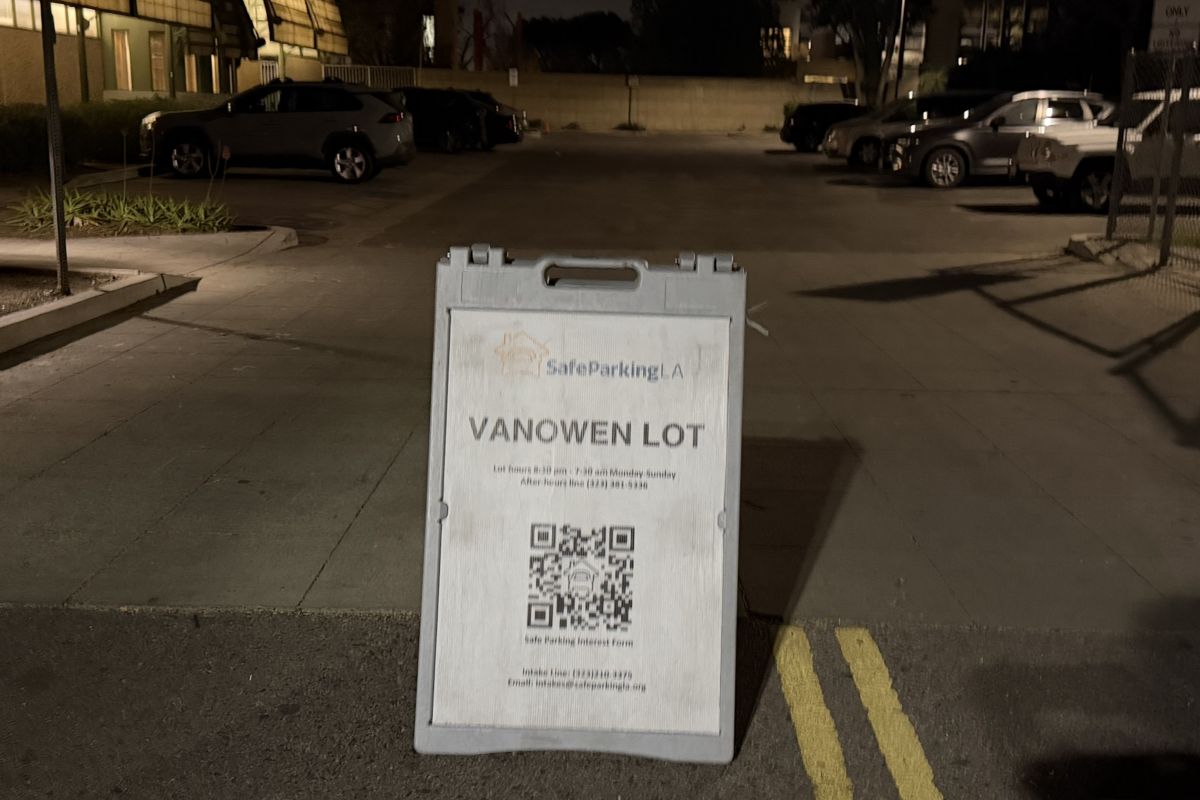
At the Reseda site, located at the West Valley Regional Library, participants begin lining up around 8 p.m. The lot officially opens at 8:30 p.m., with quiet hours starting at 10.
“This site has a capacity of 25 vehicles,” said Mirna Camarena, a program manager with Safe Parking LA. “Most of the people here work during the day or go to school. They come from all walks of life.”
Camarena said many participants are highly self-sufficient—sometimes to their detriment.
“They get overlooked for services because they don’t fit the stereotype,” she said. “People assume homelessness looks one way, but your coworker could be living in their car and you would never know.”
Challenging the ‘Low Outcomes’ Claim
In a November budget memo to the City, LAHSA recommended cuts to Safe Parking by grouping it with Safe Sleep—another intervention that uses parking lots—and labeling both “ineffective,” without citing evaluations or outcome data specific to Safe Parking.
In response, Safe Parking LA circulated a memo to stakeholders titled “Setting the Record Straight,” arguing that the two programs serve different populations and should not be evaluated together.
“Safe Parking and Safe Sleep operate at different costs and produce different outcomes,” said Carmela Carreño, director of development at Safe Parking LA. “Conflating the two leads to misleading conclusions.”
Carreño said Safe Parking LA consistently meets or exceeds the performance benchmarks required under its contracts, and that outcome data is publicly available through LAHSA’s own data summaries and dashboards.
“Safe Parking is a relatively small investment,” she said, “but it is the only intervention specifically designed for people living in their cars—many of whom are working, older, or otherwise excluded from traditional shelter.”
According to providers, Safe Parking costs roughly $40 per space per night—far less than motel-based interim housing or the emergency medical and law-enforcement responses that often follow when people are forced back onto the streets.
What Happens When Sites Close
The CAO report acknowledges that participants should not be returned to street homelessness and recommends a phased ramp-down if programs are eliminated. But providers say there is no clear plan for where people would go.
“If Safe Parking sites close, there is no system plan for where those participants go,” Carreño said. “They don’t disappear—they scatter into more unstable and costly situations.”
For Steven, the consequences feel immediate.
“This lot holds 25 cars,” he said. “If it closes, that’s 25 vehicles back on neighborhood streets, grocery store lots, or industrial areas—with no security.”
He has tried sleeping in unsanctioned parking lots before. He describes waking up at every sound, worrying about tickets, towing, or harassment.
“Most of us work—probably 90 percent,” he said. “The last thing you want is for us to lose our jobs because we don’t have a safe place to park.”
LAHSA’s Rationale for the Cuts
LAHSA disputes that assessment.
In a statement to Invisible People, the agency said its recommendation was based on utilization rates rather than outcomes.
“In a time of budget constraints, LAHSA is committed to allocating scarce resources to the most effective solutions to the crisis across Los Angeles and the entire Continuum of Care,” the agency said.
LAHSA added that it recommended in November that the City of Los Angeles stop funding Safe Parking and Safe Sleep after determining the programs were “ineffective compared to other strategies.” During fiscal year 2024–25, participants used an average of 44 percent of the City’s Safe Parking spots and 27.8 percent of Safe Sleep slots, according to the agency. By comparison, LAHSA said its interim housing programs consistently operate at more than 90 percent occupancy.
Providers say those utilization figures don’t capture the full impact of the program, warning that cuts could undermine the city’s broader homelessness goals.
“Safe Parking is about prevention,” Camarena said. “It’s about stopping people from sliding deeper into homelessness.”
For Steven, it’s simpler than that.
“This place lets me live my life,” he said. “Take it away, and everything gets harder.”