
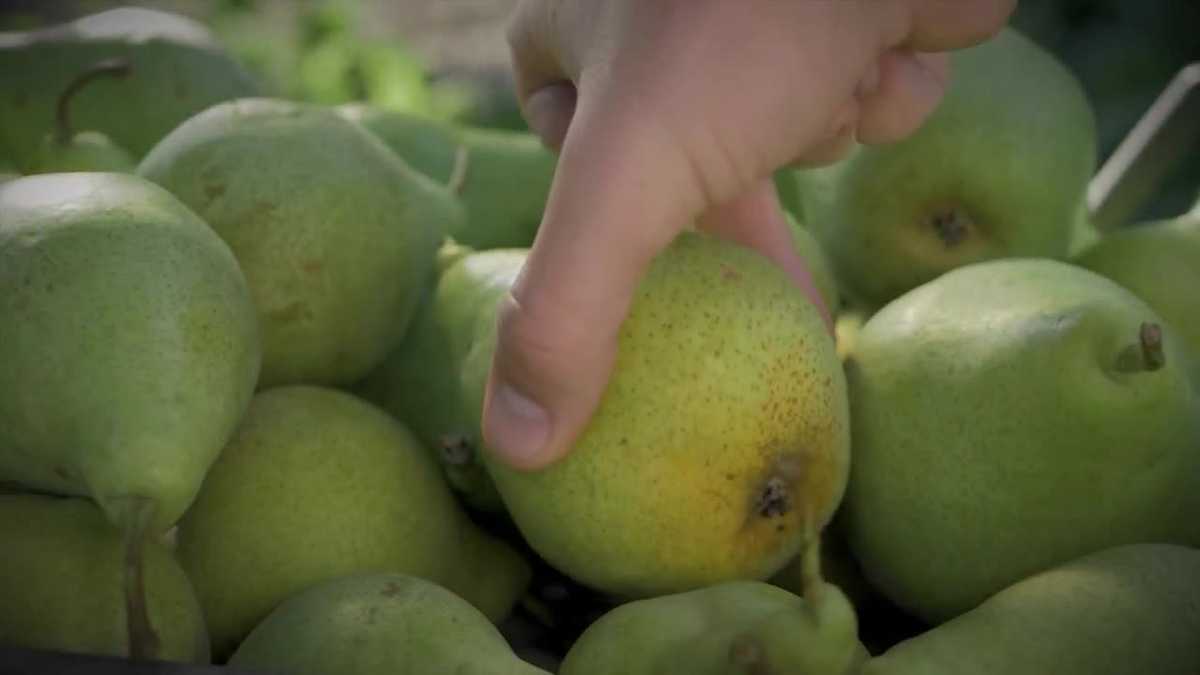
Imported pears from Argentina are causing problems for California farmers | California Politics 360
Joining us now is Alex Wilson, *** 6th generation pear grower here in Sacramento County. Alex, thank you so much for having us out here in your orchard and, um, explaining what’s going on. Yeah, thank you for coming out. So, uh, from your perspective, what is happening with pear growers in this area? Yeah, we’re, we’re, we’re under *** lot of challenges at the moment, um, both from the cannery side and the fresh market side. So I don’t know if you’ve seen the news, but there was *** closure of *** major cannery in Modesto called Del Monte. And that has had some Some issues with pear growers here locally and then we’ve also had some fresh market challenges as well and that’s mainly been driven by imports and so that’s had both of those combinations have had *** really. *** negative impact on our our pear growing situation here in California. What exactly is the impact? Like what is it specifically that you go through that’s, that’s *** problem? So this year specifically we saw *** major rise in Argentina imports and what that normally when we sell our fruit. The market’s open, you know, we’re, we’re the first to market. We’re the, the first American pear, so to speak, to, to hit the grocery store shelves, but what kind of happened this year was there’s an influx of imported fruit and then from there that that caused our marketing capabilities to kind of be. Squashed and so our our uh efforts were, were not good in the sense that the fruit wasn’t able to move. So, so with this orchard being 6th generation, I mean this is *** pear tree, uh, these are 80 year old trees behind us, um. You know, from an efficiency standpoint what we do is when we see *** weak tree or an old tree that needs to come out, what we do is we take it out and then we replant it with *** new one and then raise it up but the situation with pears is it takes about 10 years for *** pear tree to come into production, so almonds, wine grapes, olives, other commodities take *** lot longer or *** lot shorter to come into production. Pears, it takes *** lot longer and so once you see *** pear orchard get removed. Chances are that it’s not coming back into *** pear orchard just because of the economics, the labor challenges, the challenges that we face as pear growers. Um, the industry is, is getting smaller and smaller and given these market conditions as we talked about earlier, it’s only getting harder to, to farm pears, um, but you know, the other cool thing about pears is that these trees we have trees that are over 100 years old and. Um, it’s not like *** traditional commodity where, you know, after 25 years the tree comes out. Pear trees can, can last *** really, really long time here in the delta and so from *** community standpoint we’re the, the industry is facing *** lot of challenges given imports and the things discussed earlier, but, um, we remain optimistic. That’s why you see *** kind of like *** 1 year old pear tree right next to an 80 year old pear tree because once we see one that’s sick, we wanna remove it and plant with *** fresh one and. And um we’re just we’re hoping that this um industry is it gets better is our hope is pear like *** forgotten fruit do you feel like that uh no I mean here you know the reality is I think the consumer is used to just seeing pears on the shelf year round and. That may sound normal to people like you and I, but historically that wasn’t normal, you know, historically it was, oh, pears are in season now, let’s go get them they’re on the shelf, and it was like *** fresh fruit. Um, what I think consumers could use now is to recognize the difference between what’s on the shelf and then what California is providing because California is providing fresh fruit, um, that’s not treated with one MCP. The fruit that is coming over from Argentina is treated with *** material called one MCP. That has *** *** *** direct impact on the the ripening process of that fruit and so you’re not getting fresh fruit. Um, from Argentina, it doesn’t taste as good, no, and it, and it doesn’t, it, that’s part of the problem is it doesn’t taste as good. And when you go eat *** pear from Argentina and you’re like, oh, I don’t really like pears. I didn’t have that, that nice yellow, like juicy pear that you could get from California, and that’s how California is trying to differentiate ourselves is like we’re not only fresh, we’re local, and it’s, it’s from the US, it’s not from. You know, Argentina, it’s not treated with materials that are affecting the ripening process. If this issue with pears isn’t solved, do you have concerns about how other crops are handled moving forward too? Yeah, um, I, I hope it’s solved, um, you know, we’ve been doing this for for generations now, and I remain hopeful that that the community, um, the state and the federal government can maybe. Uh, have some sort of influence on, uh, what we’re facing as growers, but yeah, it’s, it’s, it’s nerve-wracking for sure, um, but I try to remain optimistic as you can see we have, we have *** tree, baby trees that are planted right next to old ones, and so you have to remain positive. Uh, farmers in general have to be eternal optimists. Um, that’s what gets people waking up in the morning and. Despite market conditions, pressure, labor challenges, we have to have something that, that, you know, we, you have to remain optimistic. So what’s your message to lawmakers directly who could handle this? Uh, that’s *** good question. Uh, my message was support local pear farmers in California would be my message and maybe they could learn about the challenges that we’re facing, and I think Chris has touched on some really good points, um, but I’m just *** farmer, so I’ll, I’ll let the. The those people talk to the lawmakers. So California is known for putting regulations and strict ones on every business, really for the environment and labor. What about that makes California pears different and the situation? Yeah, you know, I, I think when it in comparison to Argentina we definitely have *** lot stricter of, of policies, um, from labor to audits just this ranch alone, uh, the one we’re here right now, we go through 6 audits *** year, uh, that’s *** food safety audit, uh, *** primus audit, ***, um, social responsibility audit. Um, we are looked at every single different way on the way we farm and ultimately I think that our competitors in, in Argentina aren’t held to those same standards, and I hope that the community understands that we’re just trying to provide the best fresh product to the state and the country and um we’re just trying to level the playing field *** little bit so. All right, Alex, appreciate your time thank you appreciate it.
Imported pears from Argentina are causing problems for California farmers | California Politics 360

Updated: 8:25 AM PST Feb 15, 2026
California pear growers are facing challenges as the United States imports many pears from Argentina, a move that is affecting the state’s market and prompting calls for government intervention. Pear trees can last a long time in the Delta, with some trees reaching 80 years old. Alex Wilson, a sixth-generation pear grower in Sacramento County, is facing challenges with his pear orchard at Rivermaid Trading Company.”Farmers, in general, have to be internal optimists,” Wilson said in an interview with California Politics 360. He explained that it takes about 10 years for a pear tree to come into production.Wilson noted a significant rise in imports from Argentina, which has affected the market for American pears. “Normally, when we sell our fruit, the market is open. We are the first to market, the first American pear so to speak to hit the grocery store shelves. But what kind of happened this year is there was an influx of imported fruit and from there, that caused our marketing capabilities to be squashed,” Wilson said.Chris Zanobini, executive director for the California Pear Advisory Board, has observed the impact of Argentina imports on California farms. “If you look at the volume of imports over the last 10 years, it has essentially doubled with last year being the pinnacle of volume of imports and with prices that have really not changed in 10 years,” Zanobini said. He added, “When you look at our production here in California, our production and input costs continue to go up, labor goes up every year, so it is very difficult to compete with product that is low priced and undercutting our growers.”Growers are seeking government support to ensure fair competition. Zanobini explained, “Growers need some support to make sure we are competing on a fair level. Product coming in late and during our season is really having a negative impact on our ability to sell our products. We are really looking for the federal government to put some barriers on Argentina, maybe look at the amount of product that can be shipped into the U.S. market and set a timeline where no more pears are imported into the U.S.”As growers work to change regulations, they are encouraging shoppers to choose California pears. Wilson said, “The reality is I think the consumer is used to seeing pears on the shelf year-round. That may sound normal to people like you and I but historically, that wasn’t normal.” He continued, “I think what consumers can use now is to recognize the difference between what’s on the shelf and then what California is providing. California is providing fresh fruit.”Wilson expressed hope for a resolution to the issue, saying, “We have been doing this for generations now. I remain hopeful that the community, the state, the federal government can have some sort of influence on what we are facing as growers. It is nerve-wracking for sure but I try to remain optimistic.”KCRA 3 Political Director Ashley Zavala reports in-depth coverage of top California politics and policy issues. She is also the host of “California Politics 360.” Get informed each Sunday at 8:30 a.m. on KCRA 3.
California pear growers are facing challenges as the United States imports many pears from Argentina, a move that is affecting the state’s market and prompting calls for government intervention.
Pear trees can last a long time in the Delta, with some trees reaching 80 years old. Alex Wilson, a sixth-generation pear grower in Sacramento County, is facing challenges with his pear orchard at Rivermaid Trading Company.
“Farmers, in general, have to be internal optimists,” Wilson said in an interview with California Politics 360. He explained that it takes about 10 years for a pear tree to come into production.
Wilson noted a significant rise in imports from Argentina, which has affected the market for American pears.
“Normally, when we sell our fruit, the market is open. We are the first to market, the first American pear so to speak to hit the grocery store shelves. But what kind of happened this year is there was an influx of imported fruit and from there, that caused our marketing capabilities to be squashed,” Wilson said.
Chris Zanobini, executive director for the California Pear Advisory Board, has observed the impact of Argentina imports on California farms.
“If you look at the volume of imports over the last 10 years, it has essentially doubled with last year being the pinnacle of volume of imports and with prices that have really not changed in 10 years,” Zanobini said. He added, “When you look at our production here in California, our production and input costs continue to go up, labor goes up every year, so it is very difficult to compete with product that is low priced and undercutting our growers.”
Growers are seeking government support to ensure fair competition. Zanobini explained, “Growers need some support to make sure we are competing on a fair level. Product coming in late and during our season is really having a negative impact on our ability to sell our products. We are really looking for the federal government to put some barriers on Argentina, maybe look at the amount of product that can be shipped into the U.S. market and set a timeline where no more pears are imported into the U.S.”
As growers work to change regulations, they are encouraging shoppers to choose California pears.
Wilson said, “The reality is I think the consumer is used to seeing pears on the shelf year-round. That may sound normal to people like you and I but historically, that wasn’t normal.”
He continued, “I think what consumers can use now is to recognize the difference between what’s on the shelf and then what California is providing. California is providing fresh fruit.”
Wilson expressed hope for a resolution to the issue, saying, “We have been doing this for generations now. I remain hopeful that the community, the state, the federal government can have some sort of influence on what we are facing as growers. It is nerve-wracking for sure but I try to remain optimistic.”
KCRA 3 Political Director Ashley Zavala reports in-depth coverage of top California politics and policy issues. She is also the host of “California Politics 360.” Get informed each Sunday at 8:30 a.m. on KCRA 3.