
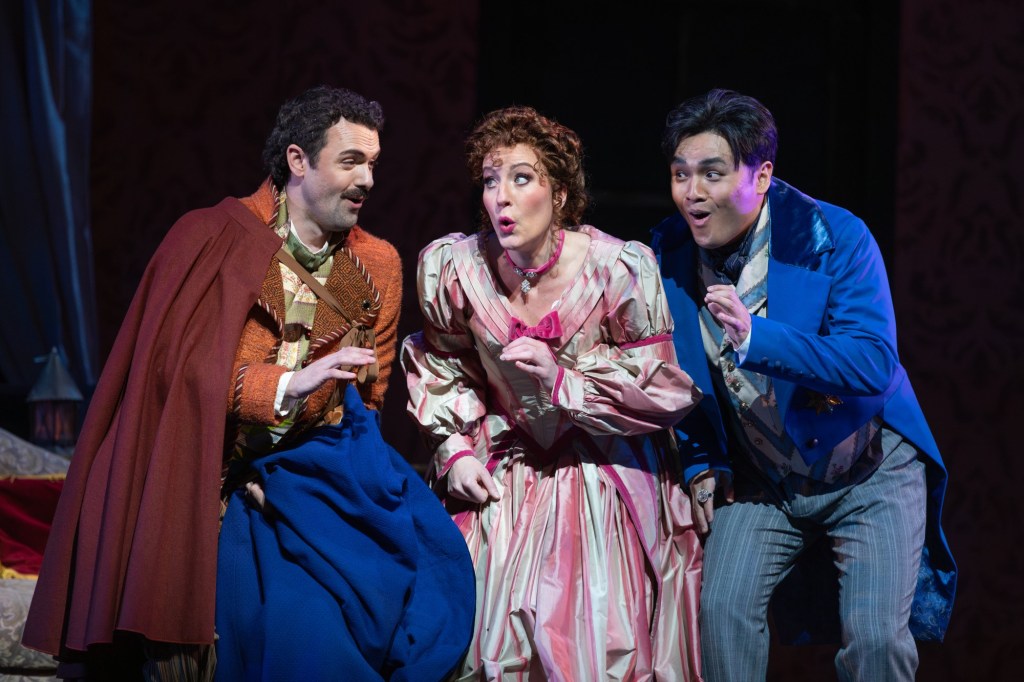
This weekend, San Diego Opera is presenting its 10th production of Gioachino Rossini’s “The Barber of Seville,” and on opening night Friday, it played to a nearly full house at the 3,000-seat San Diego Civic Theatre.
Why has this 1816 opera returned just five years after the company’s last production in 2021? Because it may be the funniest opera in the repertoire, and its score is sheer perfection. But having seen all of the company’s “Barbers” over the past 30 or so years, not all of them were as entertaining as the one that concludes Sunday.
This production shines for three reasons: director Chuck Hudson’s sharp eye for visual humor and detail, the sparkling vocal fireworks of mezzo-soprano Stephanie Doche and principal conductor Yves Abel’s mastery of the score with the San Diego Symphony musicians. Even before the curtain rose on Friday, the audience was roareing their approval for the orchestra’s note-perfect performance of the popular overture.
Set in 17th-century Seville, the opera tells the comic story of Almaviva (played by tenor Minghao Liu), a wealthy but lovesick count who has disguised himself as the poor student Lindoro to win the heart of the beautiful Rosina (Doche), a young woman kept under lock and key by her elderly guardian Dr. Bartolo (bass-baritone Patrick Carfizzi), who hopes to marry her himself.
To woo her, Almaviva hires Figaro (baritone Dean Murphy), the town’s jack-of-all-trades who (among other tasks) is the doctor’s barber and wig stylist. Figaro disguises Almaviva as a drunken soldier, and later as a music teacher, to sneak into Barbaro’s home and secretly win Rosina’s hand before revealing his true identity.
“The Barber of Seville” is a great showcase for bel canto singers, who are artists with incredibly flexible voices who can zip up and down the vocal scale with beauty, dexterity and control.
All of this “Barber” company proved up to the task, but Doche especially shined. She has a big voice, great control and a playful stage personality. The affable Murphy tossed off Figaro’s famous “Largo al Factotum” with ease, Carfizzi (who played the same role in the company’s 2021 production) once again aced the insanely difficult patter aria “A un dottor della mia sorte,” and as Almaviva, the charming and funny Liu managed the fast-paced runs and top notes of the multioctave “Cessa di più resistere.”
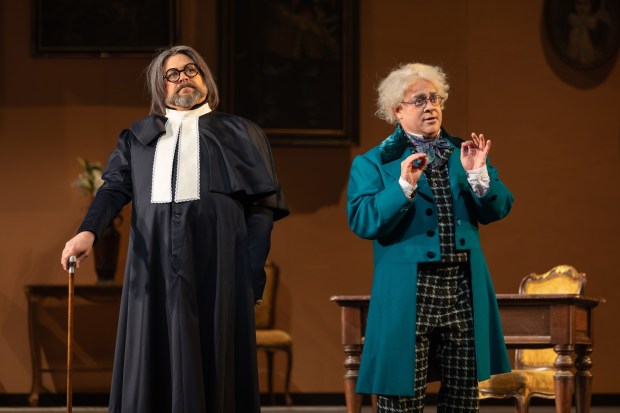 Craig Colclough as Don Basilio, left, and Patrick Carfizzi as Don Bartolo in San Diego Opera’s “The Barber of Seville.” (Karli Cadel)
Providing additional comic and vocal support were Craig Colclough as the scheming Don Basilio, Tasha Hoduao Koontz as Bartolo’s disapproving maid Berta and Joseph Calzada as Fiorello.
Chorus master Bruce Stasyna coached an all-male chorus who played a ragtag street band in the opening scene and battalion of soldiers at the end.
This production’s rented costumes by Matthew LeFebvre were colorful and lavish and Jason Bieber’s lighting was creatively programmed to spotlight individual singers and comic moments at different points in the show. Only the scenery, designed by Tim Wallace, was disappointing in its small scale and basic design.
Fortunately, director Hudson was able to fill the spartan stage with colorfully costumed choir members and supernumeraries who added visual pizzazz and humor to the scenes. One of the best of these non-speaking performers was local actor Phil Johnson as Bartolo’s elderly servant Ambrogio, who comically shuffled around the stage like Tim Conway’s “oldest man” in “The Carol Burnett Show.”
“Barber” is a great “starter” opera for first-timers, but newbies should know that the supertitles (the English translations of the Italian score projected above the stage) are not “broken,” as someone next to me wondered. Many arias from the 1800s include repeated verses to give the singers the opportunity to show off their coloratura skills by embellishing the sections of the songs the second time around. If the screen goes black for a little while, that means no new lyrics have been introduced in the song.