
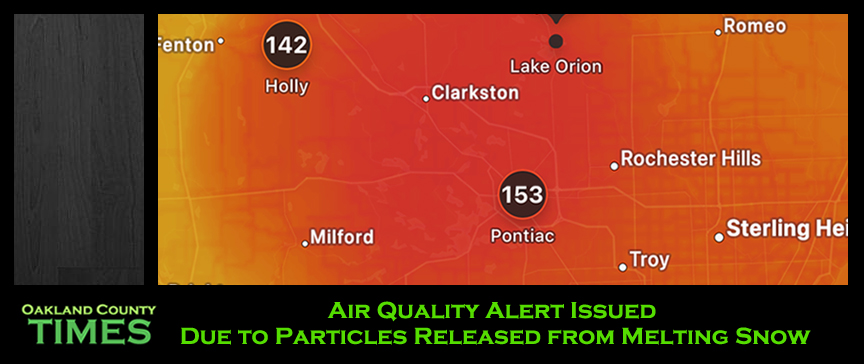

Air Quality Alert Issued Due to Particles Released from Melting Snow
(SEMCOG, Feb 15, 2026)
Michigan – SEMCOG, the Southeast Michigan Council of Governments, announces the first Air Quality Advisory of 2026 for Southeast Michigan. The Michigan Department of Environment, Great Lakes, and Energy (EGLE) has issued the advisory due to elevated levels of fine particulate (PM2.5).
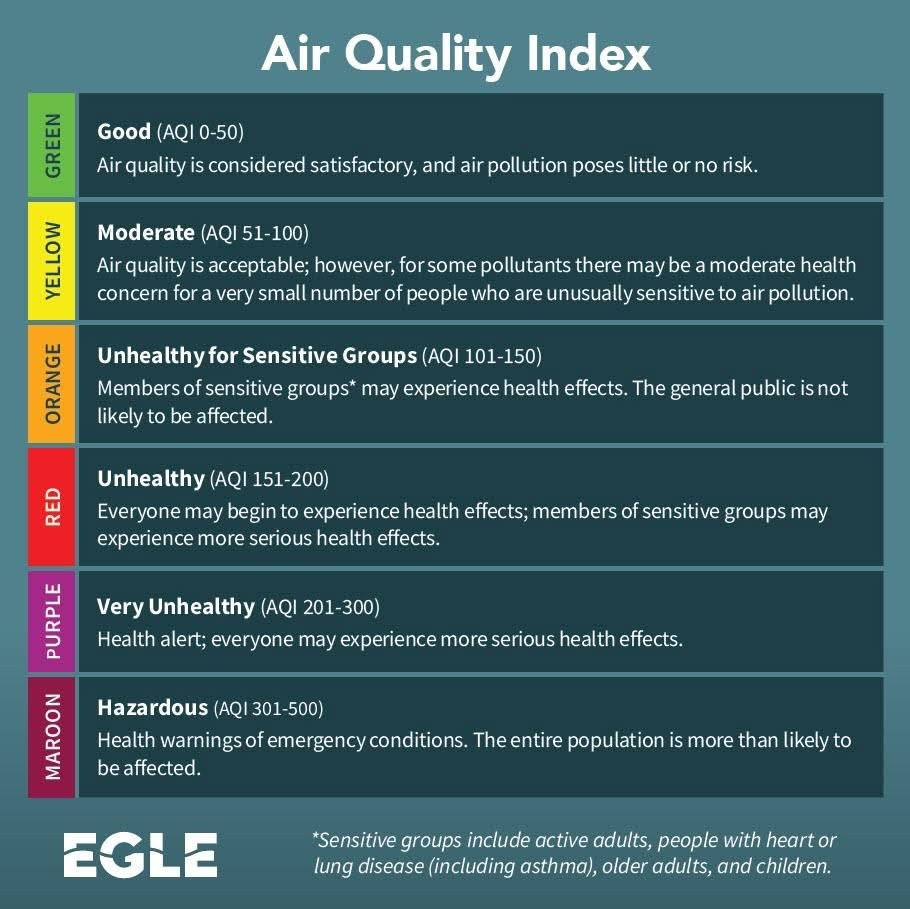
According to EGLE’s Advisory, fine particulate concentrations are expected to be mostly in the Unhealthy for Sensitive Groups (USG, Orange AQI) range through 12pm on Monday, February 16.
“Surface temperatures reaching 50 degrees F have sped up snowmelt and are releasing particulates into the atmosphere in the process,” said Alec Kownacki, Meteorologist, Air Quality Division, EGLE. “Particulates get trapped in snow when it falls and when that snow melts, those same particulates get released into the air. Couple the warming temperatures with light winds throughout today, Sunday, PM-2.5 concentrations are expected to be in the Unhealthy for Sensitive Groups range due to lack of atmospheric dispersion. For clarity, this Advisory is not due to wildfire smoke, but organic compounds and other pollutants being trapped in snowfall that are being released into the air upon melting,” Kownacki said.

Additional guidance from EGLE:
When possible, avoid strenuous outdoor activities, especially those with heart disease and respiratory diseases like asthma.
Monitor for symptoms such as wheezing, coughing, chest tightness, dizziness, or burning in nose, throat, and eyes.
Reduce or eliminate activities that contribute to air pollution, such as:
Outdoor burning
Use of residential wood burning devices
Air quality is an important measure identified in SEMCOG plans and programs for creating desirable communities, protecting public health, and maintaining a positive regional image for Southeast Michigan. In partnership with the Michigan Department of Environment, Great Lakes, and Energy (EGLE), SEMCOG is now implementing a two-tiered system of Air Quality Advisories and Air Quality Alerts. This new system is based on the EPA’s U.S. Air Quality Index (AQI).

The AQI is a scale from 0 to 500 that indicates air pollution levels. Higher values mean higher pollution and more health risks. When AQI exceeds 100, it’s unhealthy, starting with sensitive groups and worsening as it rises. There are six categories, each with a color, to easily gauge the level of health concern in communities.
More Information on Air Quality Advisories and Alerts
Air Quality Advisory: Issued when ground-level ozone, particulate matter (PM2.5) or both are expected to reach or exceed the Unhealthy for Sensitive Groups (USG) threshold. Those considered in the “USG” threshold include people with lung disease (such as asthma), children, older adults, people who are active outdoors (including outdoor workers), people with certain genetic variants, and people with diets limited in certain nutrients should reduce prolonged or heavy outdoor exertion. This is aims to provide awareness for poor air quality, encourage people to limit activities that contribute to poor air quality, and to alert those who are especially sensitive to poor air quality.
Air Quality Alert: Issued when Ozone, PM2.5, or both are expected to reach or exceed the Unhealthy threshold or worse. This alert indicates a higher level of concern as everyone, not just sensitive groups, can be affected by poor air quality.
Learn more: https://www.semcog.org/about-semcog/what-you-can-do/to-keep-the-air-clean/





 Save this post to PDF
 Print this post