
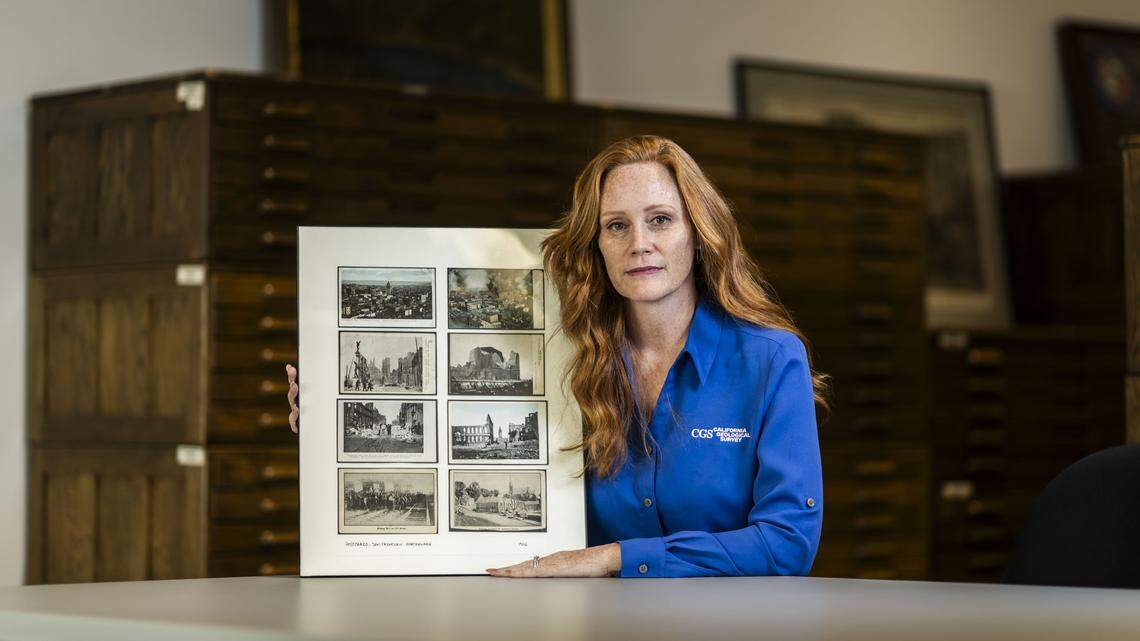
Wendy Bohon approached a table at the California Geological Survey library in Sacramento and began to give Puck’s closing speech from William Shakespeare’s “A Midsummer Night’s Dream.”
Only this time, some of the speech was adapted to be about earthquakes. Once again, Bohon was making her worlds converge.
Bohon is a trained Shakespearean actress who briefly worked in Hollywood after college. She shifted to earthquake science after experiencing an earthquake. Since early 2024, Bohon has been helping lead the state’s earthquake preparedness efforts as branch chief of seismic hazards and earthquake engineering for the state’s geologic agency.
She plays a unique role for California as someone who blends doctoral-level scientific acumen with skill in communication and drawing an audience. Some of this is evident in her TikTok account @drwendyrocksit, where she has about 55,000 followers .
“Scientifically, I do it because I think it’s important,” Bohon said. “Personally, I do it because it scratches that itch. And then I also do it because I’m really interested in the data and how we can use it to be better communicators and get more science to the people that are interested in it.”
Bohon, 49, might never win a major acting award. But through an offbeat path she’s followed to her current work, Bohon could help millions of Californians be prepared for the next significant earthquake.
Finding a mentor
Lucy Jones hired Bohon in 2000 for her first earthquake-related job, at the Southern California office of the U.S. Geological Survey, on Caltech’s campus.
Jones was in the midst of a 30-plus-year tenure for USGS that made her famous in earthquake-related work. The Los Angeles Times noted in 2016 that Jones had “been called the Beyoncé of earthquakes.”
Part of how Jones set herself apart was by communicating with the media.
“In the ’80s, when I came to Caltech, they would just be like, ‘Why are you wasting time talking to the media? That’s time you’re not putting into the next paper to be published,’” Jones said.
But a willingness to talk gained Jones influential followers, such as now-U.S. Sen. Alex Padilla. He said in a phone interview that following any major earthquake, Jones was the first individual he’d “turn to for insight and information and I think the general public expects to see on television as quickly as possible.”
It helped give Jones a reputation, too. Bohon recalled that she often heard others say, “Until Lucy Jones says it I don’t believe it.”
After graduating from James Madison University with a theater degree and moving to California, Bohon had limited professional success. “I wasn’t really interested in the Hollywood thing, but when you’re 21 it’s very appealing to just go and have a great time,” Bohon said. “I did a lot of hair commercials. I did some soap operas.”
Then Bohon felt the 7.1-magnitude Hector Mine quake, which was centered in the Southern California desert, from her Hollywood apartment in 1999. She likened experiencing an earthquake to riding a rollercoaster.
“You get to the top and you’re like, ‘Oh my God, why did I do this?’” Bohon said. “And then you go over the edge and it’s exhilarating and it’s scary but it’s exhilarating.”
Bohon reached out to the Southern California USGS office in the months following the quake and asked if there was anything she could do. She became an outreach and education coordinator for its earthquake hazards program.
“She’s such a go-getter,” Jones said. “She was fantastic.”
Bohon wrote via email that Jones “was hugely influential to me in a lot of different ways,” including in teaching her how to discuss science and in being “a woman in scientific leadership.”
“She served as a role model, showing me what was possible and now I strive to do the same for the folks coming up after me,” Bohon wrote.
In recent years, Bohon became one of 120 ambassadors selected for the #IfThenSheCan exhibit, which encourages girls to pursue careers in STEM.
Getting a science education
At James Madison, Bohon had completed a secondary major in geology, and at USGS she supplemented that education by taking classes at Pasadena Community College.
After roughly six years at USGS, Bohon left to pursue a geology-related Master’s degree at Ohio State University. Then she earned a Ph.D. in tectonic geomorphology, structural geology and thermochronology at Arizona State University.
Having unusual experience can be helpful for those wanting to pursue geology. Kip Hodges, one of Bohon’s dissertation advisers, said geology synthesizes fields.
“You can be a geologist, but to do an effective job at it, you have to know a bit of physics and you have to know a bit of chemistry and you have to know a bit of a whole bunch of different things,” Hodges said. “And so it tends to attract people who are polymaths.”
Bohon’s communication abilities came in handy for Ramon Arrowsmith, Bohon’s other dissertation advisor.
“I would get contacted regularly by the media and so I would always go to Wendy to help me prepare,” Arrowsmith said.
Others in the science social media space have noted Bohon’s skill at discussing concepts, such as Emily Zawacki, a geology TikToker known as @its_sedimentary.
“As a scientist, there’s often the perception of: You’re kind of very highly competent but maybe not as welcoming and warm,” Zawacki said. “And Wendy has such a great personality where she is such a fantastic storyteller you really want to hear what she’s saying, but then you also know that she has really trustworthy information.”
Alka Tripathy-Lang, who overlapped with Bohon doing doctoral work at ASU, said Bohon taught many courses during graduate school and excelled at accurately discussing science.
“As long as I’ve known her, she knows what she’s talking about when it comes to earthquakes and when it comes to geology, when it comes to the scientific method,” Tripathy-Lang said.
After finishing her doctorate, Bohon worked nearly seven years as a communication specialist for Incorporated Research Institutions for Seismology. She joined the California Geologic Survey after a brief stint at NASA doing communications work.
What Bohon is doing for CGS
Bohon oversees a team of about 75 people who work for CGS’s seismic hazards and earthquake engineering branch. The branch accounts for roughly half of the personnel for CGS, which is part of the California Department of Conservation.
The seismic hazards team does geologic mapping.
“They go out, find where the faults are breaking the surface of the Earth, determine how long ago those faults moved,” Bohon said. “They’re looking at areas that could potentially have issues with liquefaction or earthquake-induced landslides, or other types of earthquake hazards.”
Meanwhile, the earthquake engineering side runs a network of 1,300-plus seismic sensors throughout the state. “They measure how buildings shake,” Bohon said. “They measure bridges and other types of infrastructure.”
Bohon said that her organization is interested in doing more monitoring of structural health.
“We’re really interested in ensuring that after an earthquake, we can give people information about what things are likely to be damaged…. and importantly, which ones are not because we need to be able to resume operations quickly,” Bohon said. “We need to be able to get back to normal as fast as we can because that helps communities to be resilient.”
Padilla, whose bipartisan bill with Alaska Republican Lisa Murkowski to reauthorize the National Earthquake Hazards Reduction Program unanimously passed the Senate in January, echoed Bohon’s words about the importance of preparedness and quick response to earthquakes. He said 70% of Californians live within 30 miles of a fault line.
“The better prepared we are for immediate response in the event of a larger earthquake, the more informed we are to plan for rebuilding and recovery, the better for everybody,” Padilla said.
Bohon interacts with other people active in earthquake or emergency work for the state. Lori Nezhura is deputy director of planning, preparedness and prevention for the California Governor’s Office of Emergency Services, which partners with USGS on the early warning ShakeAlert system.
“She’s really good at what she does and we’re lucky in the state of California to have her,” Nezhura said.
At the end of the day, the information Bohon offers is not academic: The state is due for a major earthquake.
“The big one is coming,” Bohon said. “It’s not a matter of if. It’s a matter of when.”
This story was originally published February 15, 2026 at 5:30 AM.
The Sacramento Bee
Graham Womack is a general assignment reporter for The Sacramento Bee. Prior to joining The Bee full-time in September 2025, he freelanced for the publication for several years. His work has won several California Journalism Awards and spurred state legislation.