
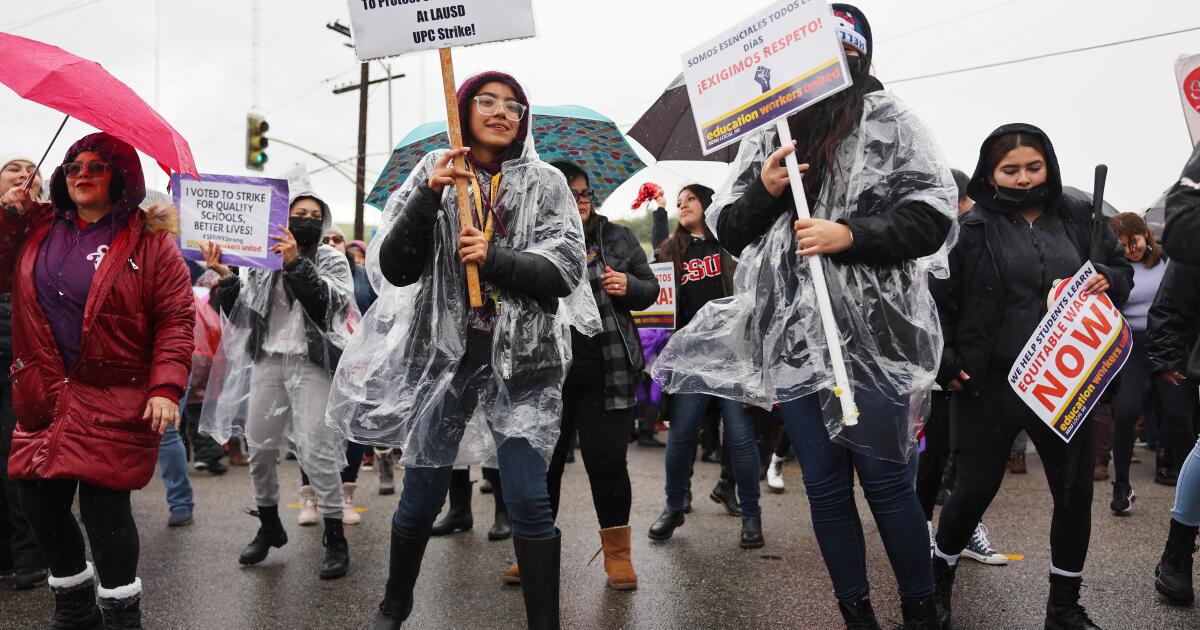
More than 3,200 Los Angeles Unified employees would receive a notice of a possible layoff under a proposal to be considered at Tuesday’s Board of Education meeting amid calls from union leaders to pause the decision until the state revenue forecast becomes clearer.
The number of workers who are likely to lose their jobs is expected to be much lower, but could still be significant. Other workers would face demotion, pay cuts and new jobs in different places.
The proposed action is part of a plan to close what officials describe as an ongoing structural deficit — meaning that the nation’s second-largest school system is spending more annually than it is receiving. Layoffs have been avoided for more than five years largely because of one-time, accumulated relief aid related to COVID-19.
In a December budget filing, the district projected deficits of $877 million, or 14%, for the 2026-2027 school year and $443 million, or 7%, the year after.
“These are dangerously high deficit levels for a public education institution, and more importantly, signal a significant structural imbalance, not a temporary dip,” according to the staff report.
The number of actual layoffs is certain to be much smaller than 3,200. The larger figure reflects required notice provisions under state law and union seniority rules. When a long-tenured employee’s position is eliminated, that employee may be eligible to bump out another employee with less seniority in a lower-position. Both employees, however, must receive notice of a possible loss of their position — as well as anyone else in the bumping chain.
A truer picture of the potential job losses may be in the number of central-office positions that are being “closed” or eliminated.
The board report lists 657 “central office and centrally-funded position closures.” Among those jobs: 220 IT support technicians, 33 parent education support assistants, 23 gardeners, five area bus supervisors, five stock clerks and three interpreters. Another 52 positions would have reduced hours and 22 positions would be paid at a lower rate.
Ultimately, the district report states, fewer than 1% of the district’s more than 83,000 employees are likely to be at risk of losing a district job entirely.
Most district unions remain in negotiations with L.A. Unified. Members of United Teachers Los Angeles have voted to give their union’s leaders the right to call a strike at their discretion.
The union is seeking an immediate 16% raise for new teachers, an across-the-board 3% raise in the contract’s second year and significant automatic pay hikes tied to years of experience and continued education. The district is offering 2.5% for the first year of a three-year contract; 2% the next, plus a 1% one-time bonus.
The largest employee unions did not release an immediate response to the budget proposal, which was posted after the close of business on Friday. However, in a Feb. 6 letter to the board of education, a coalition of three unions questioned the need for cuts in a letter to officials.
“State [tax] revenues for December and January have far exceeded projections in the Governor’s draft budget,” stated the letter, which was signed by UTLA, Local 99 of Service Employees International, which represents the largest number of non-teaching workers, and Associated Administrators of Los Angeles, which represents principals, assistant principals and many middle managers.
The three unions also called for a stand-alone meeting on the cuts that would take place later, but still before the March 15 deadline for giving employees with a teaching credential notice of a possible layoff.
“If necessary (and to be clear — it is not), the board should schedule a stand-alone meeting in early March prior to the statutory deadline so that you will have the most complete picture of Prop 98 funding at that time,” the letter stated. “This should be the only agenda item. This will give the public the time to engage and understand these devastating proposed cuts.”
The letter added: “The notion that these are dark times for education requiring harmful cuts when there are record high state revenues is fearmongering. The Board should see through this.”
Broadly speaking, the unions have focused on the size of the district’s reserve as of last July, which stood at $5 billion within a total budget of $18.8 billion, which the district has called attention to its structural deficit.