
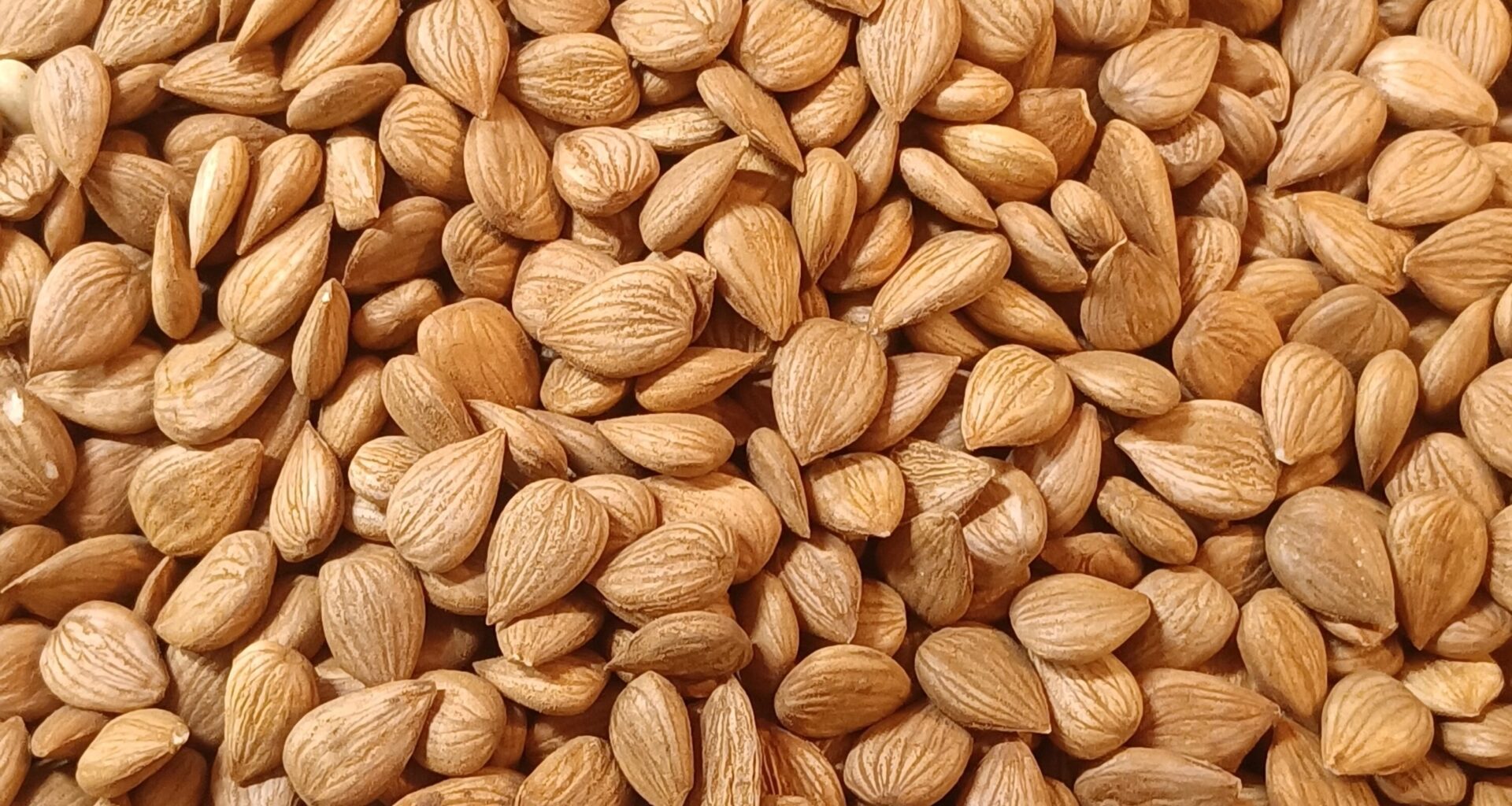
 Almonds are often a great snack. (Photo via Wikipedia/Public Domain)
Feb. 16 marks National Almond Day — a nod to one of California’s most versatile crops.
“I use almonds for almond milk and use this milk as a substitute for cow’s milk,” said Chef Troy Williams of Miss B’s Coconut Club. “This helps appease the lactose-intolerant or vegans. Milk machines for nuts are very simple, and you don’t have to soak the nuts anymore. You just blend the almonds, water, maybe a splash of vanilla, and/or maple. But it is very much a better taste than store-bought and much less expensive.”
 Troy Williams, head chef at Miss B’s Coconut Club in Mission Beach. (Photo by Dave Schwab/Times of San Diego)
His approach reflects how far almonds have traveled from simple snack packs and baking aisles. California’s almond industry now touches nearly every aisle of the grocery store — from dairy alternatives and gluten-free baking to skincare and global exports.
Here are 10 things you may not know about the mighty almond:
1. California dominates global production.
According to the Almond Board of California, the state produces roughly 80 percent of the world’s almonds and 100 percent of the U.S. commercial supply.
2. Almonds aren’t technically nuts.
Botanically, they’re seeds of a fruit related to peaches and apricots.
 Almond tree illustraion fro 1897. (Photo via Wikipedia/Public Domain)
3. Bloom season begins in February.
Almond orchards across the Central Valley burst into pale pink and white blossoms in late winter — one of the state’s earliest large-scale blooms.
 A grove of almond trees in California, CA, produces roughly 80 percent of the world’s almonds. (Photo via Wikipedia/Public Domain)
4. They’ve been cultivated for thousands of years.
Almonds originated in the Middle East and Mediterranean before arriving in California in the 18th century.
 Almonds have been cultivated in CA for decades. (Photo via Wikipedia/Public Domain)
5. Almond milk is now mainstream.
It is one of the most widely consumed plant-based milk alternatives in the United States.
 A glass of almond milk. (Photo via Wikipedia/Public Domain)
6. Almond flour is a baking staple.
Many recipes use almond flour as a gluten-free base for cakes, cookies, and breads.
 Almond flour is commonly used in baking. (Photo via Wikipedia/Public Domain)
7. Every part of the almond is used.
Hulls often become dairy feed, and shells can be repurposed for livestock bedding or renewable energy.
8. They’re nutrient-dense.
Almonds provide healthy fats, fiber, protein, vitamin E, and magnesium.
 A vile of sweet almond oil. (Photo via Wikipedia/Public Domain)
9. Almond oil extends beyond food.
It is widely used in skincare and cosmetic products.
10. Green almonds are a seasonal delicacy.
Harvested early in spring, they are softer and slightly tart, often enjoyed fresh with salt.
 Green almonds. (Photo via Wikipedia/Public Domain)
National Almond Day may be unofficial, but almonds remain one of California’s most influential ingredients — from orchards blooming each February to restaurant menus year-round.
 Smoked almonds. (Photo via Wikipedia/Public Domain)
Sources
Almond Board of California
U.S. Department of Agriculture
California Department of Food and Agriculture
Do you have any restaurant news? A new chef? New location? Special menu? If so, drop me a line at Debbiesklar@cox.net, and you could be included in a future Eat Beat..
READ NEXT