
Ciara Gonzalez is an assistant news editor of the Daily Titan. All opinions expressed in this article are those of the author and do not reflect the opinions of the Daily Titan as a whole.
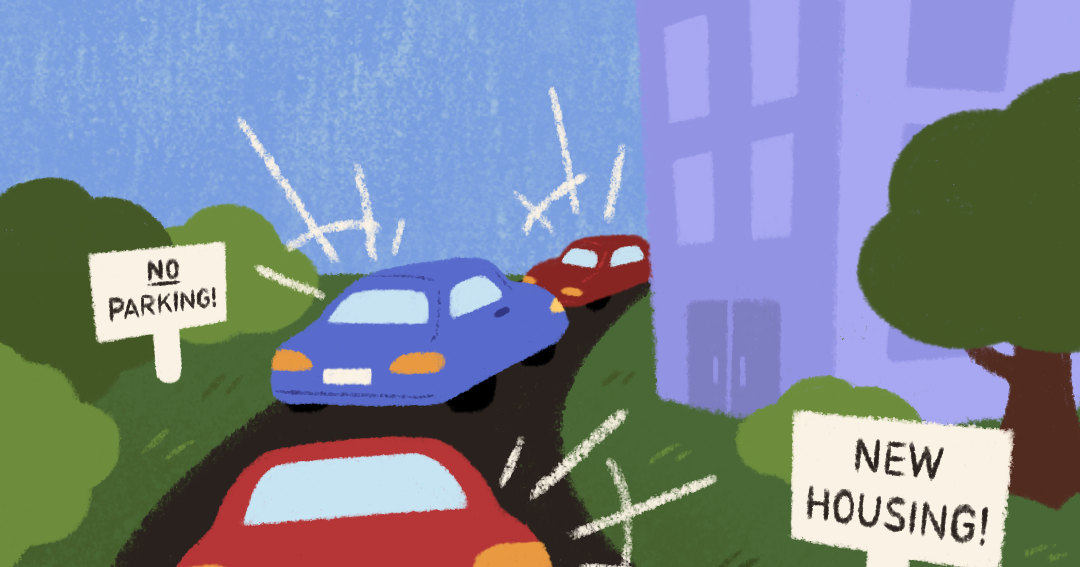
At Cal State Fullerton, students struggle daily to find parking. While the university is investing in new housing projects, this expansion fails to address its student population: mainly commuter students relying on cars to attend class.
With 95% of undergraduate Titans commuting to campus and median commutes to campus being 13.7 miles, CSUF must expand upon its limited parking to meet the community’s needs, ensuring that a lack of parking spaces does not become an obstacle for student success.
While travel and parking affect the majority of the student population, on-campus housing benefits only a fraction, with just 5% of undergraduates living in college-owned and operated housing. Continuous investment in on-campus housing ultimately neglects CSUF’s commuter culture.
Litzy Ledesma, a fourth-year psychology major, explained that CSUF’s parking seems to be constantly in a state of chaos.
“I was so shocked at how packed it was during the first few weeks of school. And then comparing that to the parking structure situation, it definitely was not good at all,” Ledesma said.
There are a total of 12,425 student parking spaces across campus. Out of the many parking lots on campus, only lots S8, S10, S-CP and the four parking structures are available for all-day student parking.
Despite the limited structure availability, students are expected to pay for parking permits. The parking pass is $334 for the semester, $140 for a motorcycle and $100 for off-site parking with shuttle services to campus. If students do not wish to pay for parking permits, they can pay for daily parking at $12 per day or $4 per hour through the ParkMobile app.
Ashley Troncoso, a first-year business major, shared her experience of being in situations where she had to pay additional parking fees even though she already owned a semester parking pass.
“It’s horrible because I can’t find parking and it takes forever, but there are other times where I have to park at the hourly rate, and I have to pay the four bucks, which sometimes is nice when I’m really late,” Tronosco said.
Cornering students into positions where they are forced to pay hourly rates, even after purchasing a parking permit, strains students’ funds who have already invested hundreds of dollars in their ability to park on the university campus.
Since CSUF Parking and Transportation Services is unable to receive state or university funding to help cover operating costs or the development of parking facilities, the office’s funding is entirely self-sustaining.
With 63% of its revenue from students’ semester permits and 26% from ParkMobile sales, students should not experience anxiety over the uncertainty of finding adequate parking, despite paying financially draining permit fees that help fund one of CSUF’s most important departments.
For many students, getting to class on time requires arriving 30 minutes early to circle the parking lots in hopes of finding a vacant spot. This is not just dauntingly inconvenient for time management; it directly interferes with students’ education.
Students are unable to perform to their best academic potential when they start their day stressed, late and frustrated before even stepping into the classroom. This lost time finding parking often results in late arrivals to class and missed quizzes or lectures, posing a threat to students’ academic success due to inadequate campus infrastructure.
Student concerns go beyond parking availability; it is also a safety issue. Activity statistics from CSUF’s Police Department showed 166 car accidents in 2025, including 82 hit-and-run reports.
Diana Palomares, a first-year psychology major, shared the nerves she feels about commuting to and parking in CSUF’s parking structures.
“I’ve seen pictures of cars that have gotten hit in there, or like, it just seems a little intense in there,” Palomares said. “I feel like I’m not a pro-enough driver to experience that.”
Students already overwhelmed by the search for parking should not have to worry about potential car damage while looking for a spot. Expanding CSUF parking would not only ease the parking struggle but also reduce the safety risks associated with the campus’s currently limited student parking.
On-campus housing expansions do not fix overfilling in parking structures or eliminate the needs of daily commuters. With CSUF student enrollment increasing yearly, a campus that markets itself as accessible must back that promise with a foundation that supports the majority of its students.
Until CSUF makes this parking issue a priority, the university will continue failing its commuting students, who make up the backbone of its campus community.