
Audiences often stare in awe at finished costumes under bright stage lights in a theater, not realizing how much work happens long before opening night. The real story begins in the shop where those costumes are created.
On the second floor of the Clayes Performing Arts Center lies Cal State Fullerton’s Costume Shop. This facility functions as a professional costume production laboratory for student designers learning and working in costuming courses.
In addition, it serves as a working space for the team of support staff and student workers that prepare, curate and organize the costumes featured in the on-stage productions each semester.
Professor Hyun Sook Kim, the costume and makeup area head and adviser for the Department of Theatre and Dance, teaches and leads multiple costuming courses on campus. She brings her experience as an international costume designer to help shape and transform how students create.
“It’s very important for me as a long-experienced professional designer to raise the next generation,” Kim said. “That’s why I’m teaching – the core purpose is to raise, cultivate and teach a really, really great next generation.”
Her focus on raising new designers reflects her belief that costume work carries meaning beyond just fabric and construction.
“Costume design is not about the garment itself, costume design is about the characters and people who are telling the story in the play,” Kim said. “There is another word in theater – it is storytelling. Costume design is actually representing those kinds of people, so costume design is about the wearer of the costume, not about the garments themselves.”
Inside the shop, a team of student workers handle much of the tedious daily production, from hand stitching and alterations to machine work. They are guided closely by Costume Lab Manager Terri Nista, who oversees the flow of projects and keeps the shop running.
“99% of the work is done by students. Some of them come in and have had no training,” Nista said. “Some of them have just barely sewn by hand and by the time the semester’s over, if they really take to it and they are interested, we’ll sit them down at the machine, teach them how to do the machine and then they start doing quick and easy machine work.”
For student workers, that hands-on learning becomes part of their routine. Kale Brown, a third‑year transfer and theater major, who first learned to sew from his grandmother when he was young, reflected on what the work means to him.
“To me, it’s therapeutic,” Brown said. “You basically clock in, and you just go and find some work to do, it’s usually some sort of sewing, whether it’s hand or machine. Sometimes Terri will give you a cool job on something specific.”
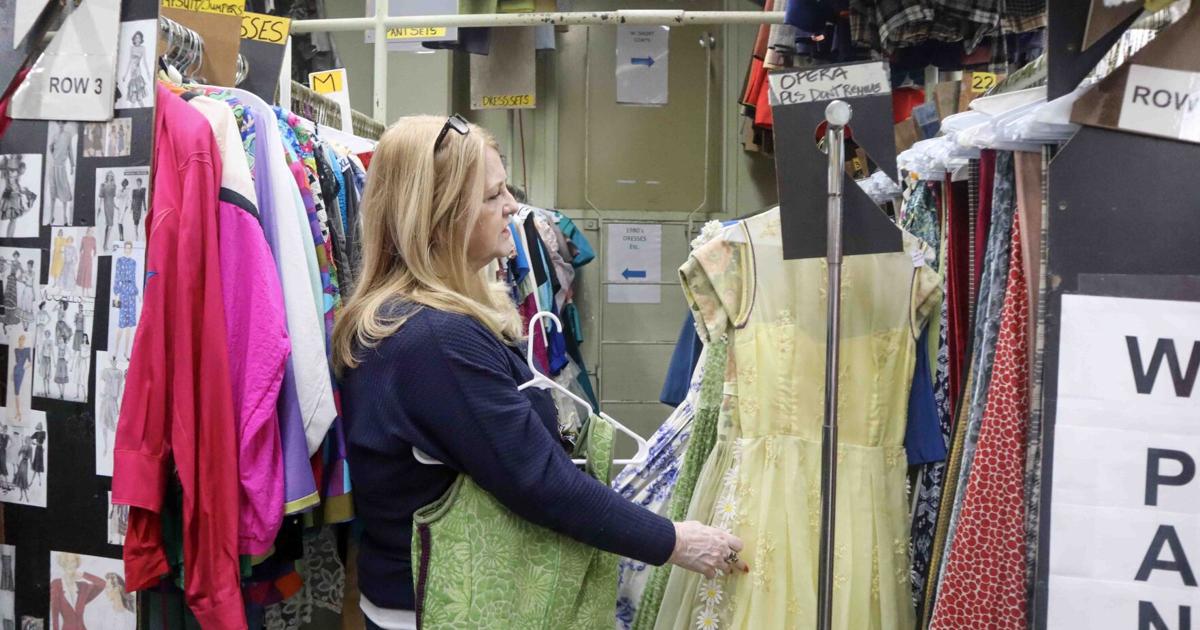
That steady rhythm in the shop extends into the storage system that keeps productions moving behind the scenes. Those decisions often rely on Costume Storage Manager Lori Koontz, who methodically organizes, preserves and maintains the eight costume storage spaces throughout CPAC.
“I like to keep things in order. When it’s out of order, it can drive me a little crazy,” Koontz said. “People will say, ‘Oh my gosh, she’s so weird about things,’ but things have to be on a specific hanger and hung in a specific way, and that’s just how I am.”
The department’s inventory expanded dramatically in 2021 with a donation of more than 30,000 vintage garments from the estate of late theater professor Richard Odle, who died in July of 2018. The arrival of that collection deepened the need for the system created by Koontz.
“I would literally take a rack of clothes, I’d pull them all off, I’d take them into the costume shop, we’d get rid of what we didn’t want and then we’d start sorting through them, just little by little by little,” Koontz said.
The work that happens in the shop is rarely visible to audiences, but it shapes the feeling of every production that reaches the stage. Every garment has passed through that network of hands, decisions and quiet but careful work.
What begins as fabric, thread and storage racks becomes part of the storytelling Kim teaches her students to honor. By the time the lights rise on opening night, the work of dozens has already carried the show long before the curtain ever lifts.