
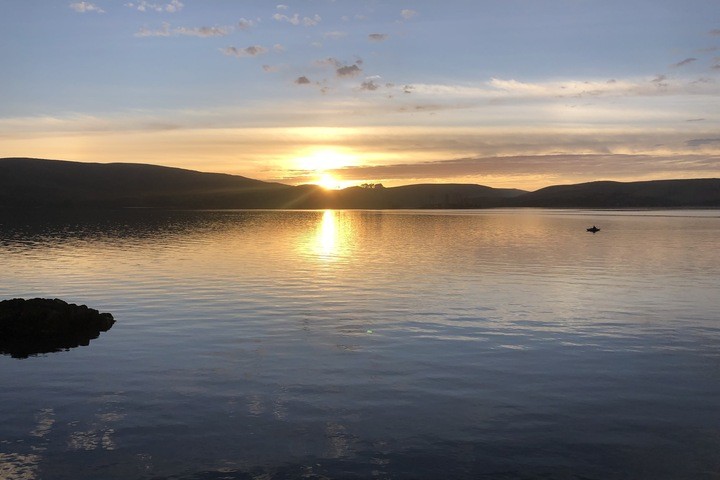
Nick’s Cove offers a view of the sunset on the northeast shore of Tomales Bay, which provides a different perspective from San Francisco, less than an hour and a half away.
Carl Nolte/S.F. Chronicle
Keyes Creek runs below rolling hills through the town of Tomales.
Carl Nolte/S.F. Chronicle
When it stops raining, take a road trip. That’s my advice. Early spring is in the air. The street trees bloomed a week or two early this year, an annual show of pink and white, a sure sign of the Lunar New Year. The backyards have been full of unfamiliar birds passing through, a spring migration. You can feel the season changing.
And when the rain has washed the sky clean, spring will make a comeback.
It will be time again for that great California institution: the road trip, a couple of days in a place that is both nearby and far away.
Article continues below this ad
When planning an early spring road trip, the compass always points north. No snow, no freeway traffic. Here’s a sample trip, heading over the Golden Gate Bridge, through suburban Marin to woodsy Fairfax and on to that other bay area, this one around Tomales Bay. A different world, less than an hour and a half away.
A dirt road leads to ranches off Highway 1 in northern Marin County.
Carl Nolte/S.F. Chronicle
After Fairfax, the road winds up and over White’s Hill into the green San Geronimo Valley. A two-lane highway heads west and then north. There isn’t a traffic signal for a hundred miles. The road runs through three small towns, a redwood forest and, at the top of another hill, a first glimpse of the long, narrow Tomales Bay.
San Francisco Chronicle Logo
Make us a Preferred Source to get more of our news when you search.
Add Preferred Source
Tomales Bay, 13 miles long and sometimes a mile wide, has the Point Reyes Peninsula on one side, rolling hills on the other. The country here is beautiful; it’s complex. The road to Point Reyes seems to be something out of the Robert Frost poem — the road less traveled.
Article continues below this ad
But that’s an illusion. Two and a half million people visit the Point Reyes National Seashore every year. There are traffic jams in the little town of Point Reyes Station on sunny weekends.
Yet there are still back roads and empty beaches around Tomales Bay, still places to explore. You can look west across Tomales Bay on a February night and not see a light.
A fishing shack at Nick’s Cove near the town of Marshall, where the country is beautiful and complex.
Carl Nolte/S.F. Chronicle
However, this part of the world has been on the map for years. The native people — the Támal-ko bands of the Miwok tribe — lived in the area for thousands of years. Their first contact with the outside world came in 1579 when Francis Drake repaired his ship near Point Reyes. Europeans came to stay in the 18th century: Spanish and Russians. The Americans — a mix of people, Mexicans, Irish, Swiss, Croatians, Scots — settled in West Marin.
The first tourists came when a railroad was built in 1875. So it has a past. You drive by towns that have vanished: Jewell, Tocaloma, Bivalve, Fisherman’s, Hamlet, Ocean Roar. You drive through places that have faded a bit, such as Olema, once a busy town with many saloons and hotels, even a meeting hall of the United Ancient Order of Druids.
Article continues below this ad
Now Olema is one of these rarities, a California town smaller now than it was a century ago. The big towns are Point Reyes Station, population 895, and Inverness, with just over 1,300 permanent residents.
My own road trips always include a stop at Marshall on Highway 1 on the east side of the bay. Marshall is the headquarters of the noted Hog Island Oyster Co., a couple of other restaurants and the celebrated Marshall Store, a modern version of a roadside oyster shack.
They serve some of the best oysters, chowder and fish stew imaginable. They have a battered-looking smokehouse, an open kitchen area. Customers waiting for their order can watch the young staffers shucking oysters. When their order is ready, customers sit outside on a wooden bench in a kind of tent and eat with the wind in their hair at the edge of the bay.
The Marshall Store used to be one of those out-of-the-way, authentic places advertisers spend millions to pitch. It was out of the way, it was authentic, it was less than famous. But the Marshall Store was so good, word got out. Five years ago, the New York Times named it one of the 50 best restaurants in the United States. So the lines are long these days.
My companion, the Sailor Girl, was the driver on this road trip, and she wanted to do some exploring. We stayed in a bayside cabin at Nick’s Cove, just north of Marshall. Beautiful sunsets, a million stars at night. The bay on one side, the open road on the other.
Article continues below this ad
We headed out north one afternoon for the Estero Americano Coastal Preserve, a 547-acre former ranch owned by the Wildlands Conservancy and just opened to the public.
The quiet town of Tomales offers a respite from Bay Area urban life.
Carl Nolte/S.F. Chronicle
We went up Highway 1, past Ocean Roar, once a seaport for small schooners and a whistle-stop on a railroad that was abandoned 90 years ago, up the broad Keyes Creek, through the pretty community of Tomales, into Sonoma County, past the small town of Valley Ford, up hill, down dale.
The countryside on the edge of spring was as green as Ireland, fields of yellow mustard, cattle on the hills, dirt roads leading to ranches. We had only a vague idea of where Estero Americano was, so we took a few wrong turns. We really were on the road less traveled.
As it turned out, the preserve is on the southern edge of Bodega Harbour, an upscale development near the town of Bodega Bay. The preserve is on a bluff on the edge of the continent where the small Estero Americano stream meets the ocean. We could see down the coast into the entrance of Tomales Bay, up the coast to Bodega Head. I imagine on a clear winter’s day you could see San Francisco.
Article continues below this ad
To our surprise, dozens and dozens of drivers had found the place too, and there was nowhere to park.
It was getting late in the afternoon, the light was fading and miles to go for a return. We’ll be back, another road trip, another day.
The Marshall Store is a modern version of a roadside oyster shack.
Carl Nolte/S.F. Chronicle