
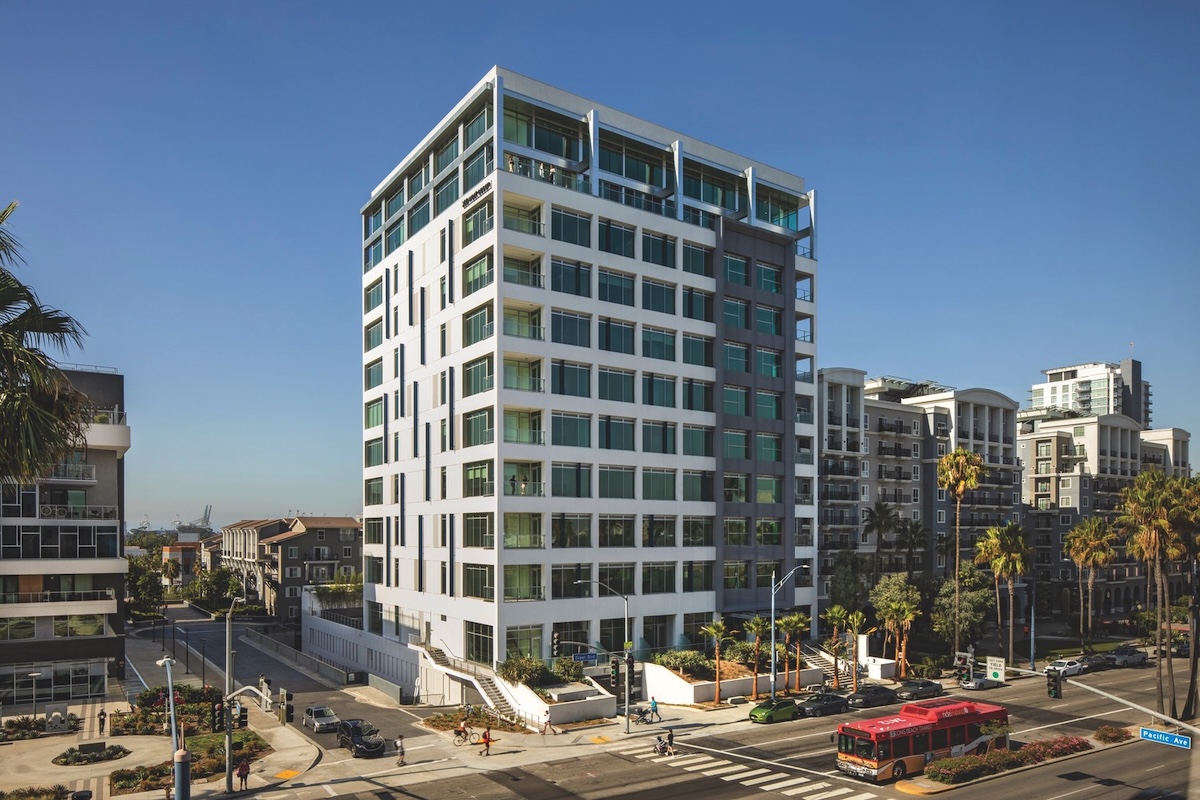
The month of February carries much zest from Groundhog’s Day to Valentine’s Day to the Super Bowl. But perhaps the most pronounced source of excitement in L.A.’s real estate world is the city’s revised adaptive reuse ordinance, which went into effect Feb. 1.
Changes to the original 1999 ordinance – which was created to incentivize the conversion of underutilized buildings into multifamily housing – include a substantial expansion of eligibility both in a building’s age and location as well as the removal of minimum unit size requirements for these projects.
Local experts across architecture, real estate investment and development are bullish that this new policy will help move the needle in the city’s housing crisis, reduce office vacancy, promote sustainability in development and lead to unique, charming residences.
Prior to Feb.1, a building had to be built prior to July 1974 in order for it to be eligible for the city’s adaptive reuse program. Now, the ordinance follows a rolling 15-year rule, meaning that buildings built in 2011 and earlier can now benefit from a streamlined approval process without project review and with certain density and height limit exemptions.
If an adaptive reuse project includes affordable housing units, it can use unlimited density bonus so long as the project is consistent with several city standards including providing accessible amenities. Affordable or partially affordable projects can also be eligible for the addition of two extra stories.
At the time the original adaptive reuse ordinance was passed in 1999, it was “an incredible game changer,” not only for L.A. development activity but also in inspiring other jurisdictions to enact similar policies, said Michael Bohn, partner and design director of Long Beach-based architecture firm Studio One Eleven.
Now, 27 years later, these revisions will make the ordinance “stronger than ever,” he said.
In its tenure, Studio One Eleven has done over three dozen adaptive reuse projects ranging from converting warehouses to creative offices, worship centers to housing, retail to housing, office to housing and more. It has completed six office-to-residential conversions and has three on the boards or under construction, Bohn said.
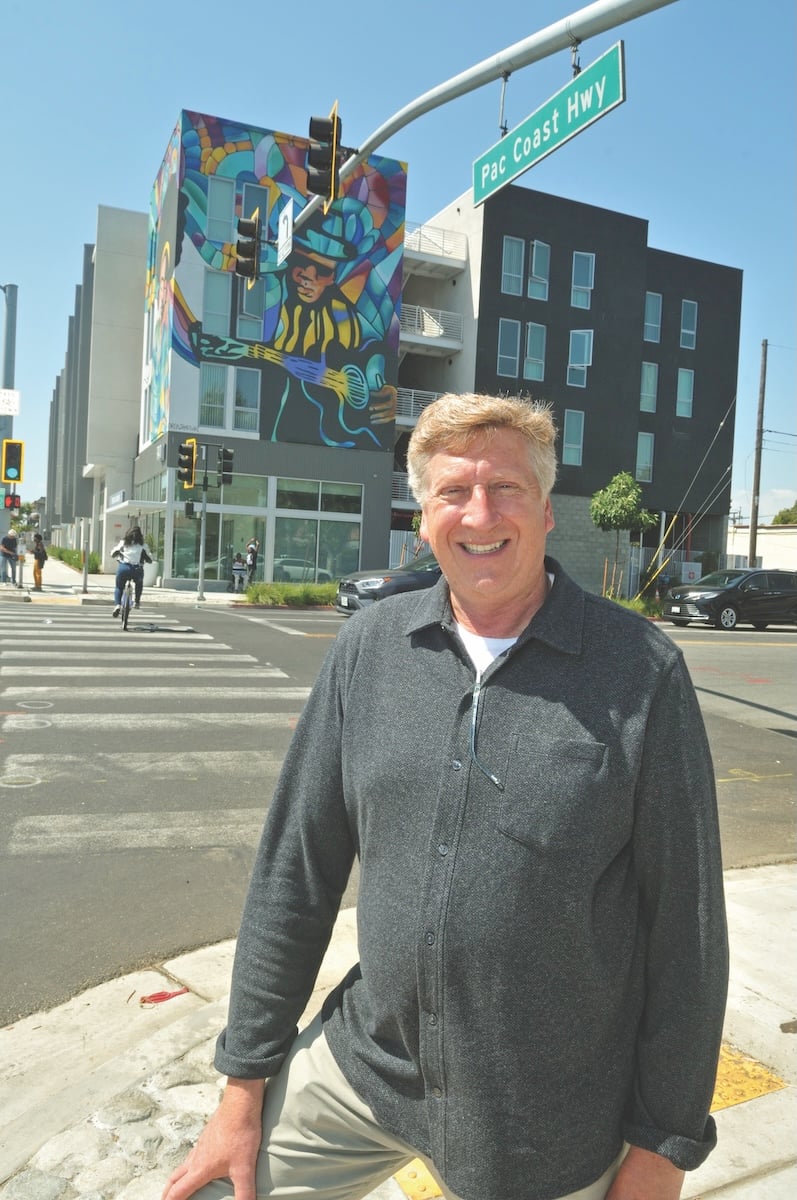 Michael Bohn with Heritage Gardens, an affordable housing project for seniors and veterans designed by Studio One Eleven. (Photo by Thomas Wasper)
Like the building age restrictions previously in place, the old ordinance also only provided incentives and exemptions to adaptive reuse projects located in and around downtown as well as Hollywood. Under the new policy, any project within L.A. city limits will be able to take advantage, which Bohn said will have a significant impact on the types of projects we will see.
Rather than the focus solely being on areas like downtown where much of the stock is skyscraper-type buildings, these projects can now be done at smaller scales, such as converting two- and three-story buildings. Bohn referenced the work Studio One Eleven has been able to do in Santa Ana, which also has an adaptive reuse ordinance. In one project, they converted a two-story building, which had previously hosted a food hall and a career college “that wasn’t really performing,” according to Bohn, into a 24-unit loft community with a food market on the first floor. Bohn sees similar projects in L.A.’s future with the new ordinance in place.
Los Angeles is not the only metropolitan area interested in leaning into conversions. In fact, CBRE recently reported that 2025 marked the first year that conversions and demolitions outpaced new office deliveries nationally. Since 2016, L.A. has seen 5 million square feet of office space converted or demolished with an additional 4 million square feet planned or in construction. Still, L.A. is behind many other major cities when it comes to the percentage of its total office inventory in the conversion pipeline. As of the fourth quarter, this stood at 1.8% in L.A., compared to 3.3% in Manhattan, 8.7% in Miami, 2.9% in both Houston and Dallas-Fort Worth, and 4.4% in Atlanta, according to CBRE data.
The city’s revised ordinance could stand to bring that number up, said Phillip Sample, a senior vice president at CBRE who created an investment platform focused on office, adaptive reuse, mixed-use development and land sales.
Moving forward, Sample sees a lot of opportunity for conversions specifically with class C office buildings. Because of the present market conditions, current owners of these buildings are not going to get the financing they need to upgrade their spaces for continued office use because investors aren’t interested in the risk, he said. For those looking to convert office to multifamily, however, Sample said “institutions will lend you the money because (the multifamily sector) is 97-98% occupied.
“There’s a lot less risk,” he said.
The maturing of loans on office buildings also sparks adaptive reuse projects, said Sonnet Hui, managing director and vice president at Project Management Advisors in downtown.
 Sonnet Hui
Typically, when loans on office buildings mature, a transaction would follow, Hui said. But with Measure ULA, investors and lenders are more inclined to hold properties. And with a soft office market, “that really pushes them to do something with (the building) because you can’t have property vacant for too long in this market,” she said.
With the revised adaptive reuse ordinance and some other pieces of legislation looking to incentivize housing production, Hui said conversions could be that next step for these owners.
While conversions won’t magically fix L.A.’s office conundrum, Bohn thinks it will lead to the gradual chipping away of our high vacancy rates.
“We need housing desperately, and we’re not getting it as fast as the market needs it,” he said. “And then we have this glut of office space… If we can empty out a building that still has a few marginal tenants to fill other office buildings, that will help strengthen the office market while creating more housing.”
Bohn also points to the benefits of districts with multiple asset types to increase street activation.
“Instead of having these mono-use office districts – which, even pre-pandemic, were dead at night and on the weekends – if we can transform those into mixed-use environments where people work, live, walk their dogs, then they become real communities,” Bohn said.
The adaptive reuse route also saves time and money for delivering more housing, Hui said, pointing to “a long and unpredictable entitlement process” for new builds.
“If you look at our typical development cycle (after receiving entitlements through project delivery) that’s typically three to five years, and in development, time is money,” Hui said.
On the other hand, a conversion – particularly where the developer is working with similar uses, such as a motel becoming permanent supportive housing – can be done in about 18 months, she said.
The upcoming 2028 Olympic and Paralympic Games also play a role in generating interest in these projects.
“Everyone knows if you want to do a ground-up project, it’s probably too late to meet the 2028 deadline,” Hui said. “There’s a real focus on what building stock is available that you can do something impactful with in the short time frame that’s still possible… and that’s where the adaptive reuse conversation becomes very attractive.”
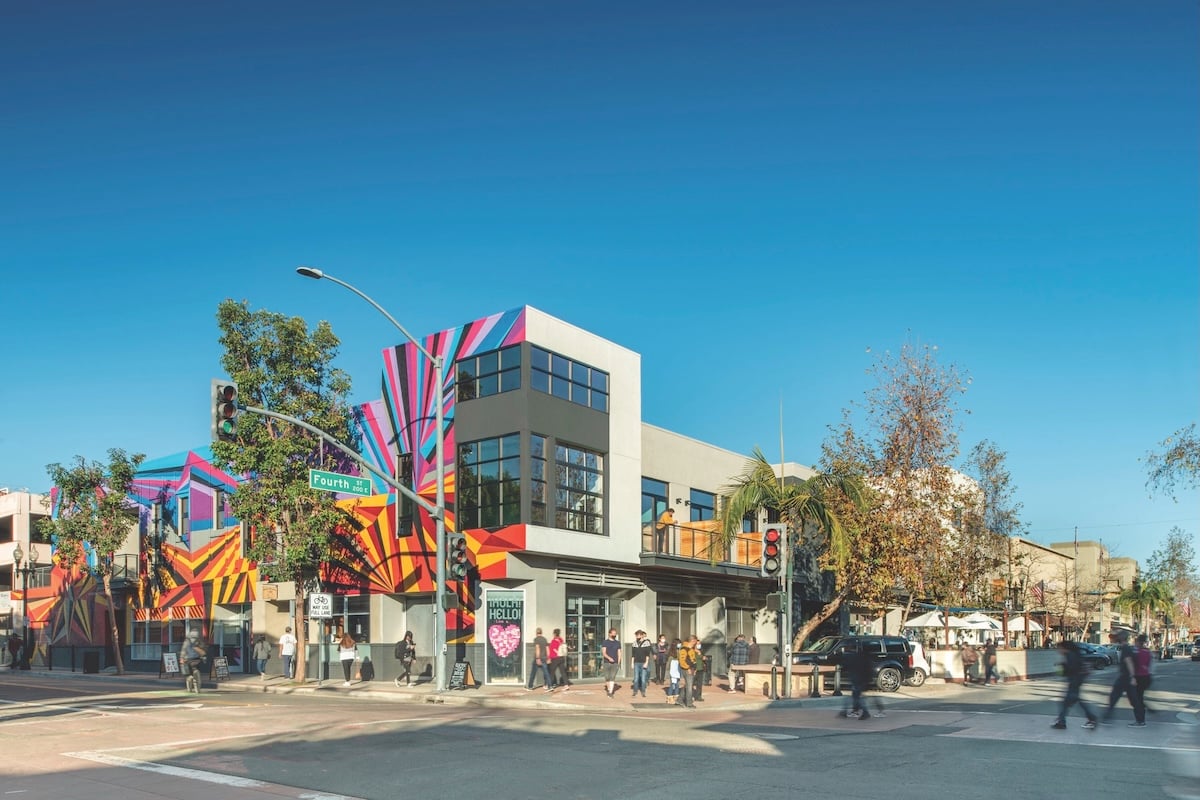 Build: 4th Street Market Lofts in Santa Ana. (Photo c/o Studio One Eleven)
Cost is another benefit, especially for conversions of steel frame buildings which Sample said require “very minimal” structural upgrades. He also noted savings for parking.
In one of Studio One Eleven’s office-to-residential conversion projects, the office building had both underground and ground-level parking structures. Because residential projects don’t need as much parking as office, Bohn said the firm was able to replace the ground-level lot with 10 additional units of housing.
Conversion projects also offer inherent sustainability when compared to ground-up construction.
“The best building, the greenest building, is the one that you don’t tear down,” Bohn said.
Comparing adaptive reuse projects of buildings with eight to 14 stories to ground-up projects of the same scale, Bohn said Studio One Eleven is able to divert 25 million tons of debris into dumps and reduce embodied carbon by 60% to 80%.
He also said adaptive reuse projects tend to have better community reception than new builds because residential “is less intensive in use,” with less parking demand and lighter traffic flow.
Aside from the technical benefits, Bohn finds adaptive reuse leads to visually stimulating projects as opposed to many of the “cookie-cutter, developer-driven looking places” we see popping up in the market today. Leaning into these buildings’ “charming” features such as floor to ceiling glass, unique brick and wood bowstring trusses can work to establish character.
“There are people that would like housing that reflects their personalities,” Bohn said. “We have found that (these projects) tend to get better rents per square foot, and they tend to stay occupied longer by the same people because the tenants become a little more attached to them.”