
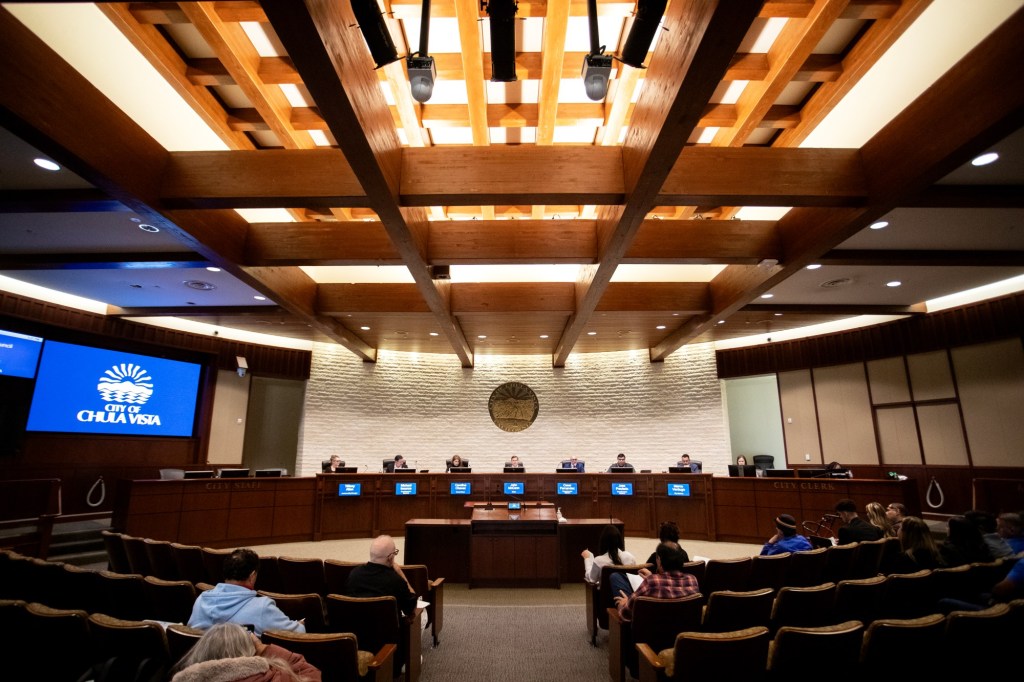
When Chula Vista Mayor John McCann left for a Navy Reserve deployment in late January, the county’s second-largest city faced a question it had no clear answer for: How should elected officials communicate their absences to ensure continuity of leadership?
As it stands, the city has no formal policy.
The result was conflicting accounts about who knew McCann was leaving and when they knew it. Deputy Mayor Cesar Fernandez said he was never notified. City Manager Tiffany Allen won’t say when she learned of the deployment. And McCann’s version of events contradicts what Allen allegedly told other officials.
While the city manager handles day-to-day administrative operations, the mayor plays a central role in setting policy direction and representing the city in official capacities. In his absence, those responsibilities fall to the deputy mayor, according to the City Charter.
Former Mayor Mary Salas, who served with McCann when he was a council member, said his current approach represents a departure from how he handled deployments in the past.
“Certainly, we were all aware that he was going to be gone,” Salas said of McCann’s earlier deployments. “We always knew when he was going to be gone.”
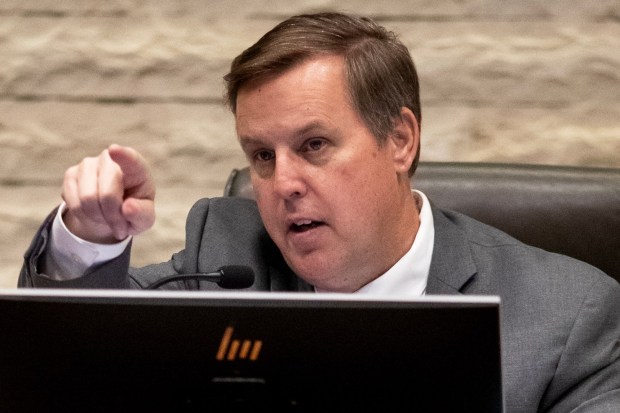 Chula Vista Mayor John McCann addresses the audience in City Hall. (Xavier Hernandez / For The San Diego Union-Tribune )
Contested timeline
McCann, a Reserve supply and logistics officer who holds the rank of commander, said he discussed his deployment with City Manager Tiffany Allen in December and they decided together to move a Feb. 3 council meeting to Feb. 10 to accommodate his military service. McCann said he discussed his deployment with Allen on two other occasions.
But Deputy Mayor Cesar Fernandez said Allen told him on Jan. 23 that she had “just found out” the mayor was out of the country — the same day Fernandez himself learned of the absence.
“She goes, ‘I just found out that he’s out of town. He’s not in the country,’” Fernandez said in an interview, describing his conversation with Allen at a Jan. 23 ribbon-cutting ceremony for a new Sharp facility. “And I was like, ‘Oh, really?’”
Fernandez said he never received formal notification of McCann’s absence.
“To date, I have not received an email, a text message, anything formally stating that the mayor was out,” Fernandez said. “Never formally was notified that he was out of town or out of the country.”
McCann did not directly address what Allen reportedly told Fernandez on Jan. 23, but emphasized security concerns around his deployment.
“Again, we all have different schedules and because of security issues with my family, security issues with my Navy service and my sailors, we’re not allowed to announce when I’m on deployment or where I’m going on deployment,” McCann said when asked about Fernandez’s statement.
Allen did not respond to requests for comment on what she told Fernandez regarding the mayor’s deployment.
City spokesman John Cihomsky declined to comment on communications regarding the mayor’s deployment, citing privacy and security concerns.
Salas said she could not recall specific written policies, but emphasized notification is expected when a member of the council will be out.
“I just think that it’s a matter of common courtesy to let the council members know that you’re going to be gone and not make it a surprise,” Salas said, adding that it was especially important to notify the deputy mayor who “has to be prepared to assume the role of acting mayor.”
McCann said he never informed members of the council of his deployments. “It’s been a long time since Mary Salas was mayor and she is mistaken. I only informed the City Manager of my Navy Deployments in the past.”
Meeting canceled weeks in advance
The timeline of a canceled City Council meeting has added to questions about the notification process.
City Council schedules provided to The San Diego Union-Tribune show a Feb. 3 meeting was listed as scheduled in an October 2025 draft. But a revised schedule sent to council members on Dec. 15, 2025, showed the meeting had been removed — nearly seven weeks before the scheduled date.
McCann confirmed he asked to move the meeting to maintain his attendance record.
“In December, I had talked with our city manager, told her that I was being deployed,” McCann said. “There were no issues of being able to move the meeting from February 3rd to February 10th. That would give me a window of opportunity to be able to attend my military deployment without missing a meeting.”
Allen did not respond to several requests for comment on the meeting between her and McCann.
Deputy Mayor role and training
The City Charter allows the deputy mayor to preside over council meetings in the mayor’s absence, and only three members are needed for a quorum to conduct business.
Fernandez said he has received no formal training on what that role entails. He was appointed to the role at the Jan. 6 City Council meeting.
“If there’s a policy that spells out specific duties of the Deputy Mayor, I definitely would’ve liked to receive that and I’m not sure that that actually exists,” he said.
The first time Fernandez saw any public confirmation of McCann’s absence was on the day of a Feb. 2 special meeting, when information about the deployment appeared on social media.
Fernandez had called the special meeting to address the death of Alex Pretti, who was killed by ICE agents in Minnesota. When asked whether calling the meeting had anything to do with the mayor being out of town, Fernandez said: “Zero. I would’ve asked for it anyways.”
McCann’s office issued a press release Feb. 2 explaining he could not attend the special meeting due to military service obligations. McCann described the meeting as a “political statement.”
“The city council was able to call a special meeting and they were successful at making their political statement,” he said.
Conflicting views on standard practice
McCann characterized his coordination with the city manager as routine.
“You have council members who have medical issues, who have vacation plans, who have conferences, and the city manager does a good job to try to be able to make sure that they work around, or she helps work around the schedule to maximize the attendance of the mayor and all council members for council meetings,” McCann said.
But Councilmember Michael Inzunza, who attended Tuesday’s council meeting virtually due to a family medical issue, said he followed a different process to ensure his in-person absence was properly handled.
Inzunza said he contacted the city to ask about absence procedures and was told he could participate remotely under the Americans with Disabilities Act provisions, which allow council members to attend virtually in certain circumstances.
“I don’t expect the city staff or the city council to postpone a meeting on my behalf,” Inzunza said. “I expect that the city council and staff need to proceed with meetings to keep the services of our city going.”
Inzunza, who comes from a military family and emphasized his respect for military service, said his concerns are about procedural clarity, not McCann’s service.
“My understanding is that members of the city council should not be asking to cancel or postpone meetings for any reason,” he said, adding that the city “doesn’t necessarily seem to have a very concrete policy in place for absences or changing council meetings to fit a council member’s schedule.”
Councilmember Jose Preciado said in an email that he also was not informed of McCann’s absence.
“I am never informed or privy to the mayor’s calendar,” Preciado wrote. “In fairness, he does not have access or knowledge of mine.”
Questions about written policies
The City Charter references absences “without permission,” though the Charter does not specify who grants permission or what the process entails.
Inzunza said the lack of clear policies is problematic.
“I still think that there are some unanswered questions in the fact that the council doesn’t necessarily seem to have a very concrete policy in place for absences or changing council meetings to fit a council member’s schedule,” he said.
Security and family safety concerns
McCann emphasized that his priority was protecting his family and maintaining operational security.
“I have the obligation to protect my family,” McCann said. “When I am off on deployment, my wife and daughter are home alone. We want to make sure that their safety is paramount.”
He referenced the Uniformed Services Employment and Reemployment Rights Act, known as USERRA, which allows service members to serve without jeopardizing their jobs, saying the city manager “has been respectful in making sure that she follows the human resources rules as well as USERRA.”
Salas said McCann never previously cited security or privacy concerns as a reason not to notify colleagues. She also said security concerns wouldn’t prevent internal notification of council members.
“If he were worried about his personal security, he could have a private conversation with the council members,” she said.
Looking ahead
McCann has been a Chula Vista elected official since 2002, serving as a council member, mayor and school board member. He is up for re-election this year.
Salas, who left office nearly three years ago, said the current lack of communication on the council is troubling.
“I just know that there’s a lack of communication between the council and the mayor, and that’s really unfortunate,” Salas said. “It really makes me sad to see what’s going on and that there’s not a working relationship or the communication that you should have with your council members. It’s kind of disappointing.”