
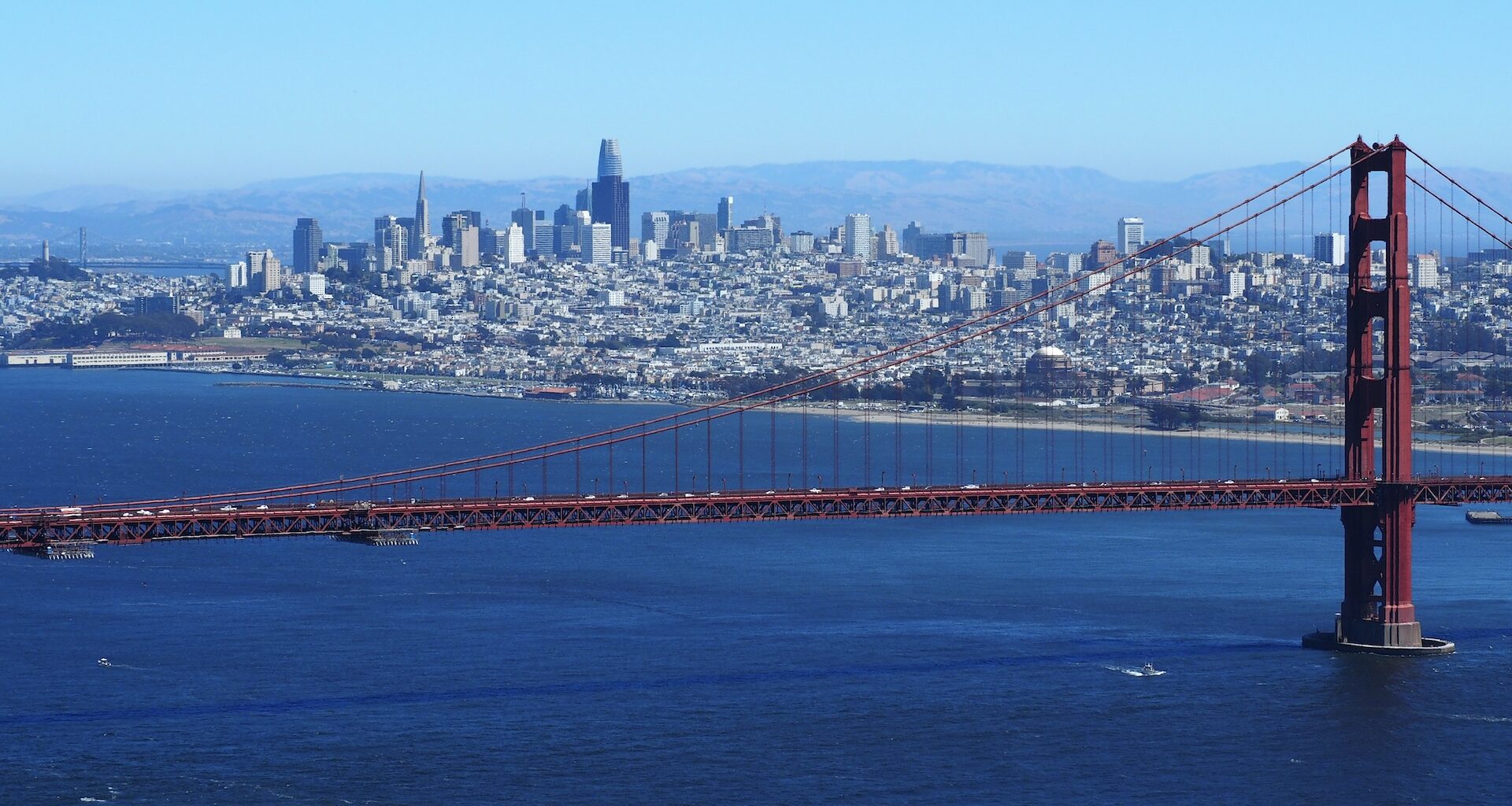
I cannot imagine a facial expression more confused than that of my former neighbor, who looked at me with a sense of utter disbelief and incredulity. We were standing merely feet apart as I loaded my family’s personal belongings into a storage container parked in my driveway. “You are moving…where?” he asked, as if almost begging for clarity. After all, we were neighbors in a small, Catholic, conservative town in Southwest Florida called Ave Maria. Ave Maria is a place one moves to, not necessarily away from; and if one moves away, it most certainly is never to the town’s antithesis—San Francisco.
I smiled at my neighbor, granting validity to his query and assuring him that the same commitment to the Catholic Faith that led to Ave Maria’s founding could very well be applied to another city’s regeneration.
San Francisco, California, is not a city typically characterized for its religious fervor. When one thinks of San Francisco, or the Bay Area in general, certain images come to mind: rainbow flags, “dog mommies,” tech bros, colored hair, homeless encampments, the absence of young children, and an abundance of the gender dysphoric. San Francisco is typically associated with oppressive progressivism, severe wealth inequality, transhumanism, AIDS, and fecal matter on the streets.
Its status as one of the most expensive cities in the United States hardly makes it attractive for young families. Major companies like Meta (Facebook), Google, Netflix, and Apple all represent “Big Tech,” which has been accused of “threatening our humanity.” And now the emergence of artificial intelligence has brought new concerns and an influx of technological pioneers into Silicon Valley. In San Francisco, God is often forgotten and His laws ignored. But it was not always this way.
Like much of the West Coast, California was settled by Spanish explorers, who founded missions sponsored by Roman Catholic religious orders. In 1776, the explorer Juan Bautista de Anza established a military fortress (Presidio) and a mission named after St. Francis of Assisi (also known as Mission Dolores). Mission Dolores was served by the Franciscan Order, then led by St. Junipero Serra and Fr. Francisco Palóu, but the mission was largely an outpost in Alta California.
In 1848, prior to the Gold Rush, there were only an estimated 200 Catholics living in San Francisco. By 1849, however, the landscape changed—tens of thousands of people flooded the city in search of gold in the hopes of making a small fortune. In response, Pope Pius IX requested that a Dominican priest, Fr. Joseph Sadoc Alemany, O.P., become Bishop of Monterey and help build up Catholic infrastructure to serve the spiritual needs of the new, bustling city. As the Holy Father reminded Bishop Alemany: “Where others are drawn by gold, you must go and carry the cross.”
By 1884, various religious orders of the Catholic Church began to found schools, orphanages, hospitals, charities, and parishes in San Francisco. The presence of the Franciscan and Dominican friars was complemented by consecrated women religious, including Dominican sisters, the Sisters of Notre Dame de Namur, the Sisters of Charity, and the Presentation and Visitation sisters. Jesuits, Paulists, and De La Salle Christian Brothers created parochial schools to help serve the growing population of Catholic children.
At its zenith, Catholic parishes in San Francisco were often staffed by several priests, who would hear confessions, anoint the sick, teach catechism, and offer the Holy Sacrifice of the Mass all in the same day. Although the city began as a fort and mission, growing in population only, initially, due to a desire for riches, the Church adequately responded by bringing the “pearl of great price” (Matthew 13:46) and preaching on the riches of eternal life.
Of course, we already know the narrative of religious decline following the 1960s, along with the various revolutions—racial, sexual, technological—that changed the landscape of America’s urban centers. That which the famous 1906 earthquake and its widespread fires could not destroy— the Catholic Faith—would quickly be undone by the liberal political influences taking over the city. As religious adherence declined, so did the vibrancy of the Faith.
Religious orders hemorrhaged members, errant “social justice” movements replaced a sense of solemnity in divine worship, and the few faithful pockets (such as those led by Fr. Joseph Fessio, S.J., and those priests offering the Traditional Latin Mass during the indult period) paled in comparison to the wider, progressive movements. But, like many places across the United States, San Francisco is undergoing a “vibe shift,” led in part by a renewed commitment to the traditional Catholic Faith and Mass.
The reason I moved my entire family to San Francisco was to lead a Catholic classical school, Stella Maris Academy, a parochial apostolate of the beautiful Star of the Sea Parish. Star of the Sea was founded in 1894 in what is now the Inner Richmond neighborhood of San Francisco. Its first pastor, Fr. John P. Coyle, was the first native San Franciscan to be ordained a Catholic priest.
The parish was comprised of mostly Irish immigrants—who were largely farmers and shop owners—and numbered 44 families. The first school was built in 1909, and by the end of the year it had 157 students. The school was staffed by the Sisters of St. Joseph of Carondelet, habited nuns who were dedicated to the education of Catholic children in faith and good morals.
The school continued its growth, similar to many inner-city parochial schools, with the regular demographic ebb and flow of the following decades. In June 2019, the school closed. In 2021, it reopened as Stella Maris Academy—the first Catholic classical school in San Francisco, opened at the request of Archbishop Salvatore Cordileone, himself a proponent of faithful, Catholic education.
My initial experience of Stella Maris Academy was one of shock and awe. During my initial visit, I entered the school at 7:30 a.m., prior to the start of morning assembly. As I roamed the halls, I heard the St. Mary’s Cathedral Children’s Choir sing a motet by Palestrina. The angelic voices of the student choristers brought me to tears. I then had the opportunity to pray with the students—we prayed the Angelus and sang a hymn in Latin.
Visiting the classrooms, I saw students filled with excitement and wonder. The classrooms had wood-finished floors, large windows letting in natural light, and images of Christ, Our Lady, and the saints adorning the walls. The teachers reflected a deep love, gentleness, and warmth to the children they had been entrusted to teach. At one point, I stopped by the kindergarten class and observed how children pointed to a picture of a tabernacle, exclaiming, “That’s where Jesus lives!”
After teaching theology at the university and high school levels, the idea of entering into elementary education rarely crossed my mind. It wasn’t until after teaching juniors in high school that I realized how important a solid primary education is in order to form the intellect and will. It is in these youngest years, from preschool to eighth grade, that children come to know the fundamentals of faith and the importance of virtue. The parochial elementary school is, when done right, a safe place for children to grow in knowledge and love of Jesus Christ; and it is where the seeds of vocation are often planted.
The Catholic classical elementary school—one focused on truth, goodness, and beauty—can arguably do more to change the world than a simple theology class undertaken by apathetic, iPad-addicted teenagers looking for something that smacks of “career-readiness.” An integrated humanities program, complemented by solid math and science instruction, produces far more intellectual and mature students than schools obsessed with Deweyism and project-based learning. The difference between Catholic classical education and its secular counterparts differs in essence and not simply in degree.
Stella Maris Academy is very much an apostolate of Star of the Sea Parish, which means it exists as a manifestation of the church’s mission. The students attend Eucharistic adoration at the parish several times a week. The pastor teaches Theology to the seventh and eighth grade students. Priests are present at morning assemblies, giving small talks on the saint of the day, speaking on the concept of vocation, blessing throats, and providing a visible sign of commitment to Christ and His Church.
The faculty and staff attend liturgy faithfully and are persons of deep prayer and good conduct. The school Masses are offered both in reverent Novus Ordo liturgies as well as the Traditional Latin Mass. There is no shortage of altar servers, nor of veiled girls. Graces flow from the parish’s Eucharistic Altar, to be channeled into the students’ academics and the culture of the school.
The school is hardly Pollyannish—families are aware of the great differences between what is taught and promoted in the school versus its alternatives within the city. And yet, the school’s families are the supporting pillars of its success, sacrificing their time, treasure, and talent to make the school a success. The parishioners rejoice in seeing so many young children, many of whom have siblings, running around the courtyard during the hospitality community hour following Sunday morning Masses.
Stella Maris Academy offers a rigorous, faith-filled, Catholic classical education in a city in such desperate need of objective truth and sound morals. The students come from many diverse backgrounds, but, as Pope Leo XIV’s Augustinian papal motto reminds us, “We are one in the One” (In Illo Uno Unum).
What could have possibly convinced me to leave behind friends, family, and a more comfortable culture in conservative Florida? The answer is simple: the Holy Spirit, who is at work in the local Church here in San Francisco. If San Francisco is to return to the Faith, it will be due, in part, to the fruits of a truly authentic parochial educational institution that labors for the salvation of souls.
Was it a surprise to my traditionalist friends that I would bring my family into San Francisco? Perhaps. But it should surprise no one that the city named after one of the Church’s greatest saints and reformers could one day soon be reformed and produce saints—which is our main goal here at Stella Maris Academy.
John A. Monaco is a doctoral student in theology at Duquesne University in Pittsburgh, PA, and a Visiting Scholar with the Veritas Center for Ethics in Public Life at Franciscan University of Steubenville.