
Last year was one that local airport executives are eager to put in the rear-view mirror.
The four airports serving Los Angeles County – Los Angeles International, Ontario International, Hollywood Burbank and Long Beach – collectively saw 90.9 million passengers go through their gates last year.
That’s a 3.7% drop in passengers compared with 2024, and the first cumulative decline in passengers since the Covid-19 pandemic hit in 2020.
Three of the airports experienced a net drop in passengers last year: Long Beach and Hollywood Burbank fared the worst closing out with an 8% and 5% drops, respectively. LAX saw a nearly 3.8% decline, in line with the overall net slump. Only Ontario International eked out a slight gain of 0.5%, but that came after its remarkable streak of 54 consecutive months of year-over-year passenger growth was snapped in September.
While final year-end passenger tallies have yet to come in for many of the nation’s airports, the four Los Angeles-area airports in general fared worse than the national average, said Ben Mutzabaugh, managing editor for aviation of New York-based travel news and advice website Points Guy.
“Nationally, 2025 was a year of slow growth at the nation’s airports,” Mutzabaugh said. “There was a lot of uncertainty at the beginning of the year with tariffs and everything else that was going on with the new (Trump) administration. Then you had drops in travel from countries where the Trump administration’s actions were not popular, such as Canada and several European nations. All that put a damper on growth in bookings.”
However, West Coast airports in particular were hit harder because of declining travel to and from Asian countries, particularly China, Mutzabaugh said.
As if that was not enough, there was the likely drop in bookings in the first half of last year for the Los Angeles-area airports because of the coverage of the Palisades and Eaton fires.
With all this, Mutzabaugh said he was not surprised by the overall decline in passengers at the four airports.
Among the four airports serving the county, Long Beach Airport suffered the largest percentage loss in passengers last year – down nearly 8%.
Dallas-based Southwest Airlines Co. is by far the dominant carrier at Long Beach, with roughly 89% of all airport passengers last year. Over the past year, Southwest has undergone considerable turbulence. Earlier in the year, the airline was dealing with a shortage of planes. Later on, the airline started charging for checked baggage and dropped its signature open-seating boarding policy, switching to assigned seating.
Mutzabaugh cited another factor that could have exacerbated the drop in passengers.
“Southwest frequently adjusts the capacity of its planes to meet demand at the airports it serves,” he said. “If they see falling demand at an airport, they can shift to a (Boeing) 737 craft with fewer seats, which in turn can further reduce passenger counts.”
Because of Southwest’s dominance at the airport, any trend toward fewer passengers on Southwest flights is an almost one-to-one direct correlation to drops in overall passenger traffic at Long Beach.
Yet even with the 8% decline in passengers at Long Beach, last year still had the second highest passenger tally in the airport’s history after 2024.
At Hollywood Burbank, financial difficulties at two airlines played a major role in the 5% slump in passengers at that airport last year compared with 2024.
Dania Beach, Florida-based Spirit Airlines Inc. entered its second bankruptcy and restructuring after a failed merger attempt with New York-based JetBlue Airways. The airline has been slashing flights nationwide. And Houston-based Avelo Airlines Inc., facing financial pressures of its own, began executing its drawdown at Burbank as part of a previously announced complete exit from the airport.
The problem for Hollywood Burbank Airport in the closing months of last year was very few added flights to offset the shedding of flights by Spirit and JetBlue.
The picture should brighten for the airport this year as five airlines – Seattle-based Alaska Airlines Inc., Las Vegas-based Allegiant Air, Cottonwood, Utah-based Breeze Airways, Dallas-based Southwest Airlines Co. and JetBlue – have previously announced a total of 11 added flight routes over the next eight months.
Last year was a mixed bag for Ontario International Airport. Overall passenger growth slowed all year, to the point where in September the year-over-year passenger growth rate turned negative for the first time in four-and-a-half years.
But overall passenger growth returned to positive territory late in the year thanks to a surge in international travel. For the year, the airport saw 7.1 million passengers, up nearly 0.5% from 2024.
Ontario’s tally of passengers traveling internationally topped 500,000 for the first time in recent history, reaching nearly 567,000 for a growth rate of 29% over 2024. Much of that growth came during the fourth quarter, where each month in the quarter posted a growth rate of more than 50% from the corresponding month in 2024.
Last year, Taipei Taiwan-based carrier Starlux Airlines began service at the airport, adding 51,000 passengers on the year to the airport’s internationally tally. An even bigger boost came from Mexico City-based Volaris Airlines, where last year’s passenger tally at Ontario rose 61% to 268,000.
“We are particularly gratified by the growth in international travel,” said Alan Wapner, president of the Ontario International Airport Authority Board of Commissioners.
“Greater Los Angeles is the second-largest air travel market in the United States and the sixth largest in the world,” Wapner said. “A region of this scale merits more than one global gateway, and Ontario International is stepping up to meet that demand by delivering a world- class customer experience defined by convenience and the infrastructure necessary to support continued growth.”
Mutzabaugh said the surge in international flights at Ontario last year was the direct result of an aggressive marketing campaign by airport authority executives. “What they’ve done with the Asia market has been incredible, especially considering travel overall between Asia and the U.S. was down last year.”
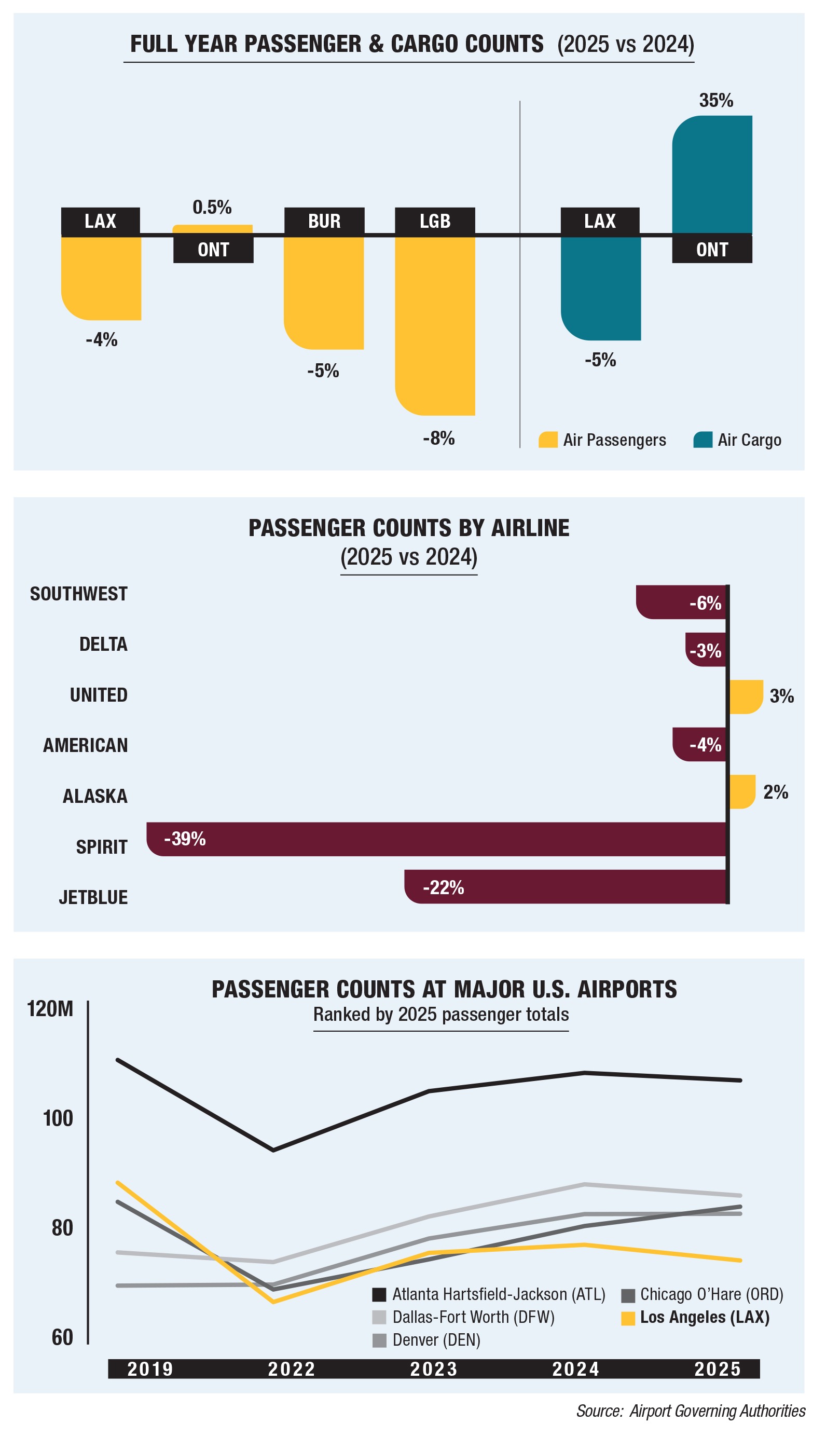
For Los Angeles International Airport, it was a completely different picture. The airport consistently posted drops in passengers for the entire year, when compared with the same months in 2024. The biggest drop was on the domestic side, where passenger counts fell nearly 5% on the year. The international side fared slightly better, though it still posted a negative growth rate of 1.6%
Overall, 73.7 million passengers went through the gates at LAX last year, down 3.8% from 2024.
When compared with its major airport peers around the nation, LAX fared among the worst last year. Dallas-Fort Worth International Airport in Texas was the next worst performer, with a passenger tally down nearly 2.5% from 2024. Next was Atlanta Hartsfield-Jackson International Airport – the nation’s busiest – which saw a 1.3% dip in passenger traffic. Denver International saw virtually no change in passenger totals last year from 2024, while Chicago’s O’Hare International bucked the trend with a passenger growth rate of 6.3%.
What’s even worse: among these airports, LAX still has by far the longest way to go to recover to pre-pandemic 2019 passenger levels. Last year, it slipped to 16% below 2019 counts. The Atlanta airport was next, falling 3.5% below 2019’s tally. Chicago was down a mere 1% compared to 2019, while Denver and Dallas posted double-digit gains of 19% and 14% respectively.
Mutzabaugh cited several reasons for the continued lag at LAX, including soft numbers of passengers traveling to and from Asia and its lack of a major airline hub.
“Since the pandemic, we’ve seen major carriers like American and Delta reinforcing their megahubs, meaning they are funneling ever larger proportions of their connecting flights to those hubs,” he said, mentioning Dallas as a megahub for American Airlines, which is headquartered in neighboring Fort Worth. that city. “This has worked to the disadvantage of LAX, which doesn’t have any of these megahubs.”
Another factor has been the ongoing construction at LAX, which Mutzabaugh said has likely prompted travelers to book at the region’s other airports whenever possible. This situation might ease this year with the expected opening later this year of the automated people mover.
Mutzabaugh said that air passenger travel is starting off this year on a more robust note.
“The airlines are now saying they are seeing strong bookings return for the first half of the year,” he said.
However, he added the situation is still rather tenuous.
“There are so many things that could derail the growth in bookings,” he said. He cited factors such as another prolonged government shutdown, more tariffs and the possibility of more financial difficulties at specific airlines.
Last year, the four airports serving Los Angeles County handled roughly 3.18 million tons of air cargo, down 2% from the 3.24 million tons handled in 2024.
LAX and Ontario comprise about 98% of all air cargo handled at the four airports and those two airports consistently went in different directions. Cargo tonnage at LAX was down 4.7% last year to nearly 2.3 million tons compared with 2024, while Ontario’s 835,00 tons was up 5.3% from the 793,000 tons handled in 2024.
Ontario’s cargo tonnage was boosted early last year because of a huge air mail contract that Atlanta-based United Parcel Service had received late in 2024 from the United States Postal Service. With this higher mail tonnage already factored in, the surge has tapered off and will not be a factor for this year.