
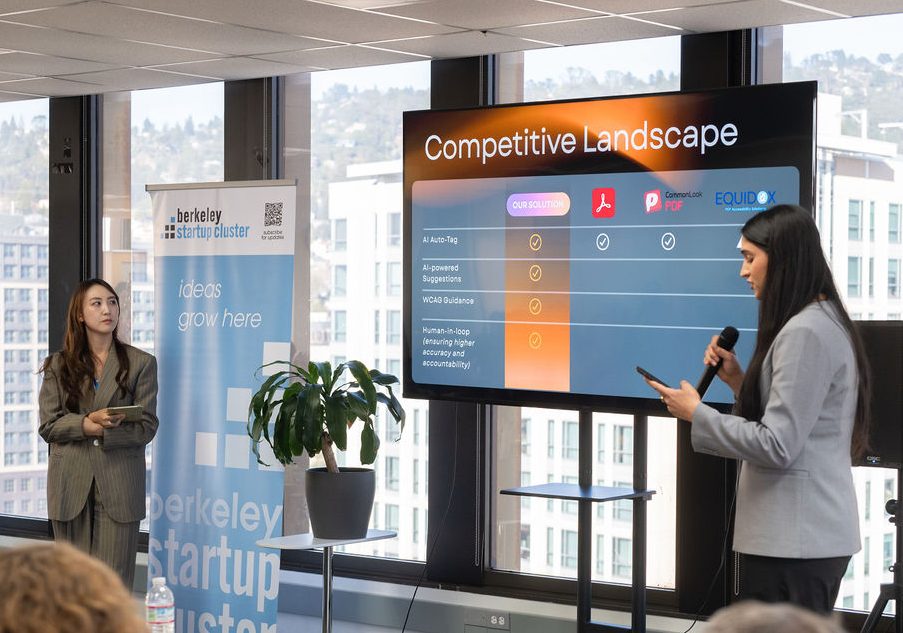
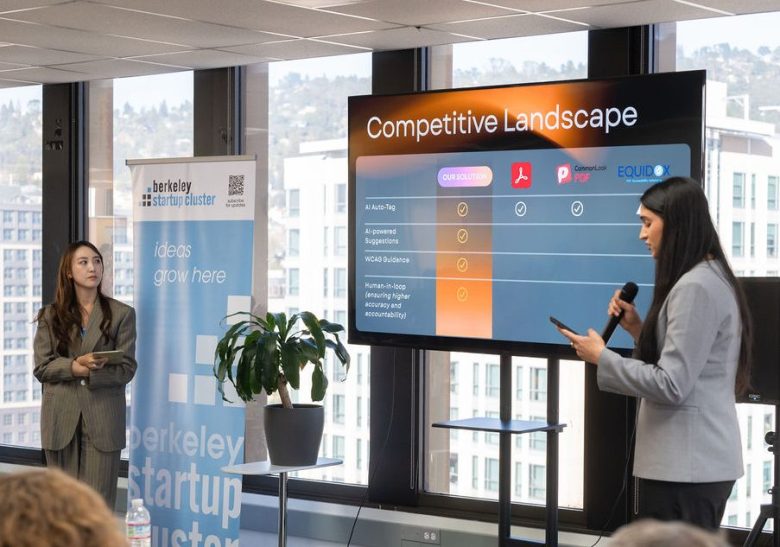
 UC Berkeley students Sejin Kim (left) Ayoung Cho (center) and Harvir Kaur (right) present their project at the Berkeley Civic Innovation Challenge. Credit: Brandon Sánchez Mejia/UC Berkeley
As a high school student, motivated by the desire to keep useful items out of landfills, William Chui built an online store where users could shop for free, pre-used clothes and household wares. When he arrived at UC Berkeley as a freshman last fall, he learned about the piles of waste generated when students moved out of their dorms – which the city then has to contend with. “The student body produces a lot of good stuff that most often than not ends up in landfill,” Chui said.
Last week, Chui had an opportunity to tackle that problem as part of the first-ever Berkeley Civic Innovation Challenge, a weeklong sprint bringing together teams of UC Berkeley students to solve pressing issues facing Berkeley city government.
Challenges in five areas — digital access, disaster resilience, housing access, small business procurement and zero waste strategies — were proposed by city officials. Finalists raced to research solutions, draft pitches, and sell them to a panel of judges including Chancellor Rich Lyons, Berkeley Mayor Adena Ishii and Vera Zakem, chief technology officer for the state of California.
Here are a few of the ideas the finalists came up with:
Have some furniture to get rid of? There’s an app for that.
To combat the overwhelm students and others can feel when deciding what to do with unwanted clutter, Chui and his team designed an AI agent that can evaluate an item’s quality and condition and make recommendations. Called ReMove, the app might suggest bringing reusable furniture to Urban Ore, for example. Textbooks could be donated to a community organization or student club, and unusable bulk waste picked up by the city or a contractor.
With more people finding new homes for their used items, the city could save money on transportation and disposal, Chui said. “One of the goals for ReMove was to create that accessible information right on the student’s phone,” he said. “We wanted to find a solution that would not just reduce stress for students but also on city services and residents as well.”
Combining technology and community to help Berkeley Hills residents make their homes fire-resistant.
New rules from the city of Berkeley barring residents in wildfire-prone neighborhoods from having most plants or wood materials within 5 feet of their homes has set off an, ahem, firestorm of criticism from some quarters. When business administration student Noor Masri and aerospace engineering student Mohammed Bukhari decided to take on the challenge of creating a digital hub where residents could learn how to prepare their homes for the “Zone Zero” requirements, they at first saw it as mostly a technological problem.
Knocking on doors in the Berkeley Hills, they quickly realized how wrong they were. “Honestly, it wasn’t pretty,” said Bukhari. “The core problem was the community thought the city of Berkeley was imposing on them rather than supporting them,” added Masri. “It was not seen as protection.”
Masri, Bukhari and their other three teammates persevered, interviewing residents in-person and on social media, as well as city and fire department officials. They identified homeowners’ concerns: Will my house still look good without its current landscaping? How much will it cost to make the changes? Some didn’t trust the city government, didn’t know whether complying was worth it, or didn’t know what Zone Zero was.
The team developed a one-stop platform, called EmberSafe, where residents could answer multiple-choice questions to receive a customized plan, including a tool that would mock up aesthetically pleasing garden designs that complied with the rules, and connections to grants that could help them pay for the changes. And they proposed partnering with National Night Out to organize block parties where residents could discuss and learn about wildfire preparedness.
“Whenever people see people with uniforms, they just shut down,” said Bukhari. “We eliminated that and made it from the community to the community.”
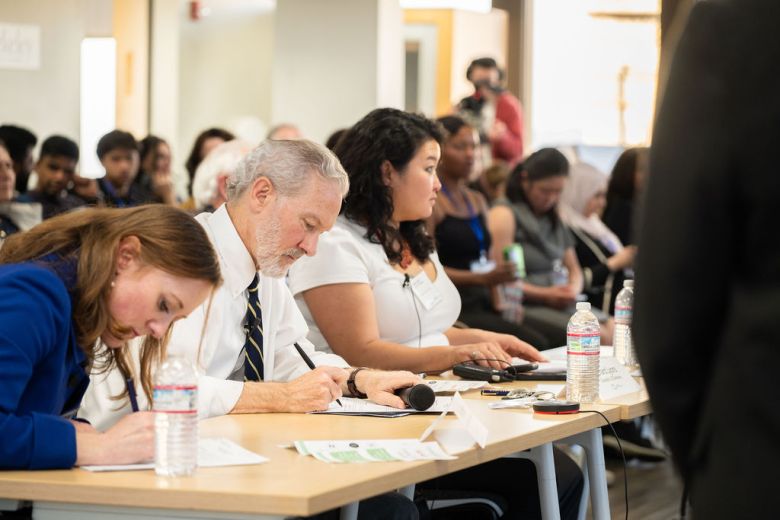 Left to right: Vera Zakem, California’s chief technology officer, UC Berkeley Chancellor Rich Lyons and Berkeley Mayor Adena Ishii were among the judges in the competition. Credit: Brandon Sánchez Mejia/UC Berkeley
Improving disability access, one PDF at a time
Like other local governments, the city of Berkeley faces an April deadline to make all of its web content compliant with the Americans with Disabilities Act. That includes a whopping 16,000-plus PDFs on the city’s website. Existing products claim to convert PDFs so they’re accessible to people with visual impairment and other disabilities, but the results are often riddled with errors, said public policy student Harvir Kaur.
So Kaur and her team built an AI tool that can take an existing PDF and spit out suggestions for how to make it accessible, including identifying tags on images and suggesting rewrites. A human city employee would then vet the changes.
Like other teams’ projects, the PDF converter – dubbed AccCo – took shape in late-night brainstorming sessions over the course of the weeklong contest, with students juggling the project with coursework, and skipping lunch breaks to conduct research. Each team included at least one student with a technological background, one versed in business, and one with grounding in public policy. Kaur said she learned the importance of collaboration.
“I thought it was going to be an individual effort, and I was ready to take on the whole project myself, and I was so confident that I would succeed,” she said. “So when we were introduced to the idea that we had to be on teams, I thought it was a hindrance. But when I started working with my team I realized how much I don’t know, and how much there is to learn from others.”
Will students’ ideas become reality?
The teams behind the PDF converter and the waste disposal tool tied for the competition’s grand prize on Friday, and will move on to Cal’s Big Ideas Contest accelerator, where they’ll get support from mentors in developing their ideas. Along with the wildfire project, other finalists’ ideas included online platforms to connect diverse small business owners with city contracting opportunities and residents with housing assistance.
Could the city of Berkeley take some of the students’ ideas on?
“I’m very hopeful we will be able to actually implement some of these solutions,” said Ishii.
She said even some projects that didn’t win the grand prize had generated excitement among city staff.
“We’re a city that has an embarrassment of riches when it comes to really bright people connected to the university. One of the reasons we wanted to do the Civic Innovation Challenge in the first place is that we know there are so many innovative ideas out there that could be used to solve some of the city’s problems.”
Berkeleyside partners with the nonprofit newsroom Open Campus on higher education coverage.
“*” indicates required fields