
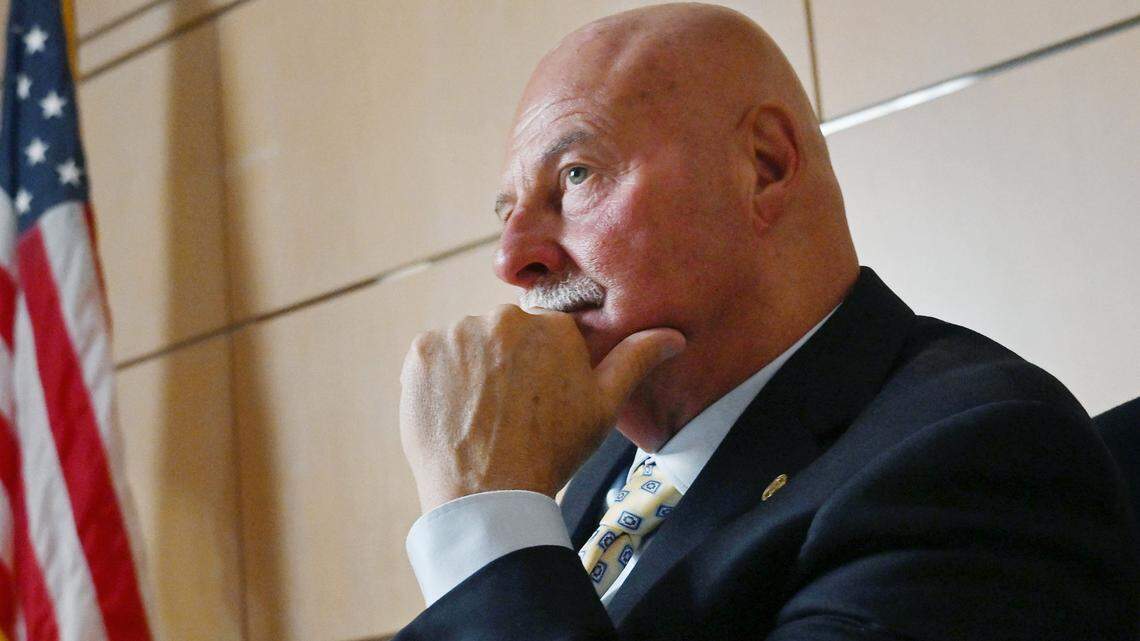
Fresno Mayor Jerry Dyer — the city’s former longtime police chief — has a lot to say about the Trump administration’s approach to immigration enforcement.
The Fresno Bee recently sat down with the mayor for a 40-minute interview. Dyer touched on high-priority local issues such as Southeast Development Area, Fresno County’s 30-year transportation tax, Measure C, housing and homelessness and downtown revitalization. Dyer’s team is currently busy preparing the city’s annual fiscal year budget. (“It’s going to be another tight year,” he said.)
Stay tuned for more of this conversation next week.
Though his attention is local, Dyer has also weighed in on the enforcement tactics of the Trump administration’s deportation campaign.
The Republican mayor has praised President Donald Trump’s efforts to secure the border, but he’s also been critical of the administration’s enforcement and arrest tactics, particularly after the deaths of two American citizens, Renée Good and Alex Pretti, by ICE agents in January.
Last month, Dyer joined a group of bipartisan mayors at the U.S. Conference of Mayors in Washington D.C. calling for more accountability and training for ICE officers and a pause to the current approach to immigration enforcement.
While Fresno hasn’t experienced the same presence of masked federal immigration agents in the streets like other large cities across the country, several people were detained by ICE in the area in late January in an apparent traffic stop. The region has also experienced an uptick of ICE arrests under the Trump administration, including courthouse arrests and during green card appointments.
Here’s what Dyer had to say about ICE immigration enforcement, with light edits for clarity.
Q. When you were in Washington D.C., you shared some remarks about what mayors can say and do regarding the federal immigration enforcement. What do you see as the role of a mayor in maybe weighing in and commenting on this national moment right now?
What happens with federal agencies in local communities ultimately has an impact on our neighbors that live in Fresno, it has an impact on policing, and has an impact on city government. We recognize that.
What I said in Washington D.C. at the U.S. Conference of Mayors was that one thing I’ve learned over my 40 years in law enforcement is the importance of trust. People have to trust the police officers that come into their community and neighborhood. And if you don’t have that trust, and you don’t have the permission from those people to police those neighborhoods, then they’re going to be rejected, and they’re going to be seen as an occupying force, and that’s what we’re seeing across the nation with ice they’ve been rejected. They’ve not built a level of trust.
Part of the reason is the manner in which they’re operating, and the tactics that they’ve been utilizing, and those tactics, in many cases, are just not being used by local law enforcement. In fact, they’ve been abandoned 30 years ago.
So my advice to the administration, to ICE is to provide training to ICE officials, ICE agents, very similar to the training we provide our local law enforcement, and for them to be held to the same standard that local law enforcement is held to. And to maybe regroup, pull back, and then let’s approach this in a different way.
And the other thing is, is that we’re seeing a lot of people that do not have criminal records be detained and deported by ICE.
That wasn’t the understanding of the American people. We were going to focus on the worst first, and so hopefully we can get to that point where we’re deporting serious criminals from our country.
Q. A new California law bans federal agents wearing masks. You’ve said that you wouldn’t support enforcing that. How do you balance not enforcing a state law with your history of law enforcement?
Note: after this interview, a federal judge in Los Angeles ruled Monday that California’s ban on federal agents wearing masks is unconstitutional because it exempts state law enforcement officers from the same requirement.
There is a time and place for law enforcement to wear masks. For example, our SWAT officers may wear a mask when they’re deploying on the perimeter for the purpose of allowing them not to be seen, especially during hours of darkness, right? They kind of blend in with the environment.
But when you’re dealing with citizens, interacting with people, that isn’t a time to wear a mask. I don’t believe it’s appropriate for that to occur. In fact, there can be a sense of anonymity by an officer, an agent, to where they start behaving in a way that they normally wouldn’t, if their face was exposed, which is why I’m a big believer in body-worn cameras. I’m glad to see that ICE is now using body-worn cameras. (Department of Homeland Security Secretary Kristi Noem announced Feb. 2 that every Homeland Security officer on the ground in Minneapolis, including ICE, would be immediately issued body-worn cameras and would expand the body-worn camera program nationwide as funding becomes available).
We will comply with that law in terms of our police officers, but there are some exceptions that are written into the law, and we understand that.
But in terms of arresting ICE agents who are armed – and having our police officers confront ICE agents because they’re wearing a mask – I think, is a disaster, and could lead to a lot of problems beyond that, we could even anticipate.
What good could come from an armed police officer and an armed ICE agent getting into a confrontation over a mask?
I’m not the only one that feels that way. The LAPD Police Chief (Jim McDonnell) just stated that, mayors and police chiefs across the nation have stated that. It’s just not something that I think is healthy.
And so I would encourage the administration to not have ICE agents wear masks.
The Fresno Bee
Melissa Montalvo is The Fresno Bee’s accountability reporter. Prior to this role, she covered Latino communities for The Fresno Bee as the part of the Central Valley News Collaborative. She also reported on labor, economy and poverty through newsroom partnerships between The Fresno Bee, Fresnoland and CalMatters as a Report for America Corps member.