
A Sloan Research Fellowship is one of the most prestigious awards available to early-career researchers.
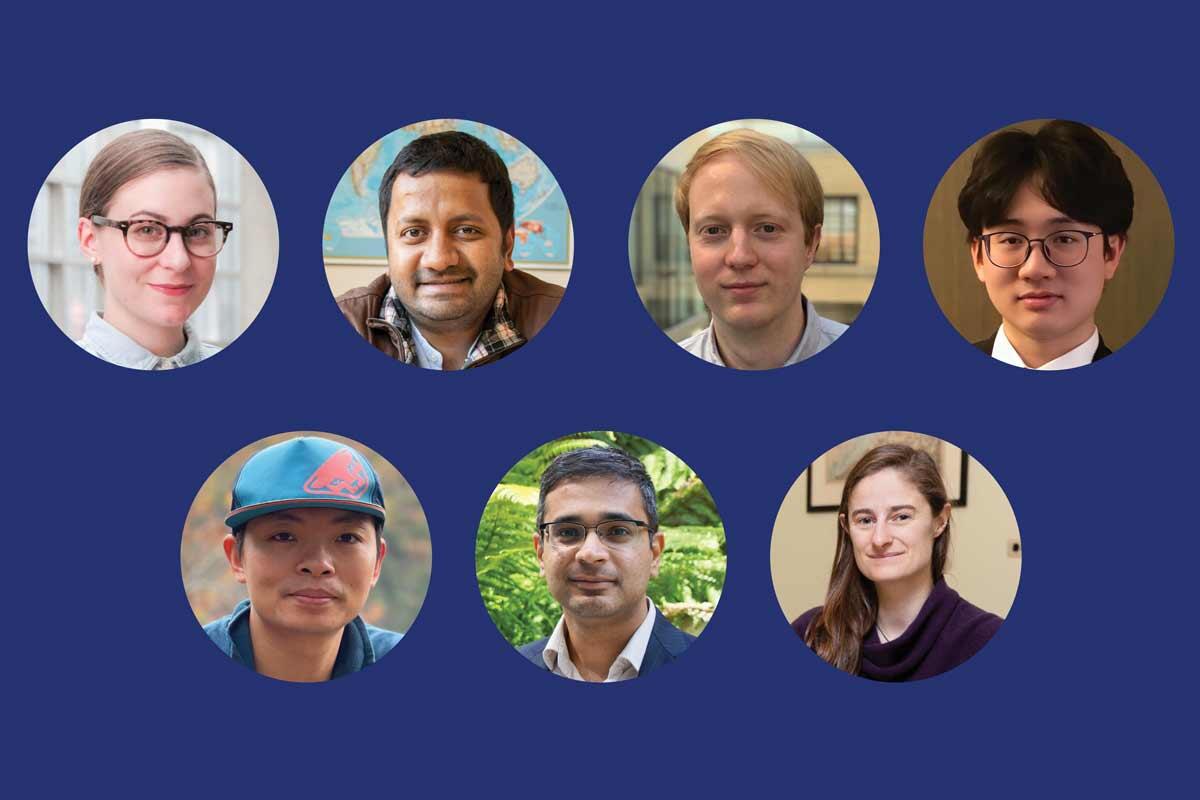
The 2026 Sloan Fellows from UC Berkeley are (clockwise from upper left) Sarah Chasins, Karthik Shekhar, John Wright, Yuan Cao, Madison Douglas, Ashok Ajoy and Wenbin Lu.
Composite image by Marissa Gutierrez
The Alfred P. Sloan Foundation today announced the names of the 126 early-career researchers selected to receive 2026 Sloan Research Fellowships, including seven from UC Berkeley.
The fellowships honor exceptional scholars in the U.S. and Canada whose creativity, innovation and research accomplishments make them stand out as the next generation of leaders. It is one of the most prestigious awards available to young researchers, in part because so many past fellows have gone on to become distinguished figures in science. To date, 59 fellows have received a Nobel Prize, including UC Berkeley Professor Emeritus John Clarke, who won the 2025 Nobel Prize in Physics.
“The Sloan Research Fellows are among the most promising early-career researchers in the U.S. and Canada, already driving meaningful progress in their respective disciplines,” says Stacie Bloom, president and chief executive officer of the Alfred P. Sloan Foundation.
Winners receive a two-year, $75,000 fellowship which can be used to advance the Fellow’s research.
The Berkeley honorees include:
Ashok Ajoy, assistant professor of chemistry. Ajoy, a physical chemist, focuses on what can be learned by measuring the quantum spins of particles, such as large nuclei. He uses techniques such as nuclear magnetic resonance and electron spin resonance to probe spins to discover the properties of materials, develop quantum sensors and improve detection techniques.
Yuan Cao, assistant professor of electrical engineering and computer sciences. Cao’s lab explores the unique electrical properties of ultra-thin, “low-dimensional” materials like graphene. His work explores how stacking and twisting these atomically thin materials can produce exotic states of matter such as superconductivity. He is best known for pioneering research on magic-angle twisted bilayer graphene, which opened a new field in condensed matter physics.
Sarah E. Chasins, assistant professor of electrical engineering and computer sciences. Chasins works closely with social scientists, scientists, journalists and policymakers to develop new programming tools and languages, with the goal of helping non-traditional programmers apply the latest computer science advances to tackling major scientific and societal problems.
Madison Douglas, assistant professor of earth and planetary science. Douglas is a geomorphologist who studies how quickly permafrost environments in the Arctic are thawing as the climate warms, releasing greenhouse gases in the process. She seeks to understand how Earth’s surface has evolved from the first expansion of life onto the continents to the present, and to inform landscape management practices for a safe and sustainable future.
Wenbin Lu, assistant professor of astronomy. A theoretical astrophysicist, Lu seeks to understand the underlying physics in many types of energetic transient phenomena, such as fast radio bursts, tidal disruption events, gamma-ray bursts and supernovas. He also is part of the team developing a NASA mission, Ultraviolet Explorer (UVEX), which will survey the ultraviolet universe to study star and galaxy evolution.
Karthik Shekhar, assistant professor of chemical and biomolecular engineering. Shekhar’s group studies the organization and dynamics of complex neuronal systems. A major focus of his research is the application of single-cell genomic approaches to dissect neuronal diversity in the visual system. His work is grounded in basic science questions and seeks to uncover the developmental principles and evolutionary origins that shape neural circuit architecture.
John Wright, assistant professor of electrical engineering and computer sciences. As a theoretical computer scientist with an emphasis in quantum computing, Wright explores the fundamental rules and limitations of quantum computing and develops better ways to understand and test quantum systems.