
A group of transportation experts have revealed their plan for how to fix Fresno County roads, which could give voters two competing proposals on the November ballot if this plan and a rival measure get the necessary signatures.
The Fix Our Roads Fresno County Initiative team unveiled their half-cent spending plan that, if passed, will replace the four-decade-old Measure C. This comes after a coalition of community groups, backed by Fresno Mayor Jerry Dyer and Clovis City Councilmember Lynne Ashbeck, presented a competing 30-year proposal.
Henry Perea, a former Fresno County supervisor and Fresno city councilmember, said the 20-year measure dedicates more to fixing roads. Rather than requiring building out trails and bike lanes, the plan allows more flexibility for cities to decide how roads should be fixed.
He also said it also keeps public transportation funding at levels similar to the existing Measure C with plans to eventually consolidate the three transit agencies: Fresno Area Express, Clovis Roundup, and Fresno County Rural Transit Agency.
“Our plan provides the dollars within categories of where they can spend their money. The other plan being proposed, they’re going to tell you how to spend your money,” Perea said. “They’re very prescriptive. Just one example, in their plan, they don’t allow a city or community to build a new lane for traffic in their cities, unless it has a bus, transit lane, and bike lanes. Well, some cities may not need that.”
At the presentation were Perea, Clovis Mayor Pro Tem Diane Pearce, Reedley Mayor Matthew Tuttle, Fresno Madera Kings Tulare Building Trades Council Director Chuck Riojas, and transportation consultant Georgiena Vivian.
The plan was created by Vivian, former council of governments director Tony Boren, former Fresno County Transportation Authority director Mike Leonardo, former Caltrans District 6 Director Diana Gomez, and California Transportation Business Group Director Malcolm Dougherty.
Fix Our Roads Dedicates 82% to Road Repair
The 20-year plan will likely raise $3.9 billion over its lifetime, compared with the 30-year plan that will raise $7.3 billion. Pearce said at the Tuesday news conference that voters in 2022 voted down the last Measure C renewal in part because of the proposed 30-year life span.
“That was one of the most heavily criticized aspects of that renewal effort. Clovis voters did not pass that measure by nearly 10 points,” Pearce said.
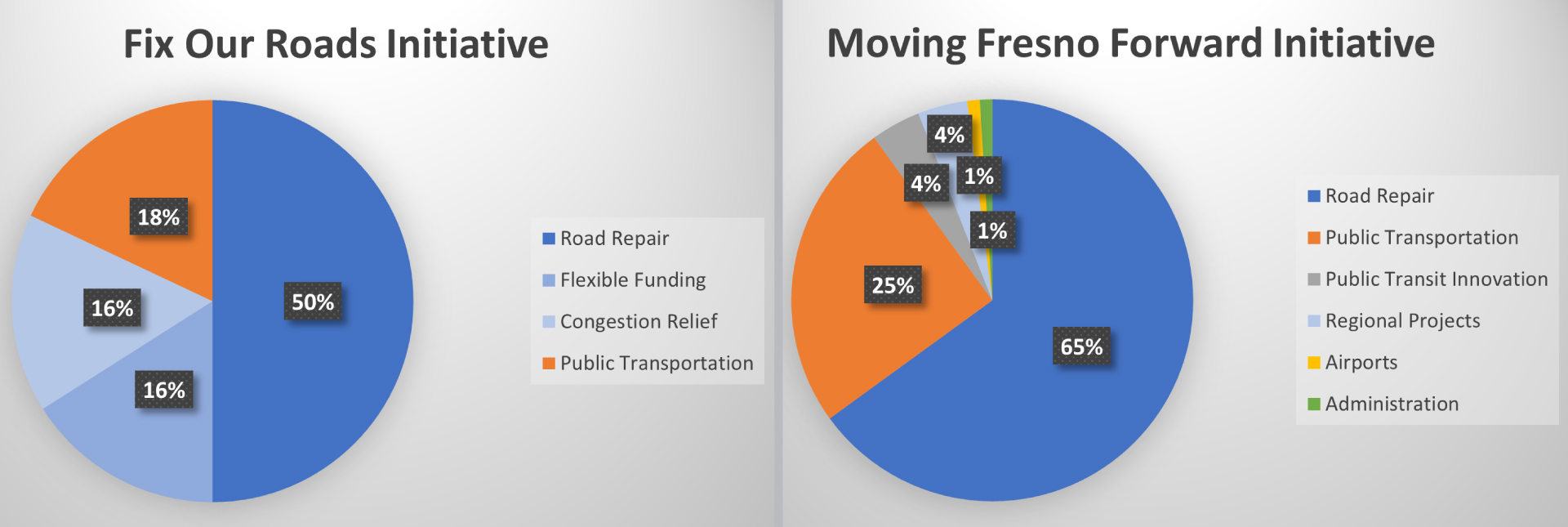
Perea said 20 years is ample time to execute a spending plan. The plan dedicates 82% to road repair, or just under $3.2 billion. It spends $702 million on transit. The plan allocates funding the following way:
82% to road repair
50% direct road repair
16% flexible funding for cities
16% to major streets and highways/congestion relief
18% to public transportation
That compares to the Moving Fresno Forward plan which allocates:
65% to road repair
25% to public transportation
4% to public transportation innovation
4% to regional projects
1% to airports
1% to administration
Moving Fresno Forward Coalition’s plan, the Fresno County Transportation Improvement Act, requires major road renovations be built as “complete streets.” That means making roadways accessible for pedestrians, bikers, or travelers using other modes of transportation.
The flexible funding allows cities to decide whether or not to invest in bike lanes or sidewalks, something the Moving Fresno Forward Coalition’s plan requires, Perea said.
Tuttle said the Fix Our Roads plan gives cities the flexibility will help both rural and urban cities.
“The folks in Fresno will be able to use their funds toward areas they need. The city of Reedley, the same. San Joaquin, the city of Fowler, county communities, we all get our fair share,” Tuttle said.
 Fix Our Roads Initiative/Moving Fresno Forward Initiative Transportation Tax Allocations. (GV Wire)
Oversight Important Following Measure P Controversy
In a statement to GV Wire, a Moving Fresno Forward spokesperson said their plan comes after meeting with “thousands of taxpayers, elected officials, and community leaders representing diverse sectors of our community.”
“There were 4,540 responses via surveys and direct feedback, 34 meetings throughout the county, and representation from 72 ZIP codes,” the spokesperson said in an email. “This is a historic and unprecedented effort that resulted in a balanced measure that doubles funding for local streets and roads, gives local jurisdictions flexibility to fix what matters most first, establishes performance metrics for the first time, and has strong public oversight and accountability standards.”
The Moving Fresno Forward plan eliminates the Fresno County Transportation Authority, deferring to the Fresno Council of Governments and a citizens oversight committee to oversee funds.
“Their plan is just throwing more money at it to see what sticks.”
— former Fresno County Supervisor Henry Perea
Perea said FCTA has ensured that Measure C money has been spent appropriately, using elected officials along with citizens to be the “keys” behind distributing taxpayer dollars.
He referred to recent allegations of embezzlement of Measure P arts money by a former Fresno Arts Council staffer as an example of insufficient oversight. The Central Valley Community Foundation supported strong community group involvement in both Measure P and now in the Moving Fresno Forward initiative, he said.
“That should send balloons up to the public’s mind because they’re taking away one of the financial guardrails of oversight of this money,” Perea said.
In a statement to GV Wire, the Moving Fresno Forward spokesperson said they have “strong and comprehensive accountability elements built into it.”
The measure creates a citizen oversight committee, requires public input for updates, and requires regular audits of spending, the spokesperson said.
Transit Consolidation Will Improve Access, Performance: Perea
Perea said despite major investment into public transit, the needle has not moved much in ridership.
The second Measure C, passed in 2006, greatly increasing funding to all three Fresno County transit agencies — Fresno Area Express, Clovis Roundup, and the Fresno County Rural Transit Agency. Despite that increase, bus trips only make up 2% of all trips in Fresno County.
The answer, Perea said, isn’t more money.
Their plan maintains funding near its current 19% allocation level, while the coalition plan increases it to 25%. In addition, the coalition’s 4% allocation to innovation is limited to public transit, effectively making it a 29% allocation.
“Their plan is just throwing more money at it to see what sticks,” Perea said.
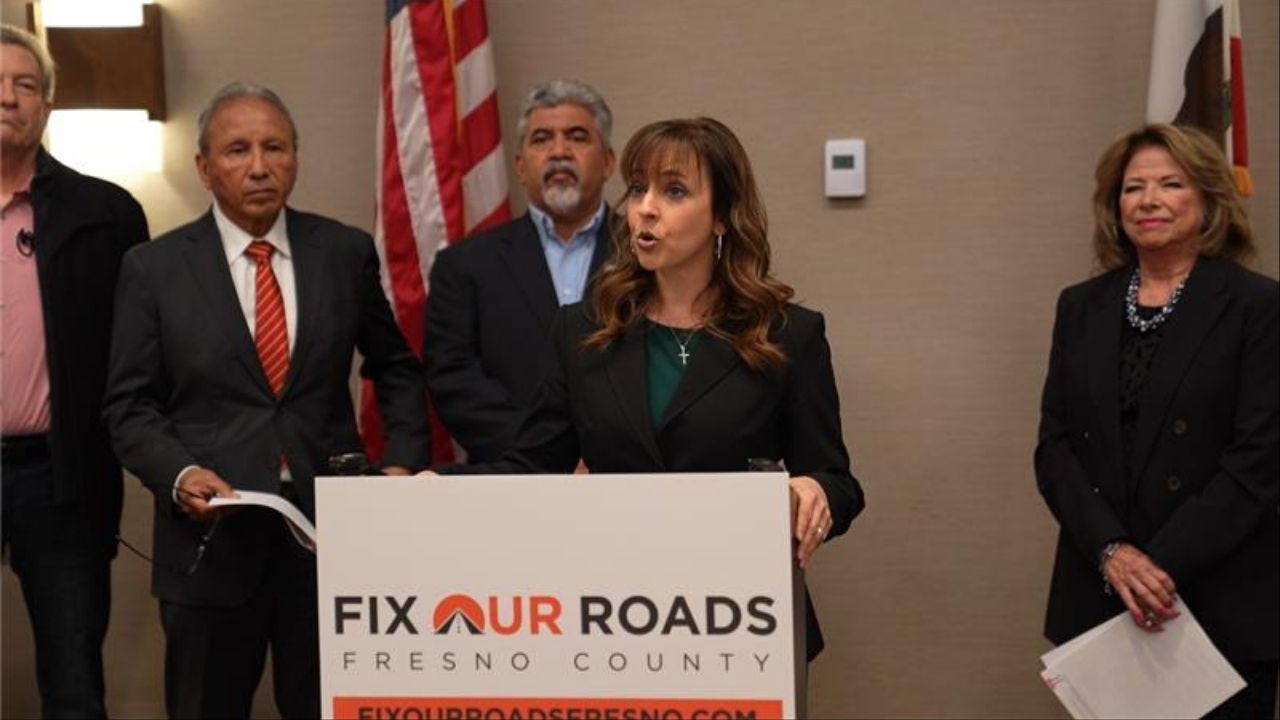 Clovis Mayor Pro Tem Diane Pearce announces a transportation tax proposal on Tuesday, Feb. 17, 2026. (GV Wire/Edward Smith)
Community groups have argued that low ridership is due to low access and long wait times, saying funding needs to be increased to make transit more attractive.
The Moving Fresno Forward plan calls on the three transit agencies to demonstrate “improvement,” whether that be increased ridership, increase in 15-minute routes, or reduced travel times.
Perea said his group’s plan would consolidate the three agencies. Getting the cities and counties to give up their agencies might be challenging, but Perea said it would lead to more innovation.
“If they’re saying it’s too hard for us to do, so instead we’re going to take more money out of your pocket to pay for a system that we all know is not effective and in the process of doing that, it will mean less money for you to fix roads in your neighborhood, I don’t know how you make that argument and think people are going to give money,” Perea said.
Regional Projects Get Funding Boost Under Fix Our Roads
The plan also allocates far more money for regional projects and congestion relief than the Moving Fresno Forward plan — 16%. Mohammad Alimi, design division manager with Fresno County, told GV Wire that many regional projects need widening such as Millerton Road, Herndon Avenue, Shaw Avenue, Temperance Avenue, and McCall Avenue.
The city of Fresno is also looking at widening the Shaw Avenue and Highway 99 interchange.
Alimi said the 4% in the Moving Fresno Forward plan does not adequately address those needs. The coalition plan also requires that before any road widening can be done, every county road must meet an average 70 pavement condition index, something Alimi said was not realistic.
New roads must also be built as “complete streets,” meaning they come with sidewalks and bike lanes, regardless of where they are.
Alimi said the Fix Our Roads expenditure plan is “more efficient and practical.”
“The implementing procedures under this proposal contain fewer restrictions, making implementation more efficient and practical,” Alimi said.
Moving Fresno Forward Plan Overly Mandates Minimum Spending on Small Communities: Alimi
Another restriction is on county roads. The Moving Fresno Forward plan requires that the worst roads be prioritized first, regardless of how much they are used.
For the county, rules mandate that between 12% and 15% of funding go to disadvantaged, unincorporated communities, according to language within the ordinance that GV Wire acquired.
Alimi told GV Wire that amount disproportionately favors a small amount of the county’s population. Many of the groups within the Moving Fresno Forward coalition advocate for those disadvantaged communities.
“Given that residents in DUCs account for less than 8% of the county’s population and these communities have less than 2% of the county’s road miles, this adjustment results in an overallocation that negatively affects other county residents,” Alimi said.
Riojas said when he was working on what would become the Moving Fresno Forward plan, he could not agree with many of the implementation requirements. He said people need to read what goes into the two measures.
“Do your research, look into what you’re signing, look into what you’re going to be promoting because it does set the table for the next 20 years for the Central Valley,” Riojas said.