

An essential component of violence prevention work in Oakland schools is at risk if Oakland Unified School District — or the city — can’t find a new source of funding soon.
For nearly four years, the city of Oakland, through its Department of Violence Prevention, has funded violence interruption and prevention teams at several OUSD high schools with lower graduation rates and higher rates of chronic absenteeism, including at Castlemont High School, Fremont High School, McClymonds High School, Dewey Academy, Ralph Bunche Academy, and Rudsdale High School. After notable results in the first year, including a reduction in suspensions for violence, OUSD expanded the program by funding teams at Skyline High School and Oakland Technical High School, the district’s biggest schools, starting in the 2024-2025 school year.
But the city only committed funding through the current 2025-2026 school year, and city leaders made it clear that this was a pilot program they would support for the first few years and then hand over to the district to build into its budget or seek outside funding. That funding cliff has arrived just as OUSD navigates a serious budget deficit and needs to trim $100 million from next year’s budget.
School communities that have experienced violence in recent years are worried the district’s multi-faceted approach to safety will suffer without an investment in continuing this program.
“Right now, the most urgent thing is the impending end of funding,” said Laura Blair, a parent at Skyline High School, where a student was shot on campus in November. “Overall we want a larger systemic improvement to violence prevention.”
The city provided more than $8 million over four years to support school-based violence interruption and prevention teams, which include a violence interrupter, a life coach, and a gender-based violence specialist. The violence interrupter intervenes when conflict is imminent and holds mediation sessions with youth who have experienced violence — or school staff have identified as at risk. The gender-based violence specialist works with young people experiencing domestic violence or sex trafficking, and hosts trainings and workshops for students and staff on sexual harassment, exploitation, and dating violence. The life coach meets with selected students to develop personal goals, which can include getting a driver’s license, seeking a job, receiving mental health services, or pursuing higher education.
Youth Alive, one of the primary nonprofit organizations staffing these teams, conducts violence interruption work in neighborhoods and in schools with a similar model. The idea is to be there before and immediately after a conflict occurs, said Joe Griffin, the executive director of Youth Alive. Being in the same school every day allows them to get familiar with students and staff there.
“There’s more opportunities to build these trusting relationships so a young person comes to you when they fear that violence is going to happen on campus,” Griffin told The Oaklandside. “There’s more opportunities for us to connect with administrators and teachers who may be able to say, ‘These are the young folks we have the most concern for, who we’d love you to give life coaching to and work with them on developing their goals.’”
Central to Youth Alive’s approach to violence interruption is hiring individuals who come from the communities they work in, who have spent time in prison, and who have made positive changes in their own lives.
“They’re a familiar face, you’ve seen them around and most importantly, you’ve seen their turnaround,” said Paris Davis, Youth Alive’s intervention programs manager. “People feel more comfortable with people they know or that they’ve seen in their environment.”
Future of funding is unclear
A report from the Urban Institute, a Washington D.C. think tank that evaluated OUSD’s school violence intervention teams, found that among students receiving life coaching, 47% met all of their goals and another 10% met at least one of their goals. The report found that in schools who were assigned teams, a higher proportion of students surveyed said they knew where to go to get help with a problem and said they felt safer than they did before. Schools with violence interruption teams saw a more than 10-point drop in chronic absenteeism. They also saw a decrease in suspensions for violence, while such suspensions increased at schools without teams in place.
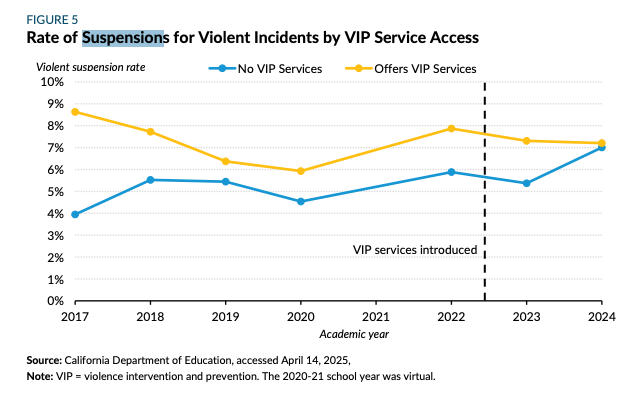 A November 2025 Urban Institute report analyzed the pilot Violence Interruptor Program (VIP) in Oakland public high schools and found a drop in suspensions for violence. Source: The Urban Institute
The report recommended that OUSD assign specific staff to support the teams and better communicate about the teams’ roles with existing staff. It also noted that information about the impact of the violence interruption teams on chronic absenteeism and suspensions would be strengthened with more years of data.
Ideally, pilot programs should begin with a five-year commitment to fairly evaluate their impact, Davis said.
Options for continuing the program beyond this year are unclear, Griffin said. OUSD hasn’t made a commitment to fund the program out of its own budget, he said, and Youth Alive may be on its own to find a funding source.
Valarie Bachelor, the school board director representing District 6, which includes Skyline, challenged the idea that OUSD alone should be responsible for funding the program going forward, since violence prevention staff are often mitigating issues that students are dealing with in their communities that then spill into school buildings. She also said she was taken aback by the abbreviated timeline to find a new funding source.
“In my opinion, violence prevention is a citywide effort, not just a school effort,” she said.
“To me, it seems the easiest, since the city already has these relationships with contractors and agencies, to at least have a one year extension so there can be more time devoted to this.”
Bringing the high school program to an end could have implications for public safety in Oakland as a whole, Griffin said. With crime rates dropping in Oakland, he said, now is not the moment to pull back on investments.
“If we don’t fund this, we lose an opportunity to keep our young people safe and help them heal from the trauma they’ve experienced,” Griffin said. “Can we afford to not invest in this? Right now when we see that something is working in Oakland?”
The school board doesn’t approve its budget for next year until June. This month it is expected to take a major step toward developing that budget by approving a list of positions to be eliminated next year, many of which will be roles at the central office, which could further reduce the district’s capacity to manage its safety strategies.
“The idea of being able to carve out additional new dollars to fund these vital programs is going to be very difficult when we don’t know if we even have enough dollars to maintain core programs and stay solvent,” said Mike Hutchinson, the OUSD board director for District 4, who graduated from Skyline. “No matter how important something is, if we don’t have the money we don’t have the money.”
“*” indicates required fields