
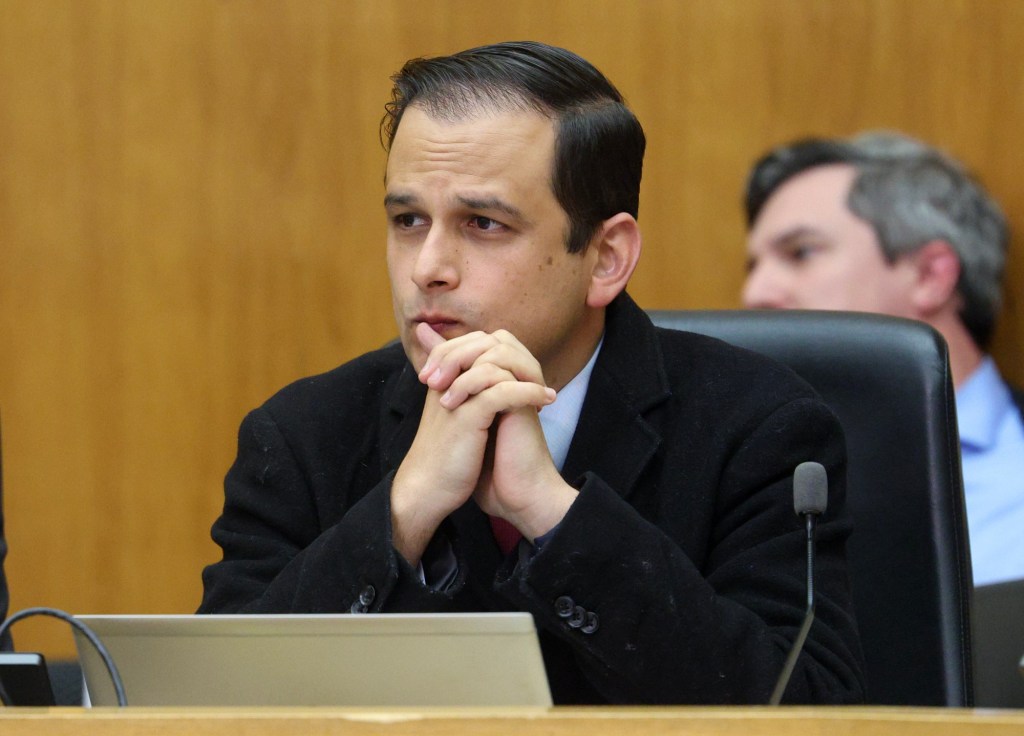
Councilmember Raul Campillo’s attempt to make it more difficult for San Diego to impose higher-than-expected fees on city residents will get a long-awaited first public hearing Wednesday.
Campillo, who initially proposed the new policy in November, said the three-month delay gave him the opportunity to significantly strengthen his proposal — with some help from former City Attorney Jan Goldsmith.
The effort, which the council’s Rules Committee is scheduled to debate Wednesday, was prompted by San Diego’s new trash pickup fees for single-family homes, which ended up much higher than expected.
Before voters considered the 2022 ballot measure that allowed the new fees, city officials had estimated they would ultimately be in the range of $23 to $29 per month, based on a relatively limited analysis.
A more thorough analysis conducted after voters had already approved levying the fees determined they needed to be much higher for the city to cover its costs. The council eventually approved a monthly fee of $43.60 last spring.
Campillo and other critics call that shift a bait-and-switch, and Campillo’s proposal seeks to prevent a repeat by requiring any ballot measure that could create a new fee — or raise an existing one — to undergo a comprehensive analysis long before voters weigh in.
In November, Campillo’s proposal would only have forced the council to publicly consider whether to perform such an analysis before or after the election.
While his proposal would still have allowed the council to delay the study until after the election, the thought was that they’d face criticism from voters for doing so and political pressure to do the analysis before the election.
But based on advice from Goldsmith in a Dec. 12 opinion piece in The San Diego Union-Tribune, Campillo’s updated proposal would require — before any election that could create or hike a fee — either a full-blown cost-of-service study or a somewhat less rigorous economic impact analysis.
In his opinion piece, Goldsmith called it a “huge loophole” that Campillo’s initial proposal would still have allowed a fee analysis to take place after the election. Goldsmith suggested that the revised policy should require a maximum amount for any new fee that couldn’t be exceeded without subsequent voter approval.
Campillo didn’t ultimately go that far, instead choosing to require an economic impact analysis if the council declines to do a full cost-of-service study.
Campillo called Goldsmith recently to thank him.
“I instructed my staff to close the loopholes that you pointed out in the original draft,” he told Goldsmith in a voicemail shared with The San Diego Union-Tribune. “Just wanted to reach out and say thank you for the suggestions and for analyzing the policy so closely.”
The proposal would exempt citizens’ initiatives from the new requirements. The goal is to avoid requiring citizens to complete financial studies they likely lack the resources to complete.
A second element of Campillo’s proposal would revamp how people can protest fee increases, such as sewer and water rate hikes.
His proposal would create new requirements for the protest notices now sent to sewer and water customers before rate hikes, which are approved by the City Council instead of being created by ballot measures.
The notices would have to say prominently on the first page that a rate increase is coming and that residents can protest it. The notices would also need to have a simple, easy-to-find protest form.
“It is in the city’s best interest that property owners that are asked to pay a new or increased fee understand basic information about what is being proposed and about what their rights are in the process,” Campillo said.
While both proposed changes may seem technical, the council member said they were extremely important.
“These are not small adjustments — they fundamentally shift the process toward transparency, accessibility and fairness,” Campillo said.
The first hearing for Campillo’s new proposal was delayed from November because the Rules Committee fell short of a quorum before the proposal could be debated.
But support for the effort could be scarce on the Rules Committee, where two of the five members — Joe LaCava and Sean Elo-Rivera — spearheaded the trash fee measure.
The trash fees for single-family homes, which had gotten no-fee service for decades, became even more contentious last spring when the pre-election estimate of the fees proved way off the mark.
Before the November 2022 election, when voters approved Measure B to let the city start charging for trash pickup, the city’s independent budget analyst estimated the new monthly fees would likely fall somewhere between $23 and $29. That estimate — called a fiscal impact statement — appeared in ballot materials.
After a consultant spent nearly two years determining what the actual cost would be, city officials announced last February that monthly bills would be $53. But backlash from the public and the City Council ultimately prompted city officials to reduce that to $43.60.