
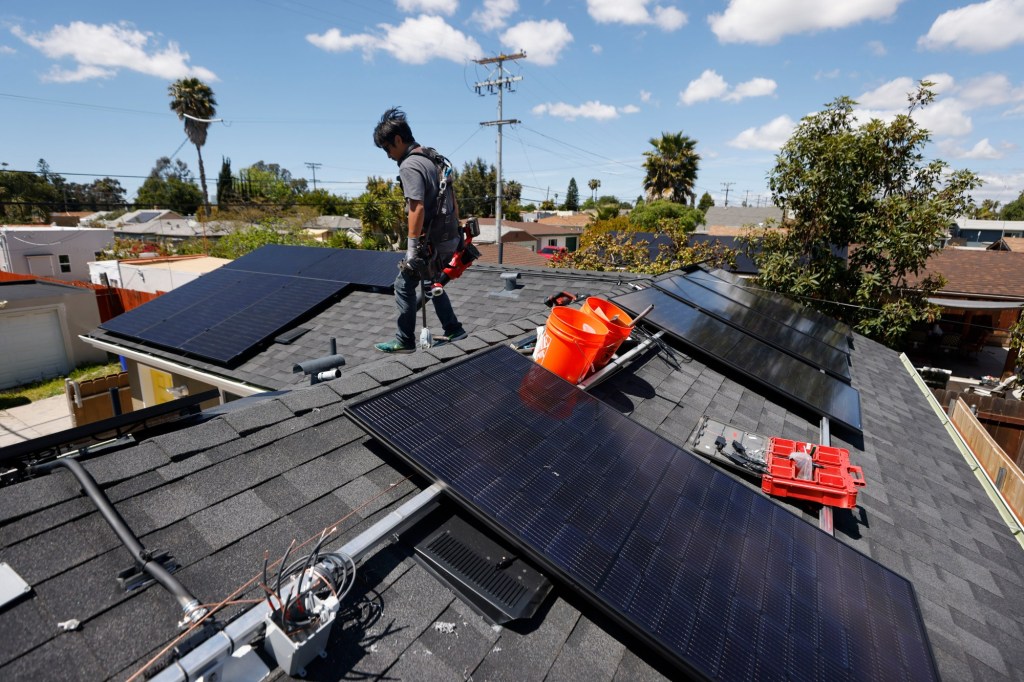
Parties on both sides of a long-running debate over the California Public Utilities Commission’s controversial overhaul of rooftop solar regulations are anxiously awaiting a ruling from the state’s court of appeals.
Depending on what conclusion the justices reach, the decision may alter the rate of compensation that at least some of the roughly 2 million Californians with solar installations on their homes and businesses receive when their systems generate excess electricity.
The decision may come down within the next couple of months. But if the court of appeals wishes to hear oral arguments, the ruling will be issued later in the year.
“There’s a lot hanging on this one,” said Roger Lin, senior attorney for the Center for Biological Diversity, one of three environmental organizations that took their case to court against the public utilities commission, or CPUC.
The decision could overturn, make revisions or simply keep in place what’s now on the regulatory books.
How we got here
The case stems from a decision the CPUC made a little more than three years ago regarding the third iteration of California’s Net Energy Metering tariff program, colloquially known as NEM 3.0.
Under a net energy metering billing mechanism, customers with rooftop solar receive credits that are applied to their utility bills when their systems produce excess power.
In December 2022, the CPUC’s five commissioners unanimously voted to update the state’s rooftop solar regulations. The complicated 260-page decision included incentives to encourage customers to pair their solar installations with battery storage systems.
But the new rules included a revision mandating that new rooftop solar customers will no longer be credited at the retail rate of electricity when their systems generated surplus energy. Instead, they get paid at the “actual avoided cost,” which is lower.
The CPUC’s commissioners said the updated framework, which went into effect in April 2023, sends “more accurate price signals that encourage electrification” across the state.
But opponents said reducing the rate of compensation undercuts the incentive for potential customers to put solar on their roofs because it will take longer to recoup the tens of thousands of dollars customers typically spend to install the systems.
The Center for Biological Diversity, the Environmental Working Group and San Diego-based Protect Our Communities Foundation filed suit, challenging the new tariff rules.
Despite initially losing in the court of appeals, the environmental groups took their case to the California Supreme Court. And in August 2025, all seven justices at the high court said the appeals court afforded the CPUC too much latitude when the commission passed NEM 3.0.
In its 18-page decision, the state Supreme Court said it was not concluding the new solar rules are “correct or incorrect — only that the Court of Appeal erred in applying an unduly deferential standard of review to reach that conclusion.”
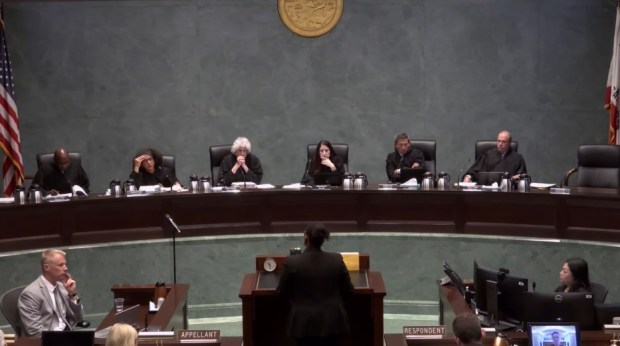 The California Supreme Court hearing oral arguments on June 4, 2025 on a case regarding the California Public Utilities Commission’s decision in Dec. 2022 to revise Net Energy Metering rules for solar installations in the state. (Supreme Court of California webcast)
The high court kicked the case back to a panel of three appeals court justices in San Francisco, and that’s where it now stands.
Both the CPUC and the environmental groups have submitted multiple briefs before the appeals court. So have the state’s three big investor-owned utilities — Pacific Gas & Electric, San Diego Gas & Electric and Southern California Edison — who are listed as parties of interest on the side of the CPUC.
When will a decision come?
After receiving arguments and responses from each respective side by Jan. 12, the appeals court can issue a decision within 90 days — which means a ruling may come down any time between now and mid-April.
However, last week the environmental groups submitted filings that requested the panel conduct oral arguments before rendering a decision.
“This is a complex case,” Lin said. “There are statutory interpretation questions that have to be discussed and we think it would be helpful for the court to have oral arguments.”
If the justices agree to hear oral arguments, the 90-day clock gets re-set, possibly pushing a final decision back to as late as October.
The arguments of the opposing sides
Environmental groups point to the passage of 2013’s Assembly Bill 327 by the state Legislature that includes a provision directing that any NEM tariff put into place by the CPUC “ensures that customer-sited renewable distributed generation continues to grow sustainably” across California. That provision is also a statute in the Public Utilities Code.
The petitioners say NEM 3.0 violates the statute and the Legislature’s intent.
They also say it doesn’t go far enough to encompass AB 327’s directive that solar tariffs “include specific alternatives designed for growth among residential customers in disadvantaged communities.”
“It’s a long-held tenet in the law that the courts have the last say on what a statute means,” said Lin of the Center for Biological Diversity. “And this case stands for making sure that keeps happening with this commission that, unfortunately, has turned out to be a runaway agency in recent times, especially for the utilities in regards to local generation opportunities like rooftop solar.”
The CPUC’s attorneys counter by saying the statute in the Public Utilities Code calls for the commission to weigh the pros and cons of any new rules.
“The Commission did exactly that,” when it passed NEM 3.0, California Attorney General Rob Bonta and Deputy Solicitor General Mica Moore said in their supplemental response brief to the appeals court. “It conducted a cost-benefit analysis for the successor tariff, and used the results to inform the design of the tariff.”
The brief goes on to say the CPUC structured the tariff “so that it allows customers who install rooftop solar to pay back the upfront cost of installation within about nine years.” Notwithstanding the state Supreme Court’s earlier ruling, “the Commission is entitled to significant deference” and the “limited issues before the (appeals court panel) provide no basis to set aside” the NEM 3.0 decision.
One of the major factors behind the NEM 3.0 tariff is the “cost shift” debate.
The investor-owned utilities have long argued that the growing number of rooftop solar installations leaves customers who don’t have solar paying an unfair share of the fixed costs that come with maintaining the electric system — substations, transformers, poles and wires, etc.
In the runup to the NEM 3.0 decision, the Natural Resources Defense Council, an environmental group, and some consumer groups, including the California Public Advocates Office, the independent arm of the CPUC, said the cost shift issue needed to be fixed.
“The cost shift had grown to $3.4 billion per year” when the CPUC started proceedings that led to the NEM 3.0 tariff, the brief by Bonta and Moore said.
Others dispute the cost-shift argument, saying it does not properly take into account the benefits of rooftop solar, such as reducing the need for utilities to spend ratepayer dollars on building more infrastructure.
In their response brief, the attorneys for the three environmental groups called the cost shift “a spurious distraction” that ignores “the real cost drivers” of higher electricity bills — “that utilities are inherently incentivized to increase their profits” by investing in capital and transmission projects.
Who is affected by the rules now in place?
As currently written, NEM 3.0’s rules apply only to customers who had their systems installed in April 2023 or later.
Solar customers who had their systems installed under earlier iterations of the tariff still get compensated at the retail rate for 20 years from the time their systems became operational before the new rules affect them.
For example, a customer who had a system installed in 2018 gets credited at the retail rate until 2038. But after that, the customer will be credited at the lower NEM 3.0 rate.