
For more than 80 years, the block on Fourth Street between University and Hearst avenues has been covered in pavement.
Spenger’s Restaurant first laid asphalt there in 1946 to provide parking for the steady drumbeat of customers who came for fresh fish and clam chowder. Later it became a parking lot for Fourth Street shoppers.
Soon the asphalt will be gone, a major step toward transforming the parcel into an Indigenous-controlled space honoring ancestors, nature, culture and the 5,000-plus year history of Ohlone people on the shores of San Francisco Bay.
It’s part of the “Let the Land Breathe!” campaign put on by the Sogorea Te’ Land Trust, which acquired the land, part of the wider West Berkeley shellmound, in 2024.
“It’s a first iteration of people actually seeing it as a green space, not a parking lot,” said Corrina Gould, co-founder of Sogorea Te’ and chair of the Confederated Villages of Lisjan. “Imagine taking up the asphalt, covering it with soil, covering it with California native flowers and plants, and allowing the time for people to reimagine something else that could be in this space.”
The transformation is funded by the fast rise of Sogorea Te’, which over the past five years has become one of the wealthiest Indigenous urban land trusts in the nation, with $54 million in assets. The trust raised $1 million in just three months toward removing the pavement, much of it from a single Zoom call, said Gould.
“Donors decided that they wanted to be a part of this historical event,” she said.
The West Berkeley shellmound site is one of the trust’s most visible and symbolic properties — a testament to Sogorea Te’s ability to marshal resources and public support for Indigenous land reclamation.
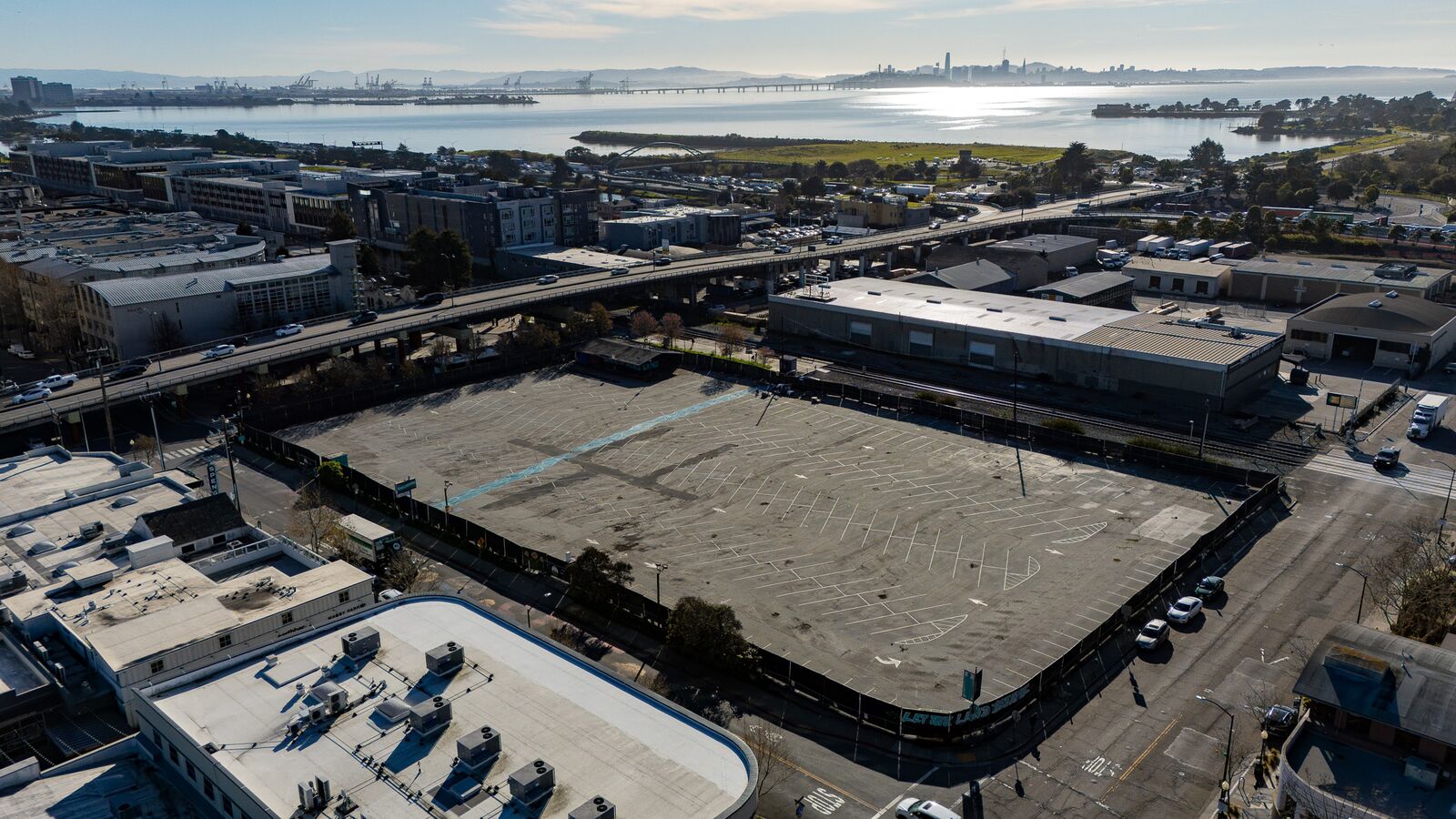 A recent aerial view of the Fourth Street parking lot, transferred to Sogorea Te’ in 2024. Members of the land trust have painted a blue creek across the lot. Credit: Sara Martin for Berkeleyside
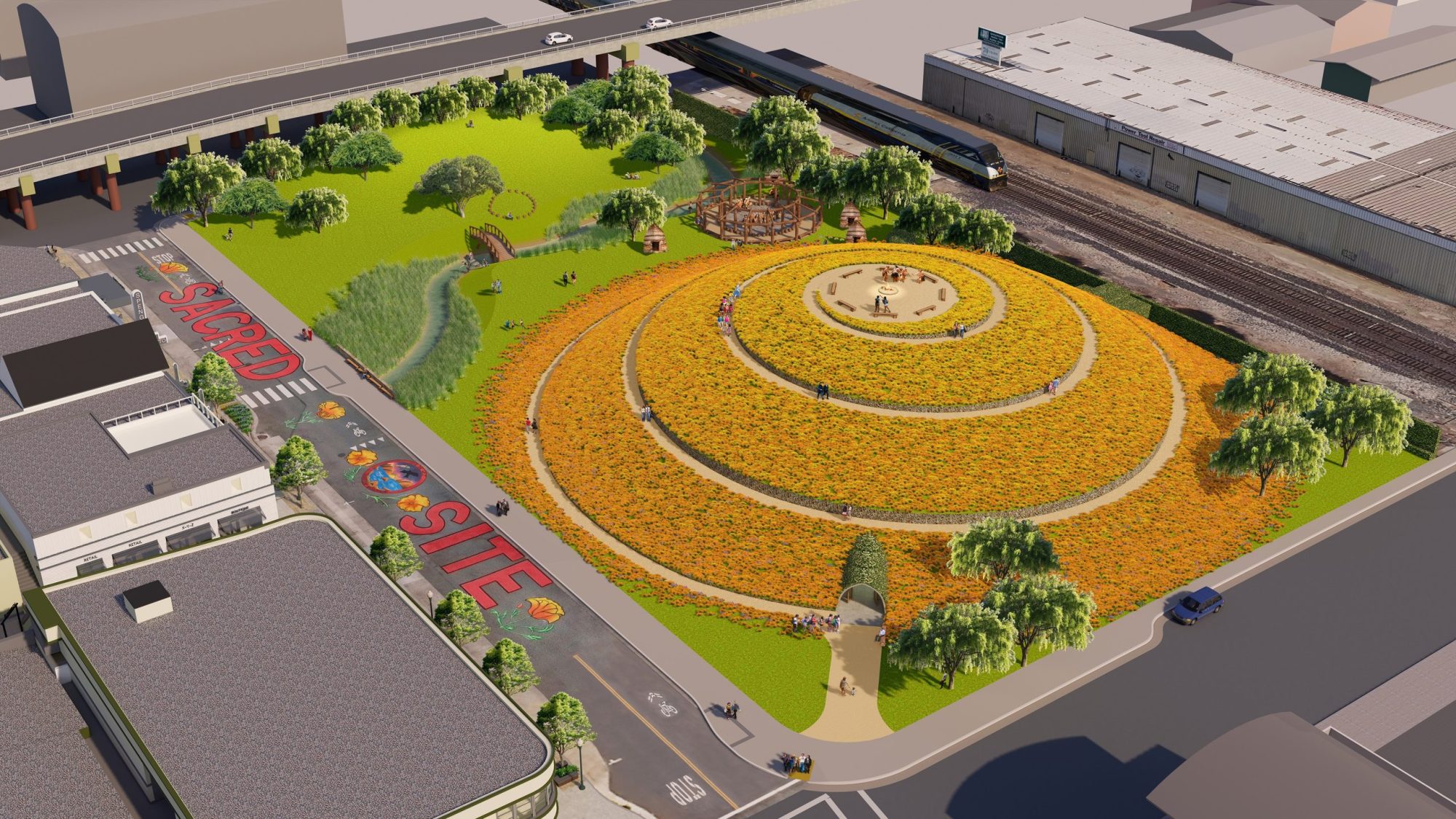 Chris Walker, a landscape architect, worked with Gould and others to create a conceptual plan for the shellmound site. Preliminary plans call for the daylighting of Strawberry Creek and the creation of a tall mound resembling the 30-foot shellmound that once rested nearby. A cultural center would be inside the mound. Courtesy of Walker
Eventually, the trust hopes to daylight Strawberry Creek and route it through the property, build gardens, a cultural center, ceremonial spaces and even rebury the bones of ancestors now stored in UC Berkeley’s Hearst Museum. The price tag could top $80 million, although that is a rough estimate as plans are still forming, said Toby McLeod, a filmmaker who worked with Gould and many others for eight years to return the shellmound site to Indigenous control.
The speed at which donors stepped up to help the nonprofit group transform the shellmound site, as well as other successful fundraising efforts, reflects Sogorea Te’s growing prominence. Founded in 2012, it now owns nine properties in the East Bay, and stewards others, many acquired through long-term leases, legal agreements, and gifts from private individuals or organizations. They include a community garden on Ashby Avenue between Mabel and Acton streets, 43 acres in the East Bay hills, five acres in Joaquin Miller Park, a quarter acre by I-880 in East Oakland, an acre along San Lorenzo Creek in Castro Valley, a park in Richmond, and three houses in Oakland. The city of Oakland is poised to grant $844,000 to Sogorea Te’ so it can acquire and preserve 16 acres of the Sausal Creek watershed.
Its largest property is the shellmound site, which the city of Berkeley bought in March 2024 for $27 million after a long legal battle and transferred to Sogorea Te’. The trust contributed $25.5 million of the purchase price, most of it coming from a $20 million contribution from the Kataly Fund, a family foundation funded by Regan Pritzker of the Hyatt hotel chain and her husband, Chris Olin. Berkeley donated $1.5 million to the purchase, on top of the $4.8 million in fines and legal fees it paid to fight a proposal from the previous owner, Ruegg & Ellsworth, to build housing and shops on the site. In total, Berkeley taxpayers contributed $6.3 million to the project.
Sogorea Te’ was born of a dream by founders Gould and Johnella LaRose to create plots of land throughout the Bay Area where, as Gould put it, “we can grow food and we can tell our own stories and train young people to tell the stories of the land.” Indigenous land stewardship, she said, would address environmental degradation and give people hope for “a different way of living as human beings.”
Sogorea Te’s team of 30, along with volunteers, grows traditional and medicinal plants like sage, mugwort and soap root on various sites and holds workshops to return the cultural knowledge lost when the Spanish, Mexicans and Americans enslaved Native people, forced them into the mission system and confiscated their lands. The trust teaches resiliency through cooking workshops and Chochenyo language workshops for the Lisjan Ohlone community. They hold ceremonies on some of the sites and have created an emergency response hub with a rainwater catchment system. Sogorea Te’ has led walks from the West Berkeley shellmound site to the Bay Street Mall in Emeryville, which was built on what was once the region’s largest shellmound, to call attention to the rights and culture of Indigenous people.
The 2.2-acre plot on Fourth Street sits in an area that once was an Ohlone Village where Strawberry Creek emptied into the bay. Shellmounds, which once dotted the bay, were made over thousands of years as Native people deposited clam, mussel and oyster shells, fish and animal bones in one place. They were used as lookout spots and served as ceremonial and burial sites. Over a 60-year period, Berkeley’s shellmounds, the biggest of which sat near Second Street and Hearst Avenue, were razed and sold as garden fertilizer, chicken feed, and material for grading for dirt roads. Native bones were uncovered across the street as recently as 2016.
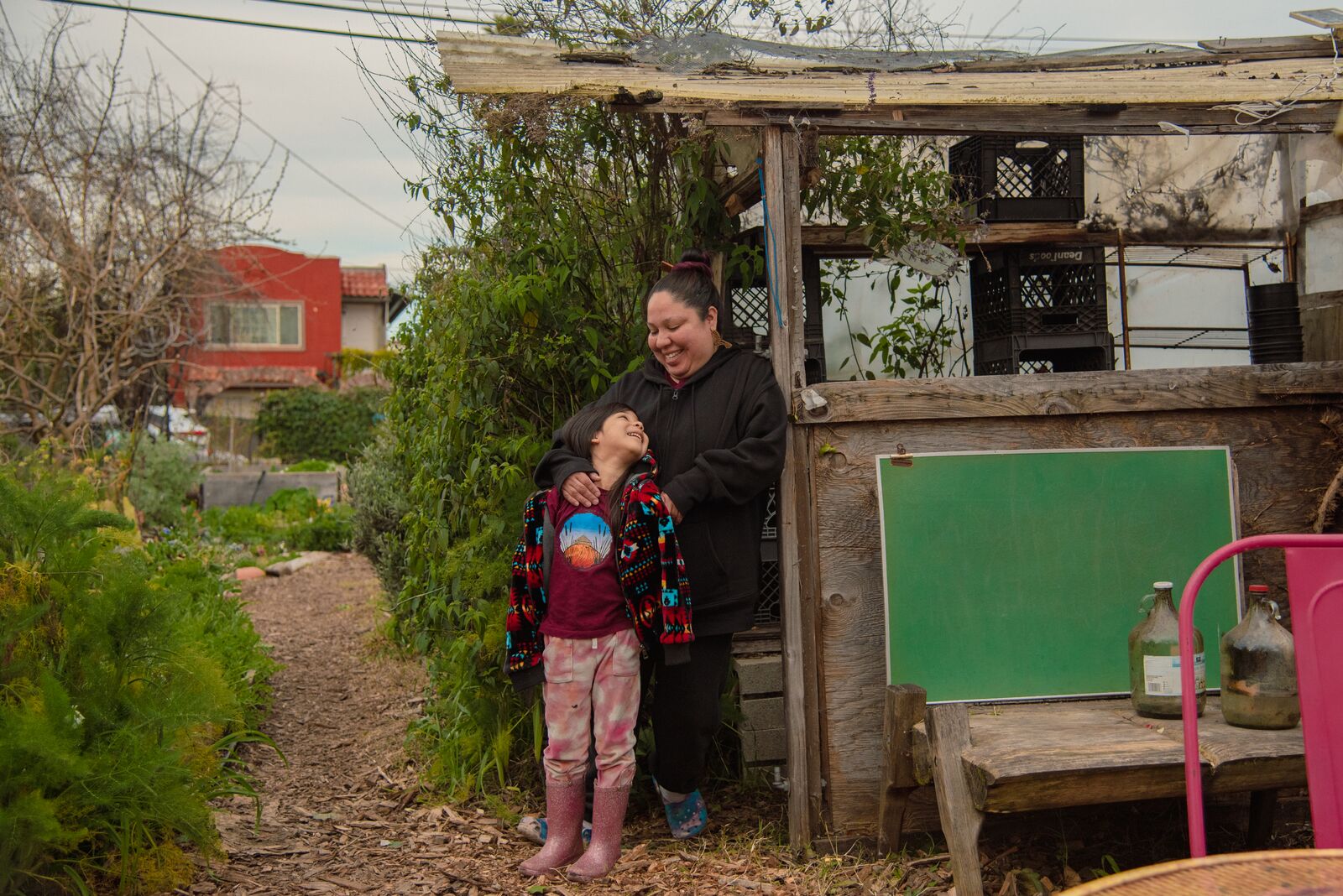 Corrina Gould’s daughter Deja and granddaughter Amné at Sogorea Te’s community garden in Berkeley. An anonymous donor paid $435,000 to buy the Ashby Community Garden and gift it to the land trust. Credit: Ximena Natera/Berkeleyside
“How do we begin to dream into this world something that hasn’t been here, but we know is underneath this asphalt?” Gould asked about the shellmound in a recent interview with Berkeleyside. “How do we listen to the ancestors? … It’s a big responsibility, not just for myself, but for the future generations. I have to make sure that whatever I do in this lifetime for that particular site is something that’s going to be good, that’s something that’s going to be sustainable, that’s going to outlive many, many generations of people.”
To celebrate the completion of the first phase of the “Let the Land Breathe” campaign, members of Sogorea Te’ painted a creek across the center of the lot and sprinkled seeds into nearby cracks. They danced and Gould joyfully drove a pickup truck around while flying a flag that read “Rematriate the Land.” Staff made it into an upbeat video for social media.
Shuumi land tax has driven parade of donations and institutional gifts
Sogorea Te’s success has been rapid. It only incorporated as a tax-exempt foundation in 2019 and raised about $700,000 that year, according to tax filings. In 2024, it raised $11.7 million in donations, driven partly by the push to acquire the shellmound site, according to Ariel Luckey, the land trust’s development director. In 2025, the trust brought in around $5.5 million. It is governed by a four-person board of directors. The trust is intertribal and entirely women-led.
Much of Sogorea Te’s financial success appears to stem from a concept called the shuumi land tax, which Sogorea Te’ debuted in 2015. The name comes from the Chochenyo word for “gift.”
Not a tax in a legal sense, the fundraising mechanism is modeled after a similar idea, called an Honor Tax, from the Wiyot Nation, a federally recognized tribe in Northern California.
People can use a simple calculator on Sogorea Te’s website to determine their suggested shuumi contribution based on rough estimates of wealth, such as their monthly rent or the number of bedrooms in their home. If you own a two-bedroom house, for example, you’re prompted to donate $309.13 per year, including fees.
In effect, it’s an annually recurring donation, a standard tool of nonprofit fundraising.
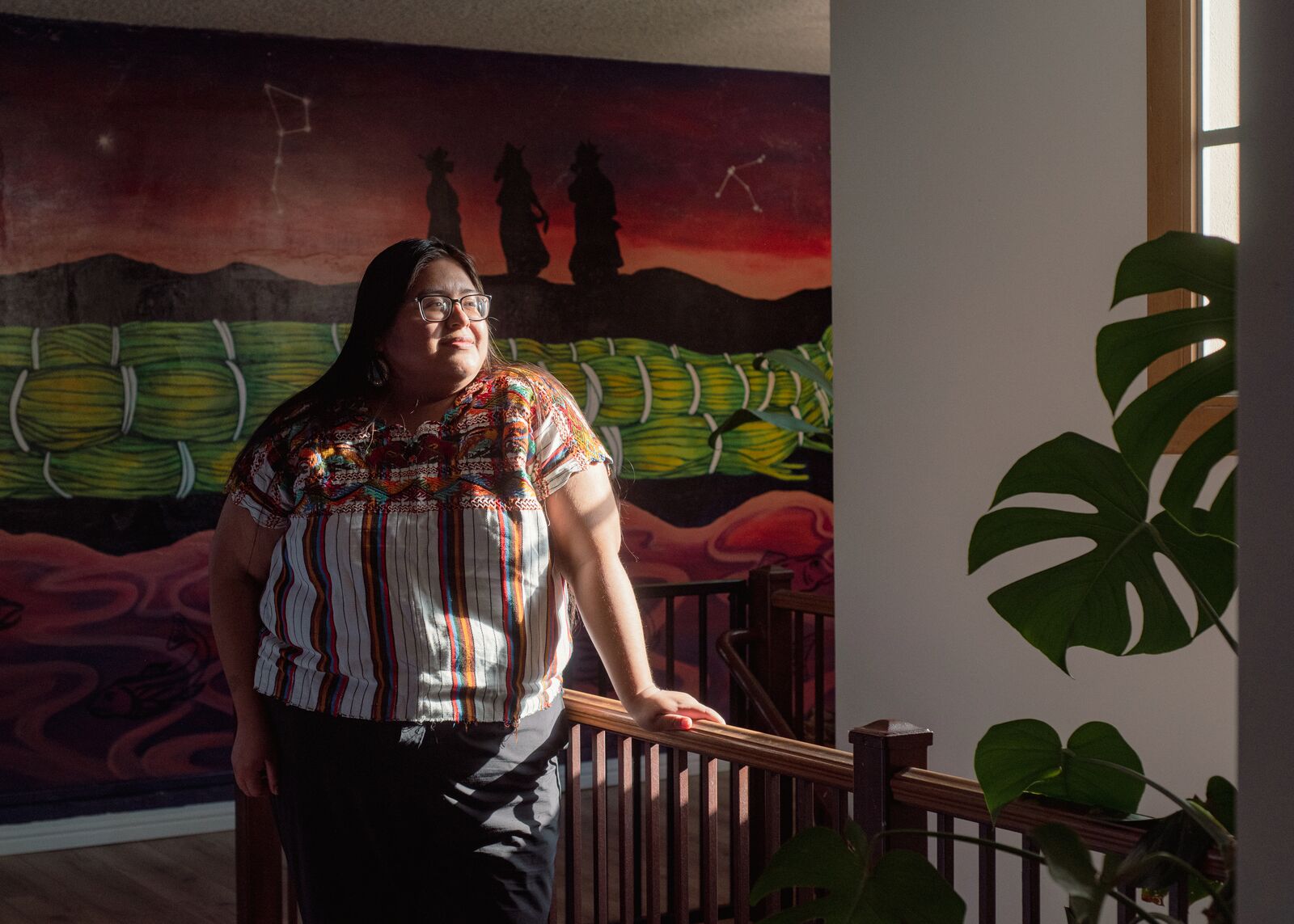 Sharon Marcos, who identifies as Q’anjob’al Maya, is an office administrator for Sogorea Te’, one of around 30 staff members of the nonprofit. Credit: Ximena Natera/Berkeleyside
But Sogorea Te’ connects shuumi with the larger struggle for Indigenous land sovereignty — positioning shuumi as a way for non-Native people living on the Confederated Villages of Lisjan’s territory — Alameda, Contra Costa, Solano, Napa and San Joaquin counties — to acknowledge the devastation wrought by colonial governments and recognize Native sovereignty.
“Living here, you are inadvertently benefitting from the genocide waged against the Ohlone people and the theft of their land,” reads a statement on the Sogorea Te’ website. “Paying the Shuumi Land Tax is a small way to acknowledge this history and contribute to its healing, to support the Ohlone community’s current work to create a vibrant future.”
In 2019, Sogorea Te’ began seeking shuumi from institutions — businesses, nonprofits, schools, city governments, religious organizations and foundations — and created a separate calculator based on annual revenue or operating budget. The decision has generated far and away the most revenue for Sogorea Te’. Both Alameda and Albany have paid the tax.
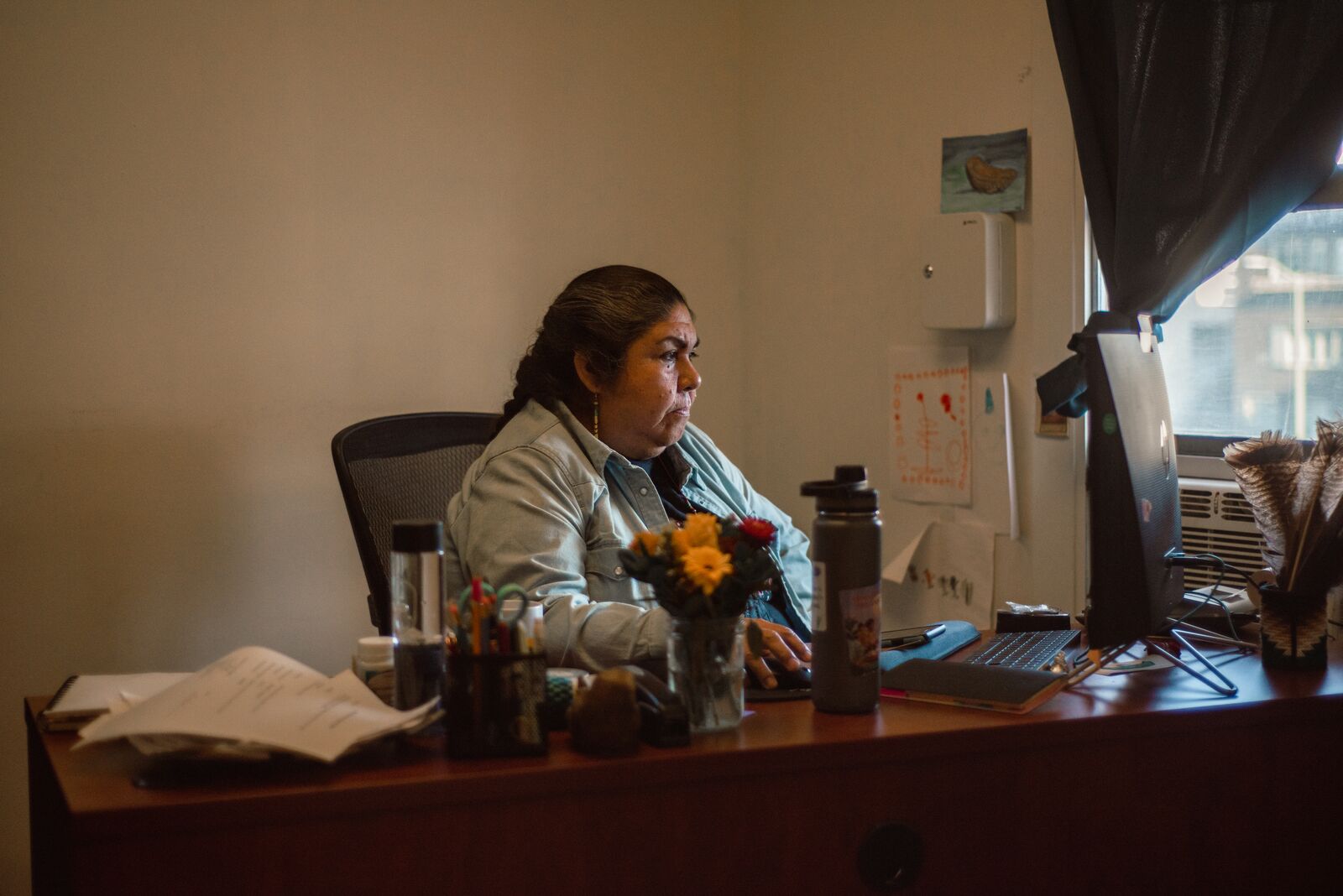 Gould in her Oakland office in 2024. Credit: Ximena Natera/Berkeleyside
Gould has been an effective champion for the tax, regularly talking to city leaders, government agencies and community groups about the history of the Ohlone people and the importance of returning land to Indigenous control. Gould, who grew up in Oakland and is a mother and grandmother, fought her first battle to preserve sacred ground in 1999, when she and others succeeded in stopping a construction project in Vallejo that would have destroyed a 3,500-year-old Karkin Ohlone village and burial site known as Sogorea Te’.
“She is both a born and practiced leader,” said former Berkeley Councilmember Sophie Hahn, who was instrumental in getting the shellmound site turned over to Sogorea Te’. “She is deeply, deeply committed to her cause. She is not in this for anything other than doing what she and, I believe a lot of the rest of the community believes, to be the right thing.”
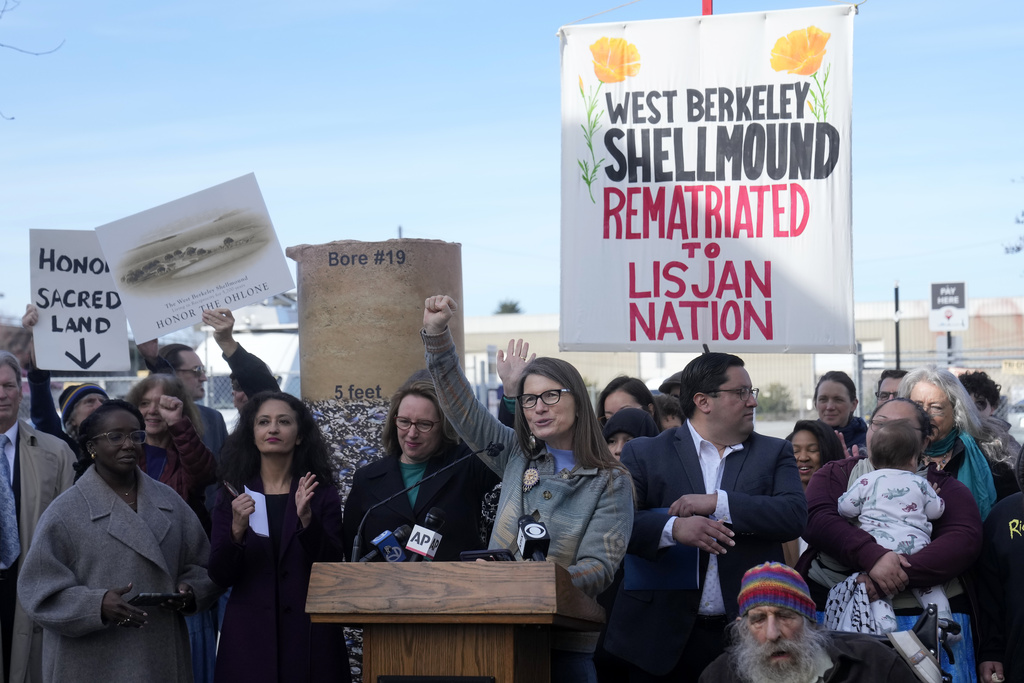 Melissa Nelson, chair of Sogorea Te’s board, raises her arm at a 2024 press conference after Berkeley transferred the Fourth Street parking lot to the land trust. She stands between Sophie Hahn, then a Berkeley council member, and Jesse Arreguín, then the city’s mayor. Credit: AP/Jeff Chiu
For the last three years, around 5,000 people and nearly 100 institutions paid shuumi to Sogorea Te’, according to Luckey. The concept is so popular that it has become its own social movement of sorts. “Pay Shuumi” yard signs dot lawns around Berkeley and Oakland. A progressive synagogue in the Grand Lake neighborhood in Oakland invited people to pay shuumi alongside their annual membership dues. A local publishing company included postcards advertising shuumi in the books they sell. Non-Indigenous supporters have set up affinity groups to encourage their friends and neighbors to pay shuumi. In November, on the 10th anniversary of the founding of the tax, a coalition of foundations, including The East Bay Community Foundation, the Bay Area Asset Funders Network, and the San Francisco Foundation called on other Bay Area foundations to join them in paying shuumi. The East Bay Community Foundation contributed $385,000 in shuumi between 2022 and 2024, according to tax filings. The San Francisco Foundation has contributed $580,000 since 2023, according to a spokesperson.
“This is an acknowledgement that we are working and living on unceded territory,” said Jes Montesinos, a senior director with the San Francisco Foundation. “It acknowledges and addresses the impacts of colonization. This is our way to do some repair of this harm, and to ensure that our Indigenous communities can continue to live in perpetuity, and that their culture and Indigenous practices can continue to be preserved and grow.”
Shuumi contributions mostly go to Sogorea Te’s general fund, where the nonprofit is free to use the money as its leaders see fit.
“We really leaned into the spirit of the shuumi tax, releasing any obligation or responsibility that they have to us. They don’t,” said Nwamaka Agbo, CEO of the Kataly Foundation.
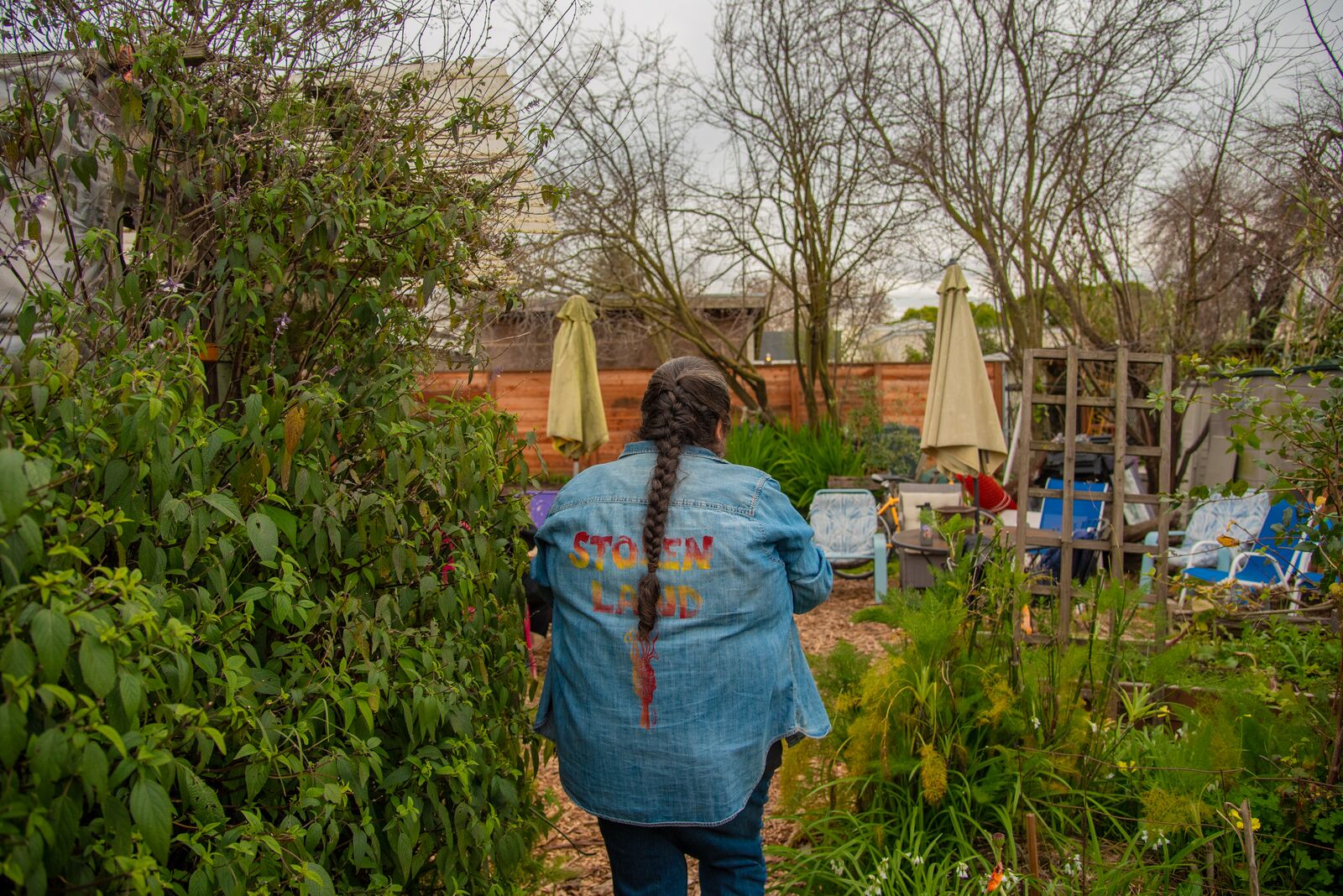 Gould in the land trust’s Southwest Berkeley garden. Credit: Ximena Natera/Berkeleyside
Jenn Biehn and Joanie Lohman of Oakland have long paid shuumi but decided to deepen their commitment to undoing the harm white people have done to the Ohlone people. They are gifting their house in the Dimond District, now worth around $1.25 million, to Sogorea Te’ in their wills.
It’s not a decision the two women, long active in social and racial justice issues, made lightly. Biehn, 77, and Lohman, 81, are living off Biehn’s pension and took out a second mortgage to make ends meet.
“This land is not our land, it’s Indigenous land from forever,” Lohman said by way of explanation. “We felt like a white couple returning land is quite a statement for others to be touched by.”
“I’m not afraid to die because I have a moral alignment on this journey that we’re on. Returning the land feels right, feels like living in sync with what we’re to do as humans on planet Earth,” Biehn said.
The couple feels so strongly about the issue that they started a chapter of Good Guest Dimond, modeled on Good Guest Kensington, to encourage their neighbors and friends to pay shuumi. Another person in the group, they said, has also decided to leave her house to Sogorea Te’ upon her death.
Critics of land tax say it is not an Ohlone value and only benefits part of the Ohlone community
The shuumi land tax has critics — particularly from other East Bay Ohlone groups that question the philosophy behind the tax and that its proceeds go to a small nonprofit, not to the Ohlone community at large.
The criticism is rooted in a fractured political landscape where tribes that share the same ancestry are competing for resources and legitimacy in the Bay Area.
Indigenous people in the East Bay were once part of a federally recognized tribe, the Verona Band of Alameda County, which lost federal recognition in 1927 after a UC Berkeley professor falsely declared them extinct. Over the years, the Verona Band splintered into separate tribes, including the Ohlone Indian Tribe, established in 1971 and now with around 200 members, and the Muwekma Ohlone Tribe, formed in the 1980s and now counting over 600 members.
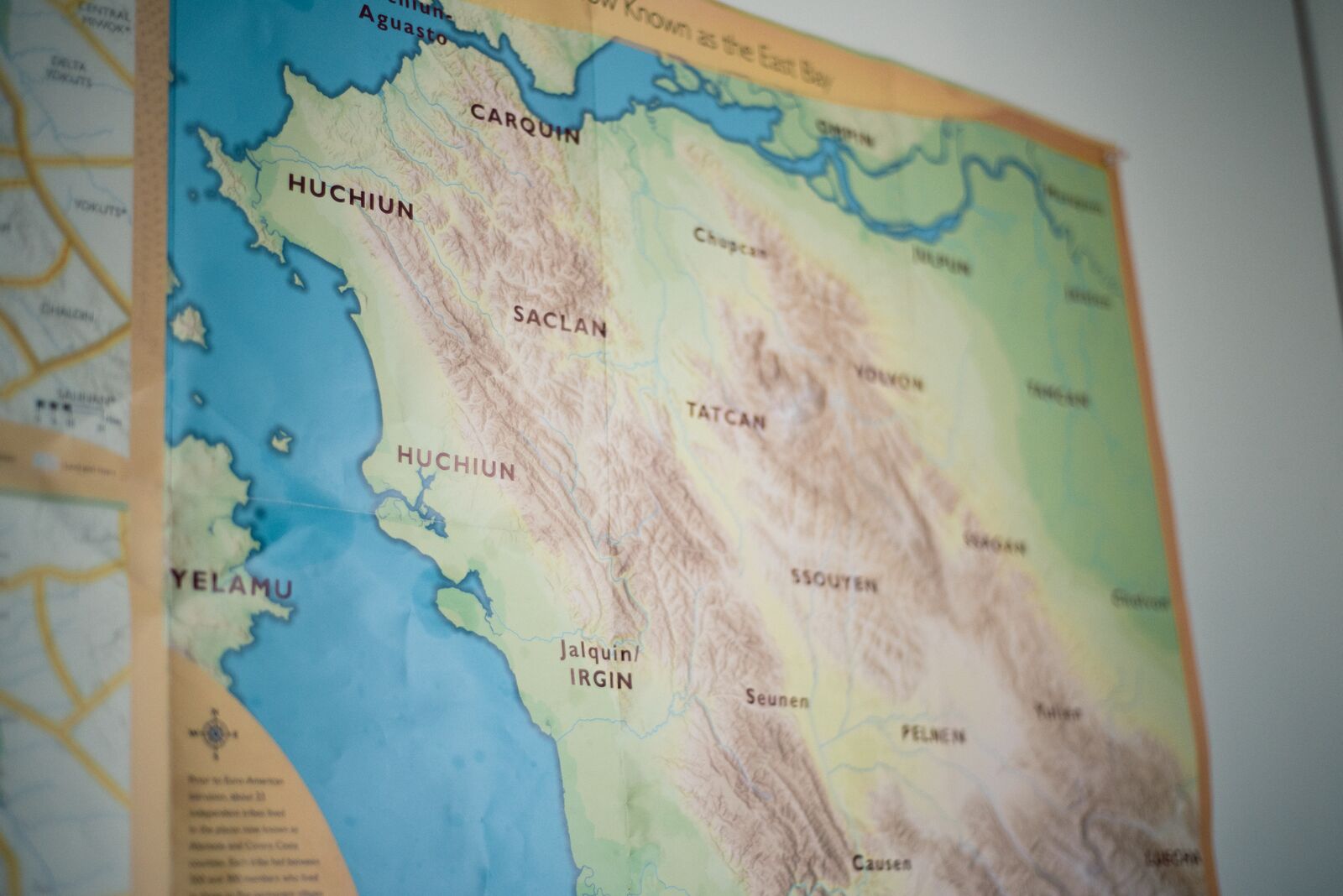 A map of Bay Area Indigenous peoples hangs in Sogorea Te’s Oakland office. Credit: Ximena Natera/Berkeleyside
Gould formed the Confederated Villages of Lisjan in 2018, an amalgamation of seven tribes across central California, according to the group. It has about 100 members — a membership separate from the Ohlone Indian Tribe and the Muwekma Ohlone Tribe. Though they share culture and language, they are distinct political entities, part of about 50 Ohlone tribes throughout California, each with its own leadership and claim to represent Ohlone interests.
Vincent Medina was last year elected president of the Ohlone Indian Tribe, which works to preserve and promote Ohlone culture and sustain its presence in the East Bay. He used to be close to Gould and worked with her to oppose the proposed development on the Spengers parking lot. The two have parted ways. Medina criticized Sogorea Te’ for not stating more clearly that its shuumi tax only benefits a small nonprofit.
“The land tax is frequently perceived by the public to support the whole East Bay Ohlone community — however, it does not,” he wrote in an email. “Not only does this mean that the public often inaccurately assumes that their generosity is reaching a broader Ohlone community, it also means that there is no broad Ohlone community accountability for the use of the funds.”
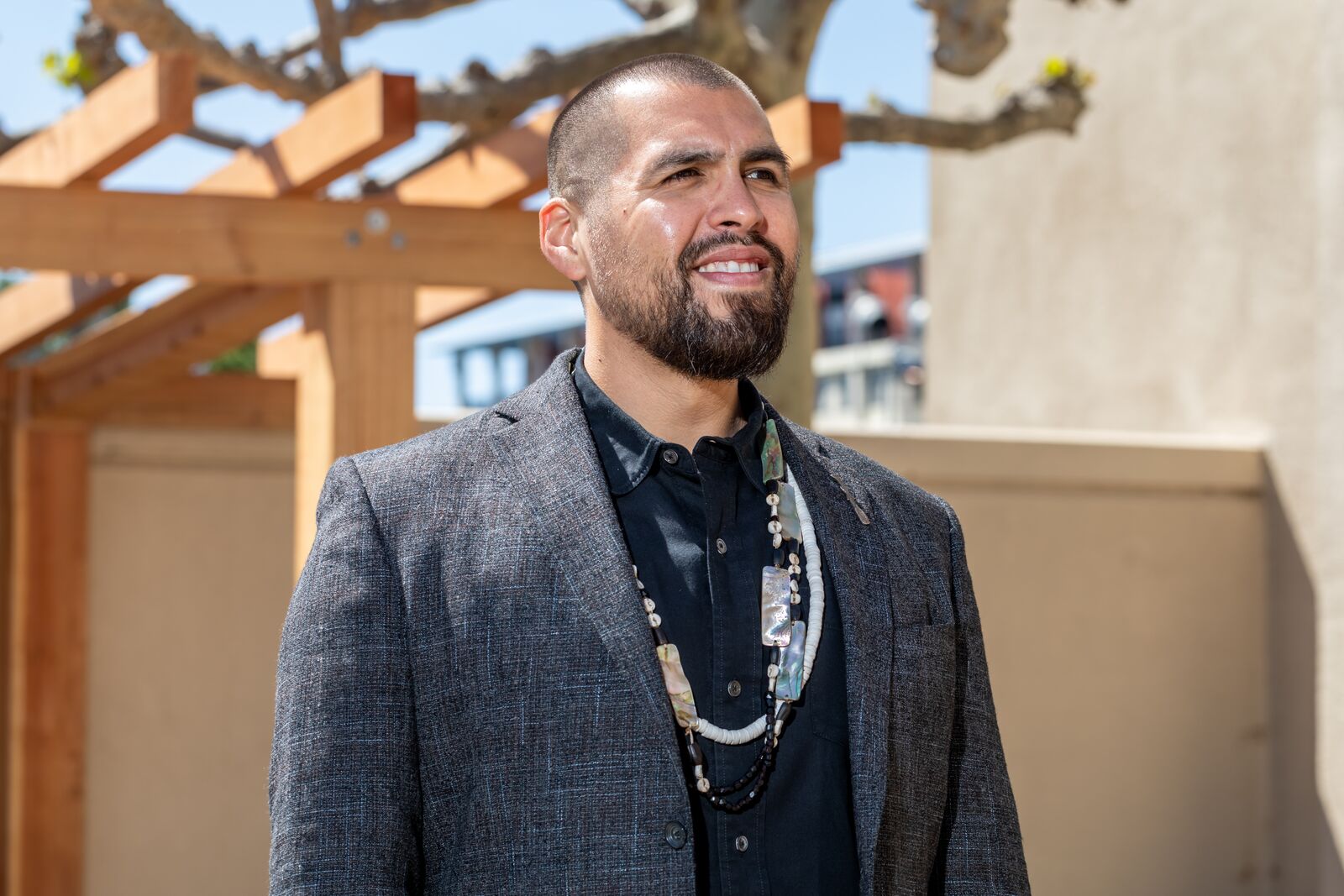 Vincent Medina, the president of the Ohlone Indian Tribe. He’s criticized Sogorea Te’ for not stating more clearly that its land tax only benefits the small nonprofit and not the wider Ohlone community. Credit: Kelly Sullivan for Berkeleyside
Medina also opposes the shuumi tax because, he says, there is no Ohlone concept of being owed anything.
“Self-sufficiency has always been valued in the Ohlone community,” Medina wrote. “Even in times when economic hardship was imposed on Ohlone people, our elders remind us that we never put our hand out to beg, but that we sustain ourselves — and [have] done so successfully. This value is passed down to this day. The framing of the tax (frequently understood as compensatory for historic harm committed against Ohlone people) is not congruent with Ohlone values; this is different from meaningful collaboration and support.”
Charlene Nijmeh, Muwekma Ohlone chair, has criticized Gould for not sharing the tens of millions the land trust has brought in with the larger Ohlone community of the East Bay.
“She’s doing good work, but Sogorea Te’ — the membership, the greater Ohlone people — do not benefit from it,” said Nijmeh in a 2024 interview. “I haven’t seen that olive branch or that extension of welcoming: ‘Here. This is for all of us and this will benefit us all.’ I haven’t seen that.”
Last May, the Muwekma Ohlone tribe intensified its criticism of Gould, stating in a press release the tribe Gould started is made up and the only “legitimate, sovereign, and previously federally recognized Ohlone tribe” is the Muwekma Ohlone tribe.
“The Confederated Villages of Lisjan is a pure political fiction designed to enrich Gould,” the tribe wrote. “Gould has been so brazen and unashamed of her behavior that she is actively promoting a ‘Shuumi Land Tax’ to dupe well-meaning people who live on Ohlone land into believing that they are donating to the Ohlone people. They are not.”
Gould has repeatedly said that Sogorea Te’ properties, including the West Berkeley shellmound site, will be open to everyone. She declined to comment on the criticisms on the advice of her attorney, she said recently. But in 2024, Gould explained her philosophy to Berkeleyside.
Gould said that she had a responsibility to members of the Confederated Villages of Lisjan and added that the advocacy work she has done with LaRose has benefited Indigenous groups throughout the Bay Area by making Ohlone people more visible.
“I am a tribal chairperson, just as Charlene is, and I have a responsibility to my tribal members, just as she has a responsibility to hers,” Gould said. “We are two separate entities, so that would be like saying that every Asian community organization would have to reach out to every other Asian community organization and ask their permission or ask ‘Do they want to be a part of it?’ And that’s just not how the world works.”
The ‘land back’ movement is growing, though other local land trusts haven’t raised nearly as much as Sogorea Te’
The success of the Sogorea Te’ Land Trust has prompted other Ohlone tribes to establish their own land back projects, but none have been nearly as financially successful yet.
The Association of Ramaytush Ohlone, whose historic home is on the San Francisco Peninsula, set up the Yunakin Land Tax to fund their land trust projects, including the Indigenous Garden in Golden Gate Park. But the association only brought in $796,000 in donations in 2024, according to tax documents, compared with Sogorea Te’s $11.7 million.
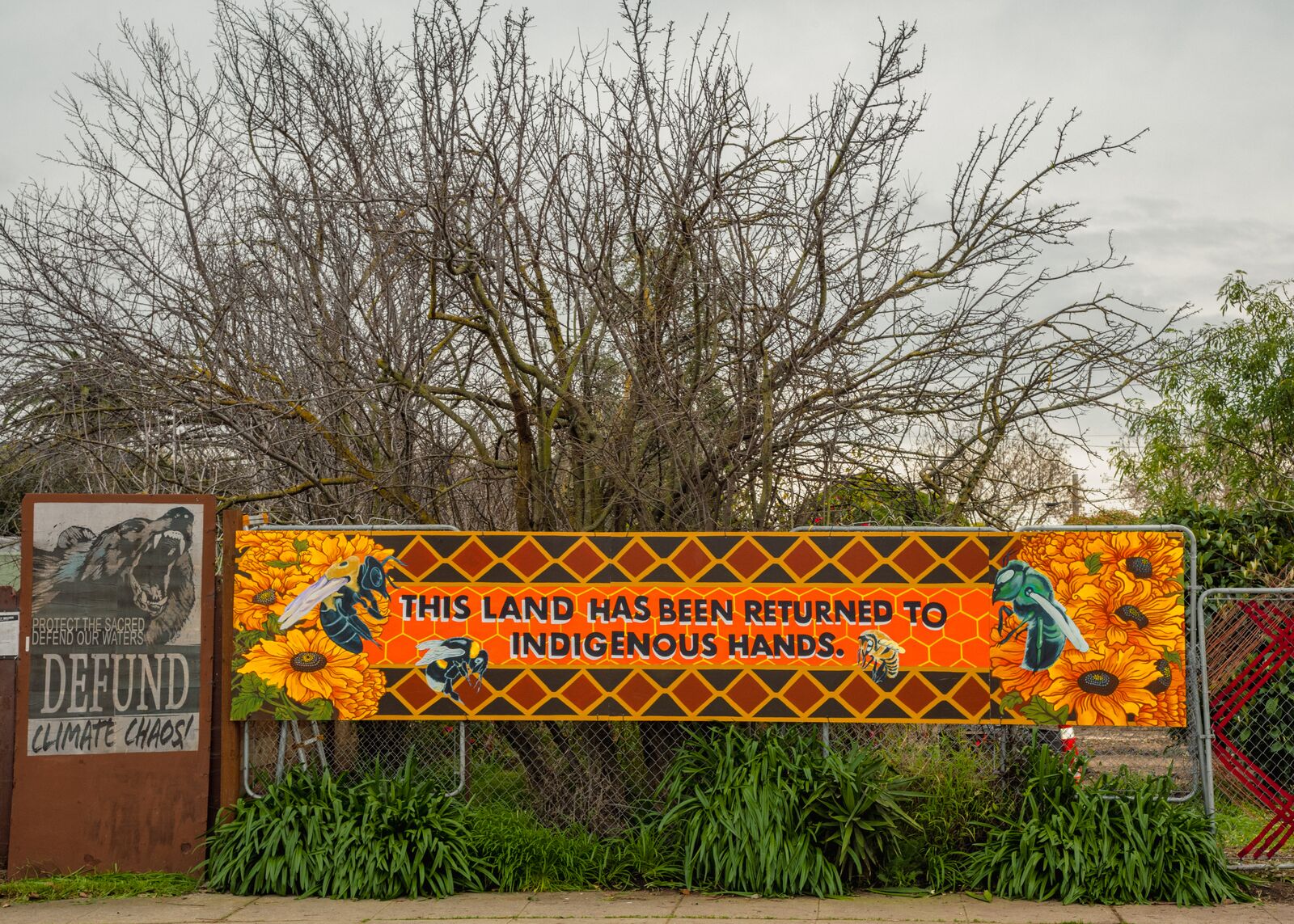 Sogorea Te’s community garden on Ashby Avenue. Credit: Ximena Natera/Berkeleyside
Medina and his partner Louis Trevino, who became prominent translators of Ohlone culture with the establishment of Ohlone Cafe at the Hearst Museum and the ‘ammatka Cafe at the Lawrence Hall of Science, incorporated a land trust in late 2024. The mak-warép Ohlone Land Conservancy’s ultimate goal is to buy a large swath of land near Sunol by 2027, the 100th anniversary of the loss of federal recognition of the Verona Band.
The conservancy manages land in partnership with the UC Berkeley Russell Research station in Lafayette and Cal State East Bay near Concord. In October, the conservancy did a ceremonial burn in Concord that promoted the “restoration of Indigenous-led fire practices in the East Bay, reaffirming cultural traditions and supporting ecological health on Ohlone homelands,” according to a press announcement. “The project is designed to reduce invasive grasses, improve soil health, and restore native plants important for food, medicine, and basketry.”
In its first year as a nonprofit, the conservancy only raised $61,000, according to tax documents. But it had previously raised more than $1 million through a fiscal sponsor, according to Deirdre Green, who works with the conservancy. Laurene Powell Jobs donated $750,000 through her Waverly Street Foundation. The Stupski Foundation was also a major donor.
The Muwekma Ohlone started their own land trust, the Muwekma Ohlone Preservation Fund, in 2021. In 2024, it raised $69,000 and had $101,000, according to tax filings.
“We’re struggling to fundraise to acquire land, so we can build a Native village, so that our people can stay here,” Nijmeh said.
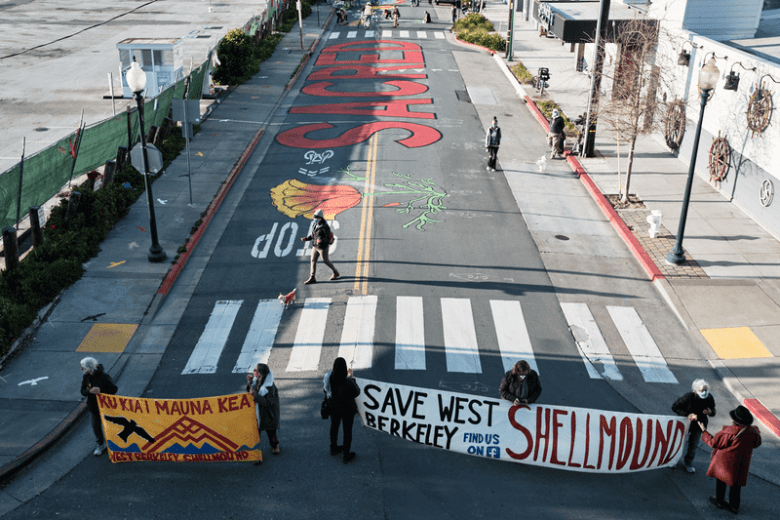 A 2021 protest against a plan to build housing on the Fourth Street shellmound site. Credit: Pete Rosos for Berkeleyside
The tribes that have succeeded the most in getting land back are ones that have received a portion of the $100 million California has allotted to help them reacquire land, both from the state and private property owners. In June, California returned a 73-square-mile stretch along the Klamath River to the Yurok tribe. In October, it gave 17,000 acres in the Sierra foothills to the Tule River Indian Tribe, among other transfers.
On Feb. 11, the Waší·šiw Land Trust, founded by the Washoe Tribe of Nevada and California, announced it had purchased 10,274 acres northeast of Lake Tahoe from the city of Santa Clara for $6 million. The state Wildlife Conservation Board contributed $5.5 million toward the purchase, drawing on funds that came from a measure passed by voters in 1990 to preserve wildlife habitat. Other donors included the Northern Sierra Partnership and the Feather River Land Trust. The trust hopes to acquire 20,000 acres in the coming years.
What’s next for Sogorea Te’ and the West Berkeley shellmound site?
Raising $1 million to take off the asphalt is just one small part of transforming the lot into a grand communal Indigenous space. Gould said they have a contractor but need to go through Berkeley’s permitting process. She hopes the project will be completed this year.
 A Sogorea Te’ spokesperson shared this photo of plants growing up through the asphalt of the Fourth Street parking lot. Members of the land trust sprinkled seeds in cracks in the pavement. Credit: Inés Ixierda/Sogorea Te’
Gould said the leadership of Sogorea Te’ is grappling with how to proceed with a project that could cost $80 million and take decades to complete. It will certainly involve more people and a capital campaign, she said.
“What does it look like for Sogorea Te’ to take on such a big project?” said Gould. “Are we looking at creating a separate entity? Are we looking at making it a wing of Sogorea Te’? There’s a lot of unanswered questions right now, so letting the land breathe will allow the public to see something happening there. It will allow them to reimagine something there, a green space, while allowing us time to figure out what the next steps are.”
Since the Ohlone people are not recognized by the federal government, Sogorea Te’ still has to comply with local zoning laws. It must get permits before any work can start.
Gould said having the shellmound once again under Indigenous control has been “joyful,” although it has its challenges. The 2024 celebration marking the land’s return was one she will savor.
“For thousands of years our ancestors prayed at that place,” said Gould. “We came together in an interfaith way and laid down prayers as well. I believe that our ancestors heard those prayers and carried us on this journey together. And so now, the next part of this journey is to ensure that I’m being thoughtful and I’m listening to what they want us to do there and I am fulfilling that dream.”
“*” indicates required fields