
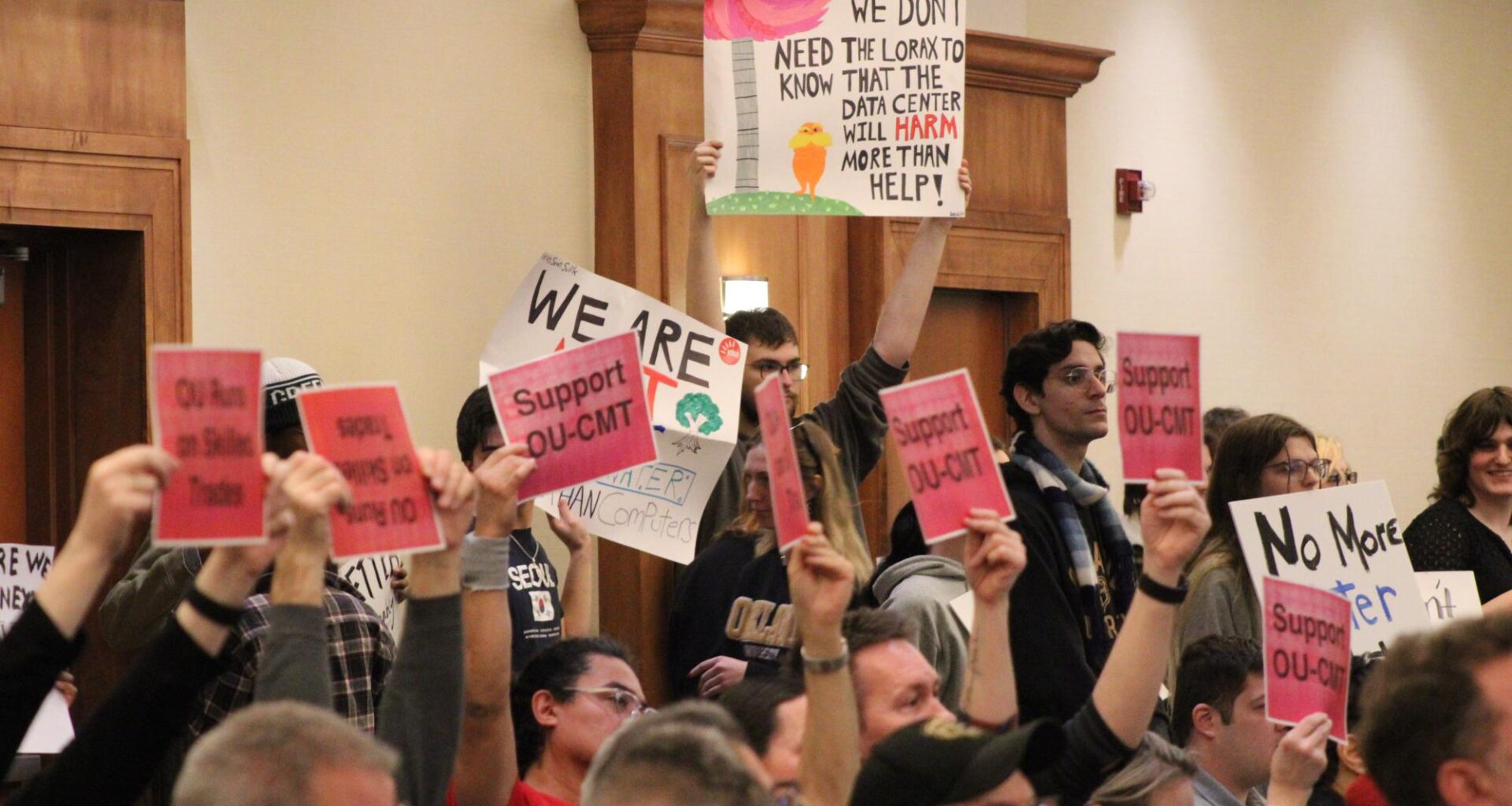
Oakland University’s board of trustees did an excellent job of creating the appearance of business as usual on Friday Jan. 12.
President Pescovitz delivered a presentation that was vaguely optimistic, somewhat milquetoast — the sort of progressivism that gets approved by a committee of a Fortune 500 company.
A safe campus commission, an award in honor of the late beloved faculty member Glenn Macintosh, a few cutting-edge grants — all super safe.
All the interesting and truly relevant matters of the press conference were sheathed within the public comment section.
Oakland has not been free from controversy in recent months. On the contrary, the typically peaceful and rather sleepy campus has been racked by a series of unfortunate events.
Union contract disputes constitute the most typical of these misfortunes.
“I know at least six guys in skilled trades that have left here,” Greg Meehan, a locksmith at the university, said to the board. “And they are getting 10 bucks more an hour. They are going other places. Other colleges, DTE, GM, starting their own companies.”
The board replied with the grace of a politician. One even remarked to another, barely audibly, “You should run for governor.”
The Midwest has a long relationship with labor unions. Rarely, except for the most isolated and privileged — and in this region, oftentimes not even then — is there a family more than a generation or two removed from intense union ties.
The board relied on this very heavily in their answer. Vague assurances, like one’s father being in a union, were common. Assurances of better pay and benefits were much less freely given.
A very well-dressed answer to very significant unhappiness. Designer stitching. Immaculate texture.
But beneath the velvet lining, what this answer truly adorns becomes harder to ignore.
Perhaps the clearest example arrived in the form of the proposed on-campus data center, planned for construction on campus near Native American historical ground and a wildlife preserve. The placement feels almost cinematic — 1980s movie-villain energy — except there is no Patrick Swayze riding in to restore balance.
“We see that the harms and risks to our campus community with this project far outweigh the benefits it may provide,” Clover DeVore, OUSC speaker of the legislature and political science major, said. “Sitting in silence means nothing ever changes.”
There were also voices eager to highlight the upside.
“A 26-megawatt data center would significantly enhance exponential learning opportunity for students,” Louay M. Chamra, dean of the School of Engineering and Information Technology, said. “It supports hands-on education, workforce readiness and industry-aligned curriculum, while increasing the long-term value of an Oakland degree.”
Both visions cannot be equally true.
The long-term value of large-scale AI infrastructure remains speculative. What is not speculative is the weight of the land it would occupy and the precedent it would set. If there are tangible benefits for students or the surrounding community, they were not clearly articulated at the meeting.
Universities are at their best when debate is invited, not managed — and when concerns are addressed directly, not upholstered and stitched away.
Oakland can present itself as polished and forward-thinking, but polish without clarity is branding — and branding is not governance.