
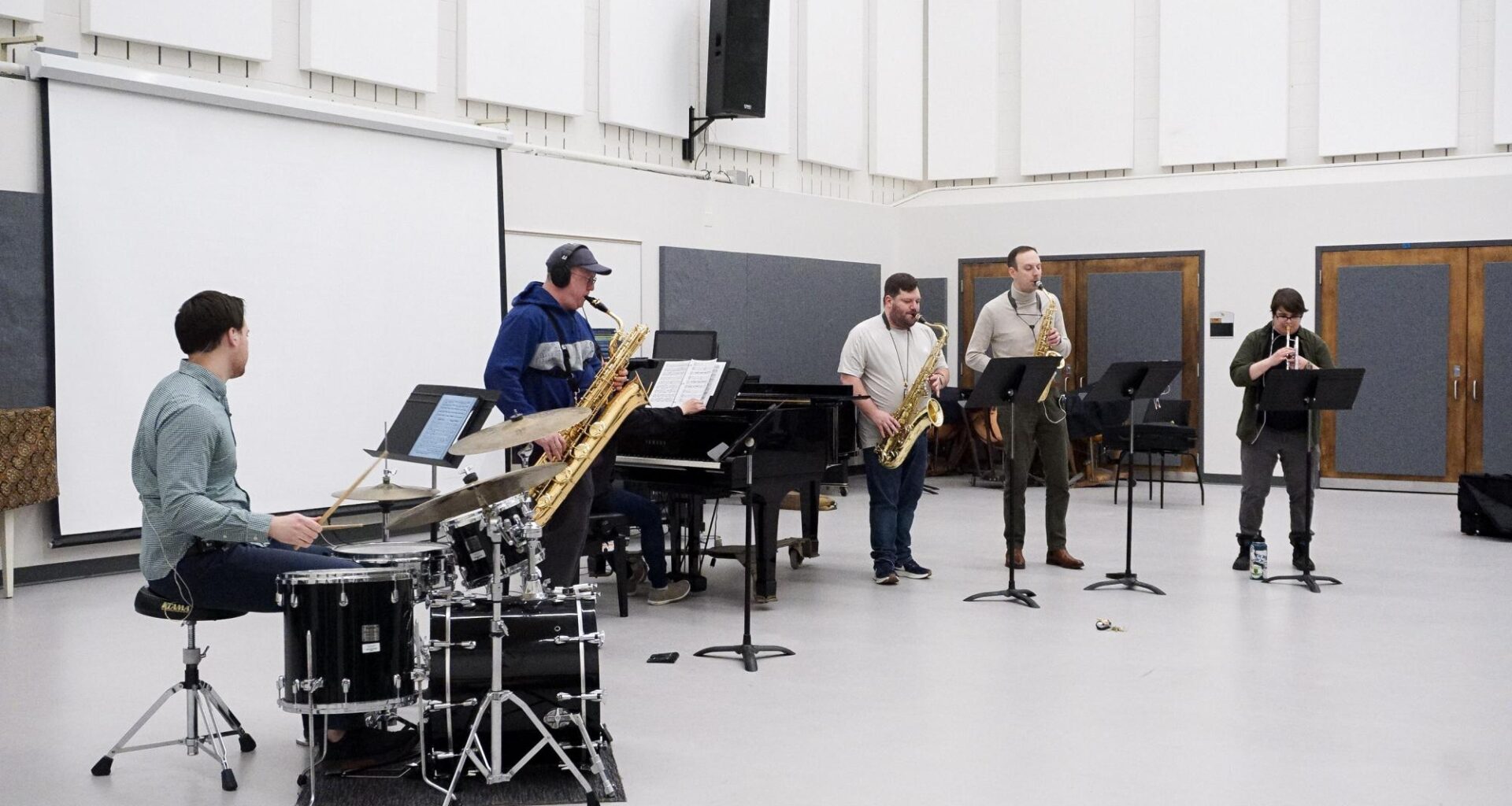
Faculty members of the Oakland University School of Music are set to perform a concert full of unconventional, exceedingly modern repertoire on Thursday, Feb. 26 at 7:30 p.m. in Varner Hall. One of the works being performed by the nOU — pronounced “new” — Music Ensemble will feature snippets of spoken commotion from 90s talk shows like “The Jerry Springer Show.”
The “fixed media” composition “Heartbreakers” by Dutch composer JacobTV is a suite for jazz sextet or sax quartet, audio and concert video. Fixed media music is a type of electroacoustic music that is pre-recorded, then utilized in performance to accompany the ensemble it plays with. Because the ensemble has significant freedom to improvise, the piece can last anywhere from 17 to 24 minutes in length.
Faculty involved in the project include saxophone professor Jeffrey Heisler, piano professor I-Chen Yeh, trumpet professor Amanda Ross, percussion professor Justin Lamb, SMTD admissions and recruitment manager Alex Sellers and saxophone professor Chris DeLouis, serving while Heisler is on sabbatical.
nOU Music Ensemble, formed last semester, is a group of professional musicians pushing the boundaries of classical repertoire. Many musicians in the School of Music, Theatre and Dance (SMTD) gravitate toward performing Western classical music consisting of three main categories: Baroque (1600–1750), Classical (1750–1820) and Romantic (1800–1915).
A fourth category focusing on contemporary music is also required, but some students do not actively seek opportunities to perform it. In her own teaching, Yeh finds that aversion is true for many students she has taught.
“Often people have a misunderstanding of contemporary music being very dissonant and difficult writing for no good reason. However, contemporary music has such diverse style and often a reaction to historical events and aesthetics at the time,” Yeh said.
Lamb, an avid performer of electronic music, selected the piece and appreciates its avant-garde nature. Having immersed himself in the style for over a decade, he has grown accustomed to the equipment and its challenges. In this particular piece, all musicians are given in-ear monitors (IEM) with a click track only they can hear — similar to what many mainstream artists wear during concerts.
“The IEM allows the performers to stay in sync with all of the prerecorded electronic tracks that they are performing with,” Lamb said. “IEMs have been popular since the mid-1980s, allowing performers to reduce unwanted noise, to protect the musicians’ hearing and to create personalized mixes for each ensemble member.”
Instrumentalists each play their separate parts as a mix track of phrases from 90s talk shows blasts sporadically in the background. The overall timbre is exceedingly brassy, given the heavy use of saxophones and trumpet in pop and jazz. Words will be displayed on screen behind the ensemble, illustrating the unhinged expressions mentioned on air.
“Shows like these make entertainment out of people’s real suffering, so playing this music along with the bits from the show exaggerates that effect. What seems like harmless comedy ends up ruining people’s lives,” Ross said.
This concert will feature other pieces, ensembles and styles. Attendees are available to watch for free, and this program is open to the public.