
School boards around Oakland County have begun deciding whether residents will vote on a countywide school enhancement millage proposal in August.
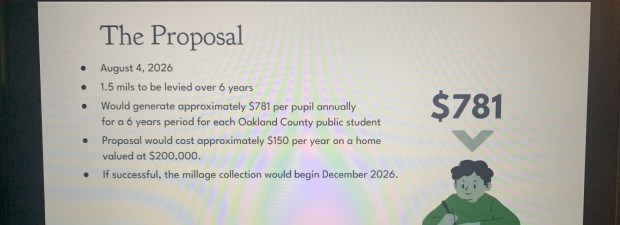
The enhancement millage would be a 1.5-mill levy over six years that would generate $125 million in its first year. Over the six years it would generate an average of $781 per pupil for all students enrolled in public schools, public academies and charter schools.
Districts enrolling more than 51% of all K-12 students in Oakland County must approve resolutions before the Oakland Intermediate School District takes action before March 30 to put the millage request on the Aug. 4 primary ballot.
Oakland County currently has 172,388 students in public schools and academies.
Brandon, Clarkston, Clarenceville, Huron Valley, Madison and Walled Lake districts have, approved the resolution.
“I am in favor of offering our population a chance to vote,” Walled Lake school board Trustee Marc Siegler said at their Feb. 5 meeting.
The board approved the resolution 5-1.
“The public should decide what they want to do and where they should be at,” said Walled Lake board President Stephanie Kaplan. “It shouldn’t be myself deciding for the thousands and thousands of residents of Walled lake and Commerce Township. This is a community thing for each individual to decide.”
Across the state, almost half the student population live in counties with a dedicated school millage.
They include Macomb, Wayne, Kent, Midland, Kalamazoo, Monroe, Muskegon and Ottawa counties. Those eight represent 600,000 students, or 44% of the total state student population.
The millages range from .085-mills in Kent county to 1.9-mills in Wayne County, which has had a countywide millage in place since 2016.
The Oakland County proposal would cost $150 per year on a home valued at $200,000. Funds received by the 27 county districts would be unrestricted and could be used for anything from salaries to construction projects to purchasing equipment.
The millage would generate an estimated $5.5 million annually for Huron Valley students. Their board approved the resolution 4-3 earlier this month.
“Huron Valley Schools is not necessarily advocating a yes or no, what we are advocating for is giving voters the opportunity to weigh in on this question,” said Superintendent Paul Salah.
Clarkston school board President Stephanie Crane reiterated that point at their Feb. 9 meeting.
“I feel very strongly and I want it out in the public that a yes vote here is not an endorsement of this millage,” she said.
Their board approved the resolution 4-3.
If it lands on the August ballot and is approved, the millage would begin December 2026.
Walled Lake Trustee Lisa West pointed out one of several issues voters would have to take into consideration if the proposal makes it onto the primary ballot.
The new 1.5-mill levy would be in addition to a 2022 sinking fund and school improvement and operating millages approved in 2024 that Walled Lake residents are already paying for.
“We have requested a lot from our taxpayers over that time,” said West.
She also said that due to its size, Walled Lake would be considered a “donor district” because the millage is countywide and some school districts would receive more funds than their tax payers put in.
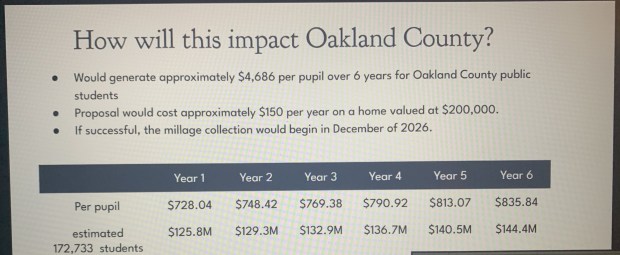 The millage would generate $125 million it is first year and almost $145 million by 2032.
file photo
Other districts which may receive less would be considered “receiver districts.” She estimated Walled Lake’s surplus would be over $2 million that would be redistributed to other districts and public academies.
Kim Abel, a former teacher and president of the West Bloomfield Teacher Association, said the stability of a dedicated millage would be one of the incentives to approve the initiative.
“Additional money to districts in this time where we take a long time to get money from the state and get approval of what that funding is, it is nice to have additional resources to get funding for the districts,” said Abel “And an enhancement millage will do that.”
She is now the director for the Michigan Education Association field office in Commerce Township and has been an advocate for an enhancement millage for over five years.
“The funding we get from Lansing is not a timely process any more and we need to figure out a way to get revenue to our schools in a timely guaranteed manner and this is a way to do that,” said Abel. “This is a way to get money directly to the districts and allow them to be a little bit more accurate with their budgets.”