

After the first week of November, City Hall could have more available space.
In the next few months, San Francisco lawmakers and a task force are set to eliminate dozens of city commissions that oversee and advise on everything from public school funding to street sweeping to public art. Then voters will have a go, likely deciding the fate of dozens more on the November ballot.
It’s one prong of a movement to reduce what critics, including Mayor Daniel Lurie, say is a bloated, inefficient city government. Lurie was not party to the original effort that produced this commission reform, but he and allies are pushing for a different November ballot measure to reform the city’s 540-page charter — in effect, its constitution.
The commission overhaul is farther along. The 2024 ballot offered dueling propositions on the matter, backed by dueling mayoral candidates. The more drastic version lost, and its backers ended up with steep ethics sanctions and in disarray. The more cautious version won. It might still cut more than a third of the city’s committees, commissions, and other bodies, and modify dozens of others.
These bodies are supposed to provide transparency and make governance more accessible to everyday San Franciscans. Some clearly aren’t doing that job. They either haven’t met in years or are obsolete like the Sanitation and Streets Commission, which oversees a department that no longer exists.
Even though they don’t add anything to the city budget, “having bodies on the books that effectively do not exist makes government more confusing and more difficult to navigate,” says Angela Yip, spokesperson for the City Administrator’s Office.
Not all of these bodies will make for easy mercy kills, however. Some commissions have real responsibilities and at least some public support, and axing them will draw fire. Even modifications to committees can be threatening. The Commission on the Status of Women isn’t on the chopping block, but members are protesting proposed modifications that they say diminishes its independence.
The Commission Streamlining Task Force — or, if you prefer, the commission to reduce commissions — has just wrapped up a year of hearings and produced a list of 60 bodies to eliminate.
Whether bicycle policy, delinquency prevention, or food security is your jam, there’s more time to weigh in. How this unfolds in the next few months is a potentially baffling process, so we’ve assembled this FAQ to help sort it out.
Q: Why is this happening?
In 2024, self-described moderate political advocacy group TogetherSF (now called Blueprint), bankrolled by SF Standard owner Michael Moritz, proposed Prop D. Its backers hand-picked 65 city bodies and put them up for elimination. Former supervisor Mark Farrell made it a centerpiece of his mayoral campaign.

With a fraction of the funding that supported Prop D, opponents including longtime supervisor and mayoral hopeful Aaron Peskin floated Prop E as an alternative.
Prop E won 53 percent of the vote, Prop D only 43 percent. Farrell received a record ethics fine for commingling his mayoral campaign and Prop D funds.
Q: Who is this task force?
Prop E established the five-member Commission Streamlining Task Force in 2025. The city controller, city administrator, city attorney, Board of Supervisors, and mayor each got one appointee. Former city controller Ed Harrington was named the chair. The task force spent a year convening more than two dozen public meetings. It recently submitted a final report to the Board of Supervisors with recommendations to either eliminate or keep each of the 152 bodies it assessed. The task force also proposed how to modify some of the keepers.
Q: What do these bodies do?
SF’s commissions, committees, and so forth are made up mostly of private citizens. Some are mandated in the City Charter, others have been created through legislation. Many have powers beyond just giving advice. For example, the Civil Service Commission helps set standards for hiring city workers. Others are purely advisory, meant to make government less obscure and give ordinary San Franciscans a direct way to bend City Hall’s ear on issues like bike safety and building codes.
Q: What is SF getting rid of?
We don’t know yet. The next step is for the task force to submit a hairball of legislation to the Board of Supervisors by March 1. This will include a hit list of 36 bodies that will be relatively easier than the rest to eliminate.
 Outta here? The next few months will determine how many of SF’s 150+ committees and other government-adjacent bodies will be swept out of City Hall. (1024greenstreet/CC)
If the board doesn’t like the list of 36, it must veto the entire thing, which requires a supermajority of eight supervisors. With a veto, the board can draft a new version of the package. A simple majority vote will be enough to axe the new list of bodies.
Without a veto, the recommendations will automatically take effect after 90 days, and those 36 bodies will be wiped off the face of the Earth.
Q: That’s only 36. What about the other 24 on the task force’s list?
Those bodies are baked into the City Charter and can only be removed by the voters. These will follow a different legislative path.
First, the supervisors must debate which of the 24 they want to put on the November ballot. According to City Attorney spokesperson Jennifer Kwart, the board can make decisions on individual bodies or combine them into packages.
They must hold hearings on the final list by April 1, then submit the question by July to get onto the November ballot.
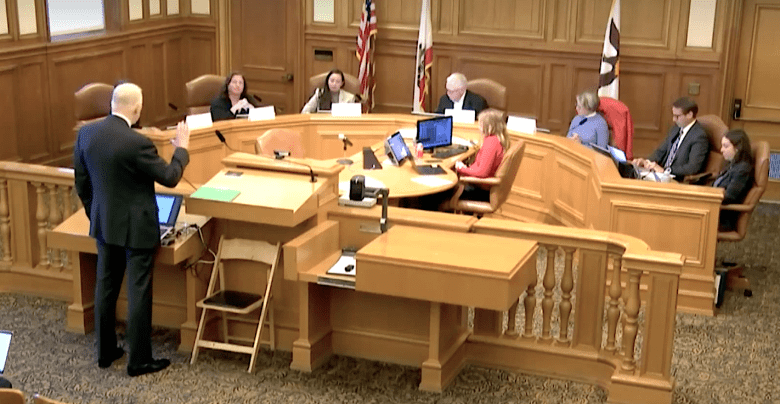 The Commission Streamlining Task Force members listen to public comment during their April 2, 2025 meeting. (Courtesy SFGovTV)
Q: Has any proposal to kill a commission already gotten pushback?
The task force considered axing the Sheriff’s Department Oversight Board and the Sweatfree Procurement Advisory Group, but boosters talked them down. There will almost surely be more as this moves to the supervisors, each with personal favorites and favors to give their constituents.
Q: I really care about the Flying Hydrogen Scooter Oversight Committee*. How do I make my voice heard?
The Board of Supervisors will have to hold public hearings on the task force recommendations. Exact dates and committee assignments haven’t been set. But there’s no time like the present emailing and calling your supervisor to underscore how much the city needs flying scooter oversight.
Q: What about the bodies the task force says to keep?
Buckle up, this part of the process could add some length to the November ballot. The task force says more than 80 commissions should stay on, many with modifications. For example, it says the Commission on the Status of Women should be moved from the City Charter to a more mundane set of rules called the administrative code.
The task force also recommends term limits for some bodies — bad news for anyone hoping to lord over the Arts Commission for more than three years.
Any modification that requires changing the charter will also mean going to the November ballot. According to Kwart at the city attorney’s office, that requirement means the supervisors also must craft a measure with these modified commissions and committees — or perhaps combine them with a proposal to get rid of others.
Q: Do we also have to vote to eliminate the Commission Streamlining Task Force?
No. Thanks to Prop E, the task force will automatically disband next year. So far, no one seems to object.
More from The Frisc…