
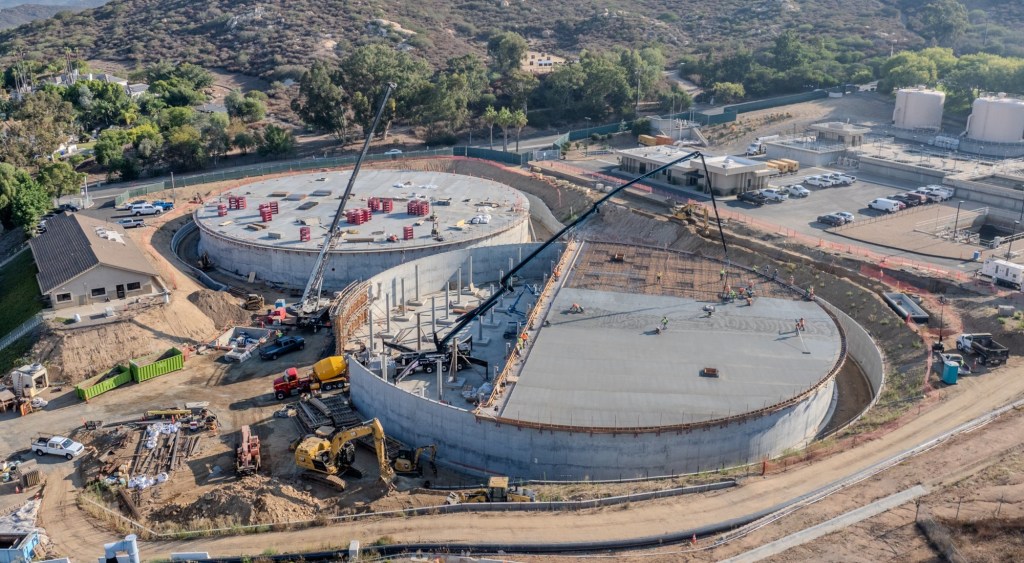
A nearly $87 million project to improve Poway’s water system will reach another milestone this spring when an aging Clearwell is replaced with two 4 million-gallon circular concrete water tanks.
The Clearwell replacement project is under budget, approximately 95% complete and on schedule for commissioning in spring 2026, according to a staff report.
The water infrastructure improvement program is the largest capital project in the city’s 45-year history, said Robert Weber, the city’s principal civil engineer for public works-utilities, at the Feb. 3 Poway City Council meeting.
The three-phase program aims to improve reliability, redundancy and resiliency of the city’s drinking water system, Weber said. The program consists of a Clearwell bypass project that is in operation, a Clearwell replacement project under construction, and a treated water facilities project that is in the design stage, he said.
The $9.3 million Clearwell bypass project was necessary to bypass the existing Clearwell so the new facilities could be constructed, Weber said.
This portion of the project consists of temporary and permanent bypass pipelines, a temporary pump station, a pressure regulating station and two temporary bypass tanks, states a staff report. Each tank has a storage capacity of 1.4 million gallons.
The bypass pipelines, pump station and pressure regulating facility are within city property at the Lester J. Berglund Water Treatment Plant site and at the Public Works operations yard and parking lot. The two temporary bypass tanks are on the softball field at Lake Poway park.
Construction of the bypass system allowed the original Clearwell to be taken offline for replacement, a staff report said.
“This project was completed under budget and has been operating successfully since November 2022,” Weber said.
About $37.4 million of the project cost is being spent on replacing the former Clearwell and related facilities that date back to 1964, Weber said. The two new 4 million-gallon tanks are needed to maintain reliable service to city residents, according to a staff report.
The concrete tanks provide “redundancy” by allowing one tank to be taken offline for future maintenance and repairs while the other provides continuous, uninterrupted service. They should be more durable in an earthquake and last 75 years, states a staff report.
The new tanks could be in service this spring and the softball field could be restored in fall 2026, Weber said.
“The next step for the Clearwell project is to install the remaining pipes and accessories and move into the testing and commissioning phase in the spring,” he said. “Once that is completed, we will decommission the bypass and restore the softball field.”
The third phase of the project is the estimated $39.8 million treated water facilities project. This will provide the city with its first treated water connection to the San Diego County Water Authority system. The project is coordinated with the Ramona Municipal Water District and the water authority.
“The treated water facilities project will provide the city with treated water during the water authority’s future crossover pipeline rehabilitation project as well as serve as the permanent treated water connection for overall redundancy and to allow the Berglund Water Treatment Plant to be taken offline for maintenance and repairs,” states a staff report. “Also, the project will allow the city to provide locally treated water to Ramona, either on the water authority’s behalf or by direct agreement between the city and Ramona.”
Weber said the treated water facilities project will continue with selecting a construction management firm in late spring, completion of environmental documents in the summer, completion of design in the fall followed by advertising the construction project by the end of this year and returning to the City Council in early 2027 for approval to award a construction contract.
The staff report noted that the Clearwell bypass project is $900,000 less than projected and the Clearwell replacement project is $2 million less than projected. A $1 million grant is also anticipated from U.S. Rep. Darrell Issa’s office for the treated water facilities project.
Mayor Steve Vaus said the project deserves to be highlighted not only because it is the largest public works project in the city’s history at a projected cost of $86.57 million but also because it is on schedule and under budget by millions of dollars.
“That’s not something you hear very often except here in Poway,” Vaus said during the council meeting. “The system dates back more than 60 years. Our team kept the system running every day, they strengthened it to withstand earthquakes, they met every state requirement and they did it during one of the most inflation impacted periods.”