
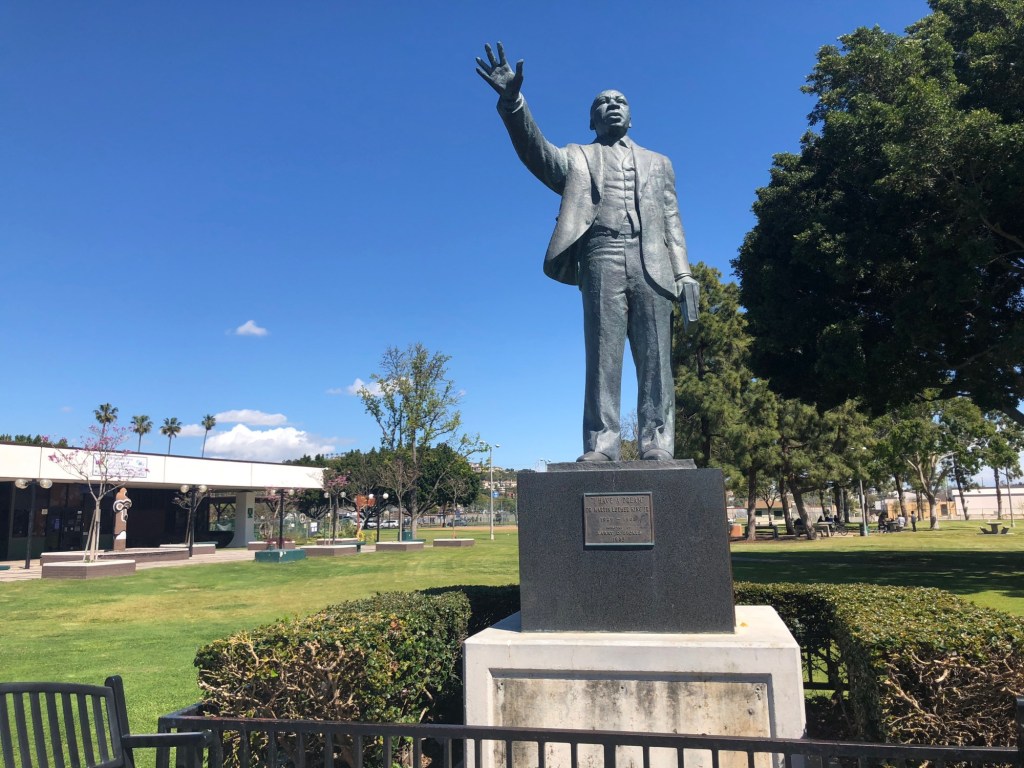
Long Beach will rename the Central Facilities Center at Martin Luther King Jr. Park after Dale Clinton — a longtime community volunteer, civil rights leader and social justice advocate whose work has had a lasting impact on the city, officials said.
The City Council formally began the process to rename the building during its Tuesday, Feb. 17, meeting. City leaders said that this renaming will remind future generations of how trailblazers such as Clinton can make lasting impacts citywide and even nationwide.
“The naming of the public space signals our values,” said Sixth District Councilmember Suely Saro, who brought the recommendation to the council. “It tells future generations who we choose to uplift and why. Dale Clinton’s life represents resilience and advocacy, courage and community building.”
Clinton was born in 1927 in Tupelo, Mississippi. She grew up during an era of deep racial inequity and limited economic opportunity. She later became part of the “Great Migration” of Black families out of the South – which occurred from 1910 to 1970 – arriving in Long Beach in 1957 as a single mother with young children, seeking better opportunities and a more just future for her family and community, according to the staff report.
Soon after arriving in Long Beach, Clinton became actively involved in community organizing and anti-poverty efforts, according to the staff report. She quickly emerged as a trusted community leader during the early years of the federal “War on Poverty.”
In the 1960s, Clinton gained national recognition after writing a letter to President Lyndon B. Johnson advocating for the rights of poor mothers and the continuation of critical social programs, such as Head Start. The letter was widely published and entered into the congressional record, elevating the voices of low-income families at a national level.
Her leadership was also foundational to the progress Long Beach has seen, including her work with former Rep. Alan Lowenthal to solve racial tension in the education system at Poly High School in the 1960s.
Her advocacy led to extensive work in human relations, civil rights education and community development, according to the staff report. In Long Beach, Clinton worked closely with community organizations, faith leaders and city departments to address welfare rights, fair housing, racial equality, youth development and economic opportunity.
Clinton ultimately built a long career with Long Beach, serving in community relations and human services roles for more than two decades, city officials said. Her work helped open pathways into city employment and leadership for women and people of color, contributing to the integration of Long Beach’s government and strengthening trust between the city and its diverse communities.
Clinton, 98, is widely regarded as one of the respected “Mothers” of the Black community in Long Beach, and has mentored generations of civic and community leaders, officials said.
“The Central Facility Center, which opened in 1974, is directly connected to her legacy,” Saro said. “Dale Clinton played a meaningful role in initiating and shaping the facility, and later worked within it, ensuring it responded to the health and service needs of the surrounding community. Renaming this building reflects her direct contribution to its creation and mission.”
The proposed renaming reflects the facility’s original mission and permanently connects it to the legacy of a community leader who helped bring it into existence, officials said. The community has demonstrated strong support for the naming request, with more than 400 petition signatures, along with numerous letters of support from residents, community leaders and elected officials, Saro added.
“I’ve known Dale for over 50 years; it was a different Long Beach,” Lowenthal said during the meeting. “She was a fighter when it took a lot of guts to stand up to the institution, to be part of the social change that was taking place in Long Beach, to make it a great multicultural city that responded to all people. Maybe we’re not perfect, but without Dale Clinton, we would never be where we are today.”
Friends of MLK Park also supported the proposed renaming.
“Dale Clinton’s vision, advocacy, and commitment to community well-being reflects the very principles of Martin Luther King Jr. Park and represents equity, service and empowerment,” said Lillian Parker, a member of the Friends of MLK Park. “It is both honorable and fitting that the city formally recognizes her contributions in a space that she helped bring to life.”
With the renaming will come updated signage, as well as a photo and a biography inside the building to connect Clinton’s legacy to the facility, Saro said.
The City Council approved the renaming recommendation with a 7-0 vote. Following the Long Beach administrative policy for name designations of buildings in parks, the next step will be for the Parks and Recreation Commission to conduct a study and subsequently make a recommendation to the Government Operations and Efficiency Committee to rename the center. That committee will then study and consider the recommendation, which will go back to the City Council for final approval.