
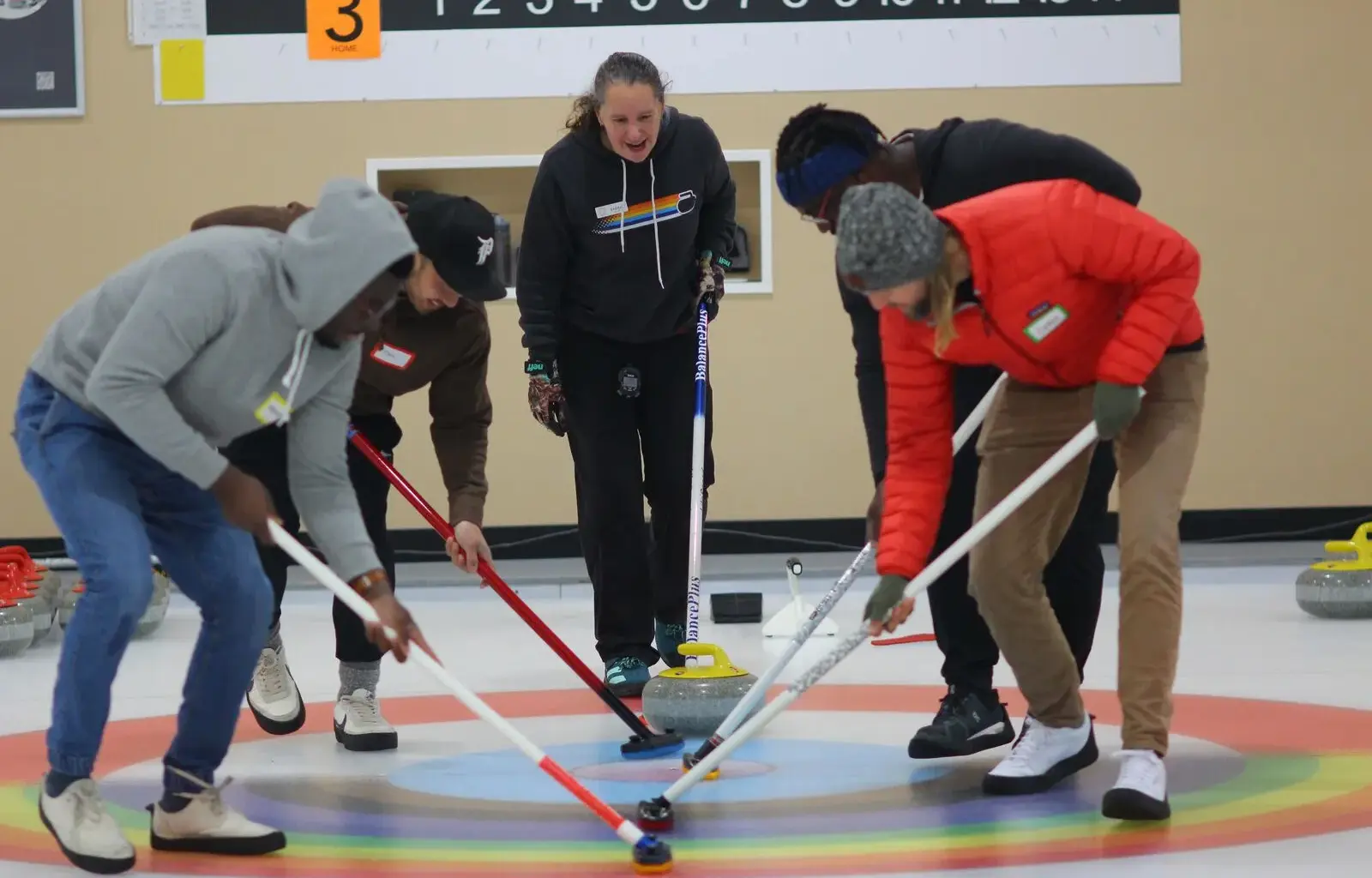
The East Bay is hardly a hub for Winter Olympic sports. Although gold-medalist figure skater Alysa Liu trains at the Oakland Ice Center, our lack of snow rules out big air snowboarding and ski mountaineering, and as far as I know, nobody’s tried to build a luge track through the hills.
You might assume that curling, where athletes slide specialized granite stones along meticulously groomed ice in a game reminiscent of bocce ball or shuffleboard, is similarly out of reach — destined to be the kind of sport you might get obsessed with once every four years, even if you never have the chance to play yourself.
But on Monday night, I joined dozens of people at an unassuming East Oakland warehouse to do just that. We had come to the home ice of the San Francisco Bay Area Curling Club, the only dedicated curling facility in California, packed on this rainy night with novices hoping to learn how to throw stones and sweep like the Olympians we’d been watching in Italy.
The club’s facility, just off Hegenberger Road near the Coliseum DMV office, opened several months after the 2022 Winter Olympics in Beijing. That means this year is its first opportunity to ride the wave of curling interest that crests with the games — and the all-volunteer club is taking full advantage.
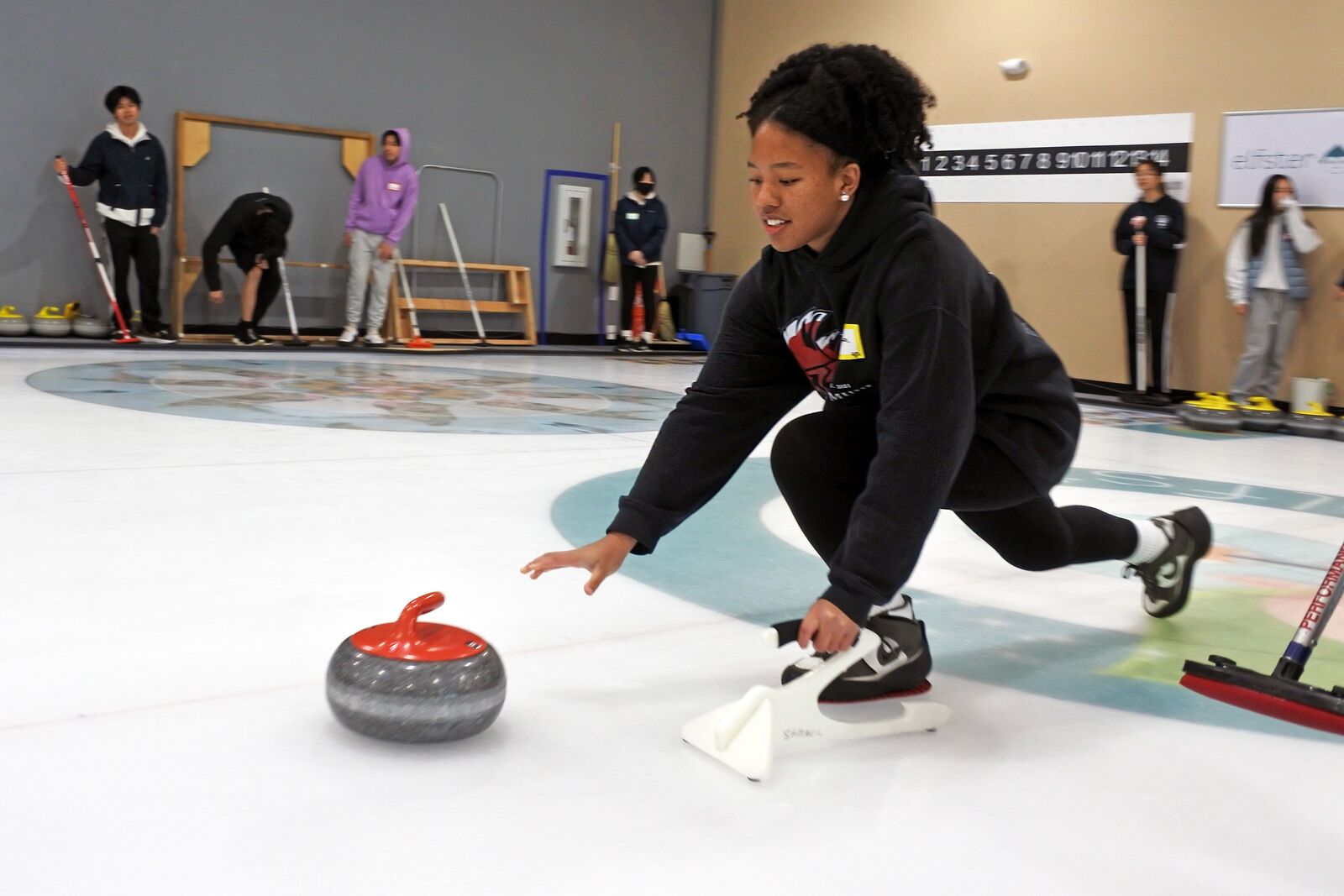 The San Francisco Bay Area Curling Club offers classes to learn the winter sport and a place to play. Credit: Courtesy of San Francisco Bay Area Curling Club
It’s hosting dozens of “learn to curl” workshops through the spring, like the one I attended, along with lessons and leagues to bring new curlers on board. Club members are planning to gather for watch parties at Pizzeria Violetta in West Oakland’s Prescott Market during the medal matches later this week.
Never miss a story. Sign up for The Oaklandside’s free daily newsletter.
Part of the club’s pitch is that curling is a surprisingly accessible sport. While sweeping will raise your heart rate, you don’t need to be in top physical condition to play, making it an option for everyone from kids to older adults. There’s no need to drop a fortune on specialized equipment either, since the club provides everything from the stones and brooms to the rubber grippers that help you walk on the ice and Teflon sliders that let you deliver your shot.
“Because it is so approachable, that makes it really great for people of any ability to be able to participate,” said Erin McInrue Savage, one of the club’s roughly 250 members.
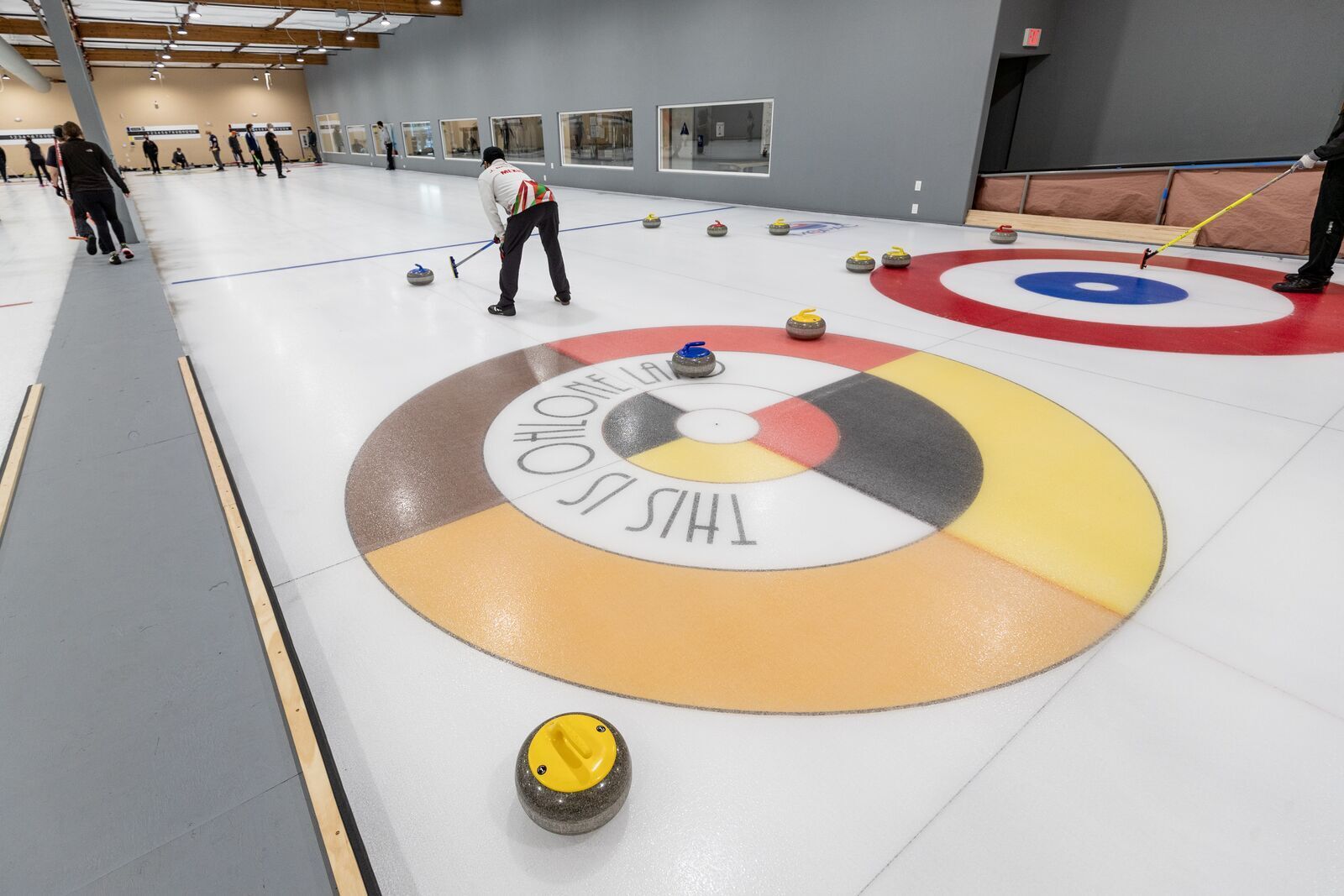 The object of curling is to slide the heavy granite stones down the ice and into the rings of the “house.” Teams score a point for every one of their stones that is closer to the center of the house than their opponent’s nearest stone, once all of the rocks have been thrown. Credit: Amir Aziz/The Oaklandside
After a quick safety video — ice is slippery, we were warned, so don’t run or jump on it — my fellow prospective curlers and I stepped into the chilly five-sheet rink. If you come for a class, you’ll want to wear warm and flexible layers; jeans aren’t recommended, and I was grateful for my thick wool socks after standing on ice for 90 minutes.
We’d been sorted into small groups, so I met my coach, Gabrielle Coleman, and three other participants. None of my classmates had curled before, but they were part of a group of friends who enjoyed watching the sport during the Olympics.
This wasn’t the first step in my curling journey. I’d learned about the game during the 2010 Olympics, while I was in college at the University of Wisconsin and living with a curling-obsessed roommate. I was hooked on the game’s intricate strategy — sometimes you’re trying to put your stone at the center of the target-like “house,” other times you’re aiming to knock your opponent’s stones out of the house, or position a rock as a “guard” to protect your team’s stones. Plus, there was the high drama of listening in to players on the broadcast as they debated the best shot. (Sure, you’re more likely to get physically hurt in other Olympic sports, but are any of them as emotionally harrowing as hearing Midwesterners make a group decision?)
When I moved to Janesville, Wisconsin, for one of my first newspaper jobs after graduation, several of my coworkers were curlers and encouraged me to join the club there. I wound up playing several times as the weakest member of a team in a weekly league, where each game ended with a potluck meal and beers in the club’s warming house.
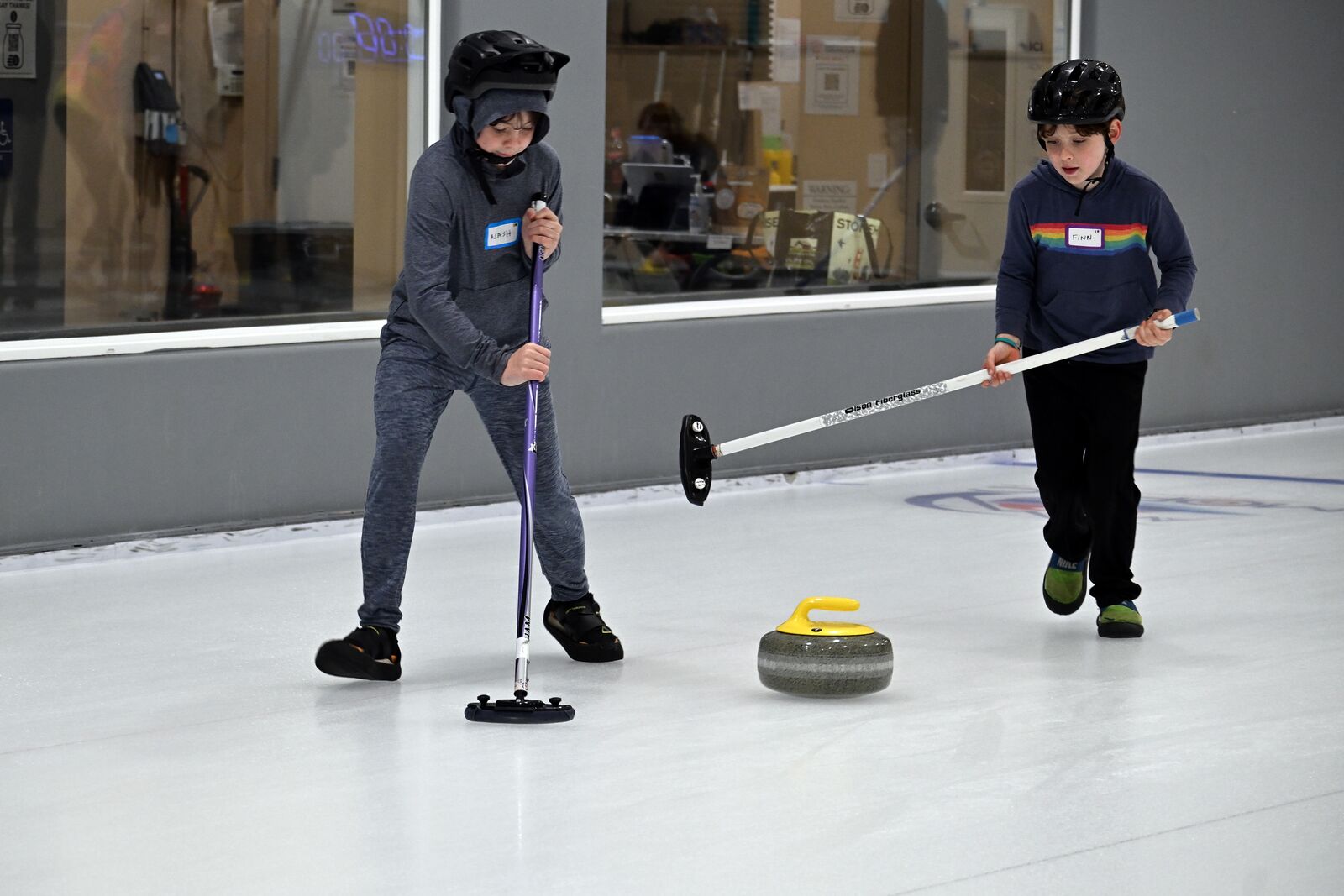 The San Francisco Bay Area Curling Club offers classes to learn the winter sport and a place to play. Credit: Courtesy of San Francisco Bay Area Curling Club
But that was well over a decade ago. So while I know how the game works and appreciate its convivial culture, built around sportsmanship and the post-game socializing known as “broomstacking,” I’d long ago forgotten what little I knew about how to actually play.
Coleman guided our squad through the game’s basics. We learned how to deliver a shot by crouching in the rubber starting block known as the hack, then pushing off with the slider under our front foot while using a plastic stabilizer to help us balance. We practiced sweeping, which creates friction that melts the tiny “pebbles” on the ice sheet, allowing stones to travel farther and straighter. And we tried to master the delicate touch you need to gently turn the handle on the rock as you release it, which makes the stone curl in one direction or another as it slides down the ice.
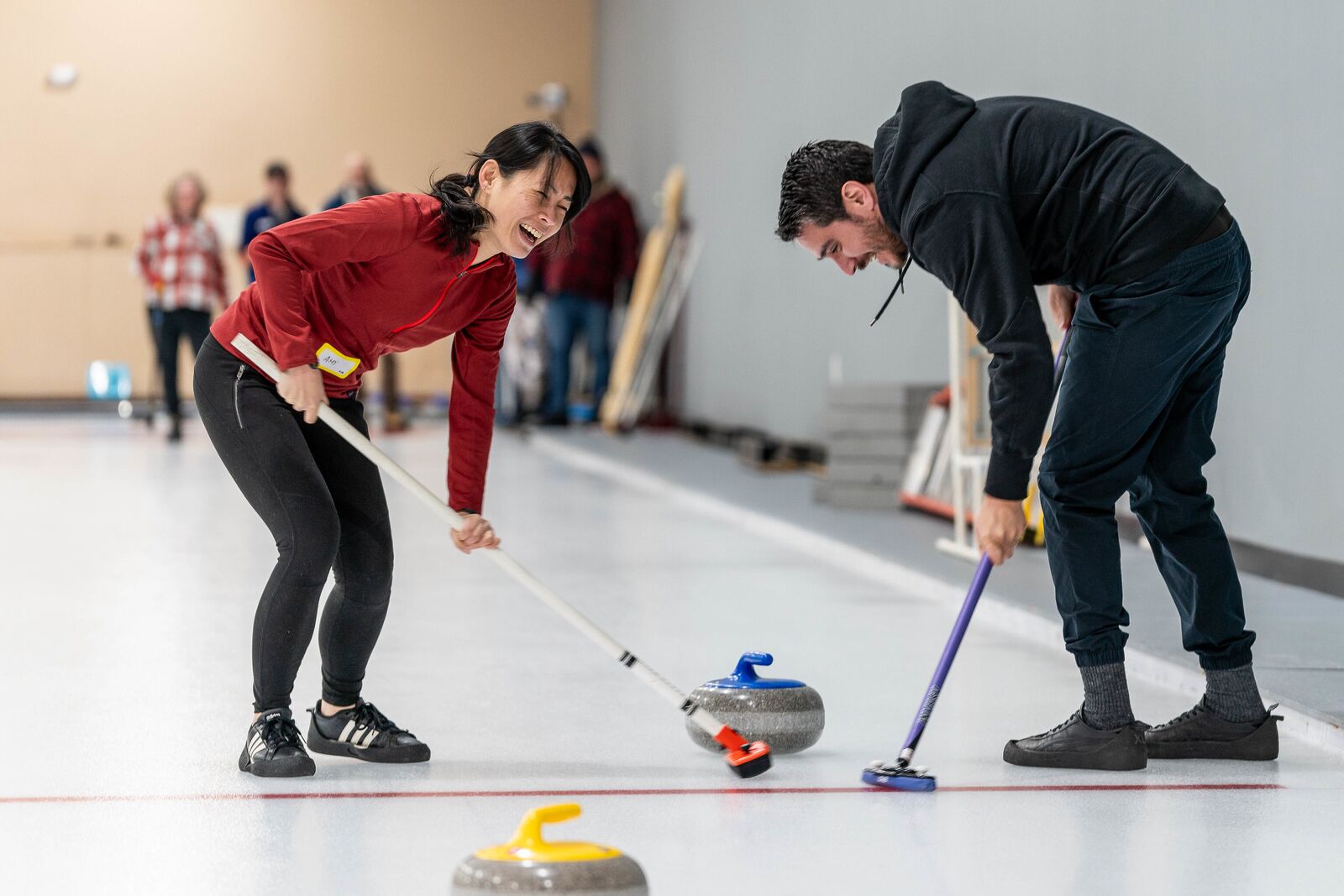 The San Francisco Bay Area Curling Club offers classes to learn the winter sport and a place to play. Credit: Courtesy of San Francisco Bay Area Curling Club
Coleman had come to an event like this one with her brother after watching the sport in the 2006 Olympics, figuring it would be a lark.
“We’ll take funny videos and laugh at each other,” she recalled thinking. “And the joke was totally on us, because we got down there and it was awesome.”
Three years later, she was competing in the U.S. Olympic trials.
It wasn’t easy for Bay Area curlers in those days, though. The club dates back to the 1950s, but before the Oakland facility opened, its members had to curl at hockey rinks, where the Zamboni-groomed ice made for a poor playing surface — it’s a bit like telling a golfer you don’t have a dedicated course, but they’re welcome to practice putting on the grass at a city park. Coleman, who lives in Mountain View, eventually stepped away from the sport when traveling to train at clubs in Seattle and Vancouver became too demanding.
The club’s new Oakland home is one of several dedicated curling facilities that have opened recently in places like Arizona and Georgia, far from the sport’s North American heartland in the upper Midwest and Canada. It makes a world of difference, said Coleman, who returned to curling in 2022 and now travels to competitions around the country.
“There’s much more ice time, and it’s high-quality ice,” she said. “You can train to play at an international level.”
Several people do — the club’s members include curlers who play on the national teams for Mexico, India and other countries.
To cap off our lesson, my squad faced off in an abbreviated game against other newbies.
We stole a point in the first end, the curling term for the rounds of play that are like innings in baseball, when my teammate placed a stone near the back of the eight-foot circle in the house. Nobody on the other side could get closer to the center, even with the advantage of taking the last shot. The other team came back to tie the game in the second and final end, though that was thanks to a rock their coach had pushed along with his broom after an errant shot.
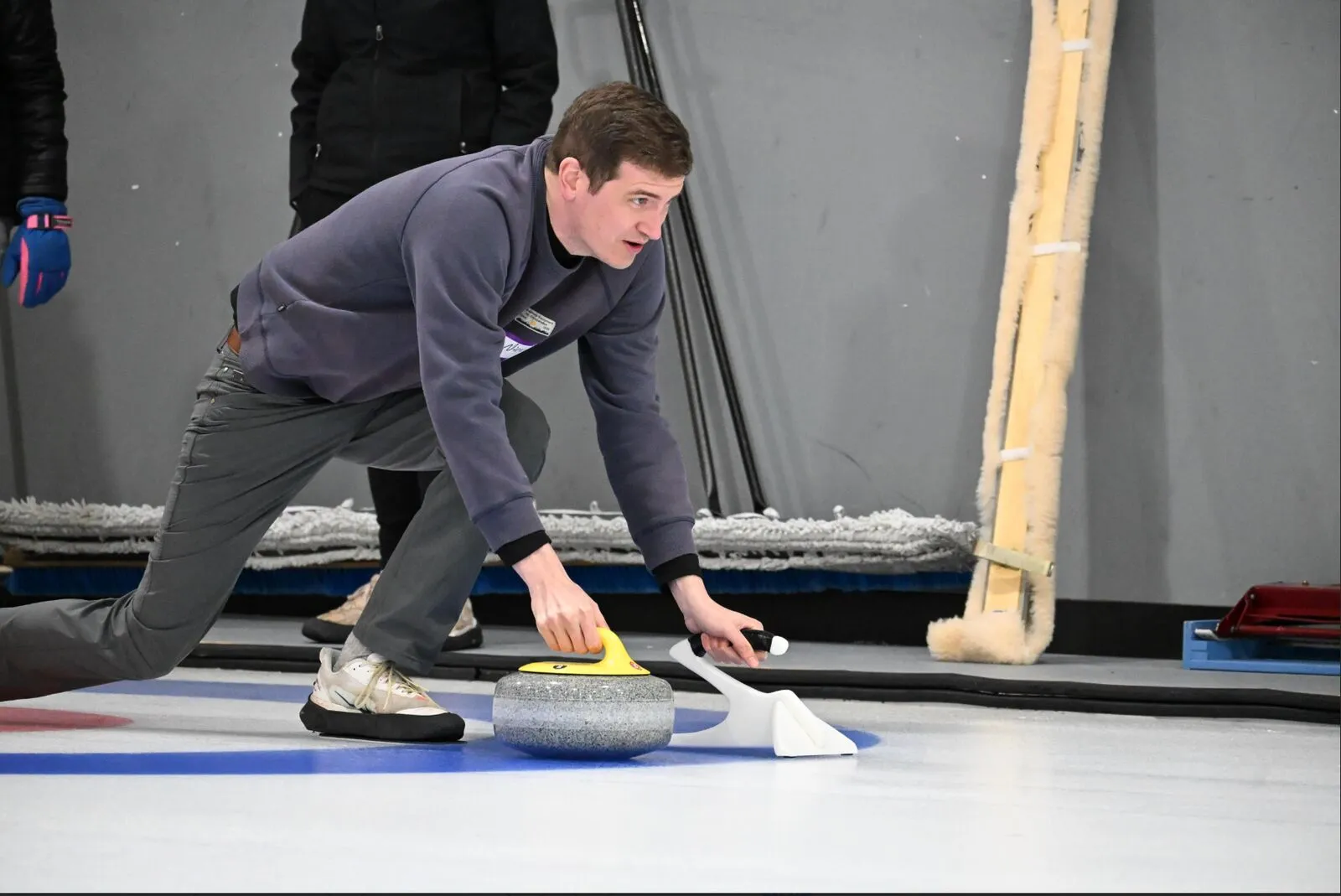 Nico Savidge, Berkeleyside’s news editor and City Hall reporter, throws a stone at a recent curling class at the San Francisco Bay Area Curling Club. Credit: Courtesy of San Francisco Bay Area Curling Club
My modest goal was to deliver a stone that stayed somewhere in the field of play, meaning it didn’t sail too far or stop too short to count. I managed that twice, and even threw an expertly placed guard on my second shot — never mind that the stone it protected belonged to the other team.
The club makes it easy for new members who catch the curling bug to get started: the $45 we paid for the introductory event included a drink ticket and a $40 coupon we could put toward a future class, like a four-week series of beginner lessons or novice-friendly pickup games on Friday nights. I don’t think this week’s class will be my last visit.
As players gathered to warm up over beer, wine and hot chocolate, Coleman told me it’s been exciting to see so many people give curling a try. Monday’s class was at capacity, and sessions in the coming days are full or close to it. She hopes people will be hooked not just by the game, but also the “amazing community” that you find in a curling club.
“There’s a real need for that at this moment in the world — to have something fun to do in community, and meet strangers [who] become family,” Coleman told me. “I hope that’s what curling brings to everyone right now.”
… We rely on your support
Hey, we know that most readers only scan a headline and a couple of paragraphs. Thank you for reading to the end of our story. Since you clearly appreciate the in-depth approach we take in reporting the stories that matter to Oaklanders, please consider chipping in to supercharge our newsroom.
“*” indicates required fields