
“We’re smart, we’re scrappy, we’re unconventional — but The Rogue can’t be stopped.”
That is how Executive Producer Yolanda Serrato defines the enduring ethos of the Rogue Festival as it celebrates its 25th anniversary in Fresno’s Tower District.
A quarter of a century after its founding, the festival remains one of the Central Valley’s most resilient cultural institutions, proudly grassroots, fiercely independent, and unwavering in its commitment to artistic freedom.
The 2026 Rogue Festival runs Feb. 27 through March 7, once again transforming the Tower District into a concentrated corridor of live performance. Over nine days, audiences move from venue to venue, encountering theatre, stand-up comedy, live music, storytelling, dance, burlesque, magic, spoken word and experimental performance, often within the span of a single evening. Schedules and ticket information are available at www.fresnoroguefestival.org.
The scale of the event continues to grow. According to the 2025 press release, last year’s festival featured more than 180 individual performances from roughly 45 performing groups across nine venues, underscoring the breadth and diversity Rogue brings to Fresno each season.
Yet the festival’s origins were far humbler.
Longtime Rogue veteran and supporter Jayne Day recalls that Rogue began in 2002 when founder Marcel Nunes hosted performances in his own backyard. “We call him the Godfather of Rogue,” Day said. By 2003, the festival had moved into the Tower District, where it has since evolved into a defining artistic fixture of the neighborhood.
Central to Rogue’s identity is its radically open structure. Serrato explains that the festival is “unjuried as long as it is not illegal.” Rather than relying on curatorial panels or aesthetic gatekeeping, participating productions are selected through a lottery system. The result is a democratic, unpredictable lineup that connects global artists with audiences in the Central San Joaquin Valley.
Unlike many fringe-style festivals, Rogue’s financial model is equally unconventional. “The tickets go directly to the artists,” Serrato said. “Rogue makes its money on wristbands and merchandise alone. No one on staff is paid. We’re all volunteers and still always looking for volunteers.”
The festival’s infrastructure is sustained entirely by community labor and participation: a model that allows performers to retain full box office earnings while reinforcing Rogue’s artist-first philosophy.
That independent spirit extends even further through “Off-Rogue,” a fully sanctioned but self-produced extension of the festival spearheaded this year by Day. While included in Rogue’s official website, printed program, and ticketing system, Off-Rogue operates without access to Rogue’s volunteer base or production apparatus.
“I found and paid for the venue on my own,” Day explained. “I find the people, find the artists, find the equipment — we get none of the Rogue machine.”
Despite the logistical challenges, Day sees Off-Rogue as an extension of the same artistic electricity that defines the larger festival.
When asked why audiences should attend, she responded simply: “Because there will be a show for just about anybody. That’s the magic.” She added, “You come to see a show and just get caught up in the excitement.”
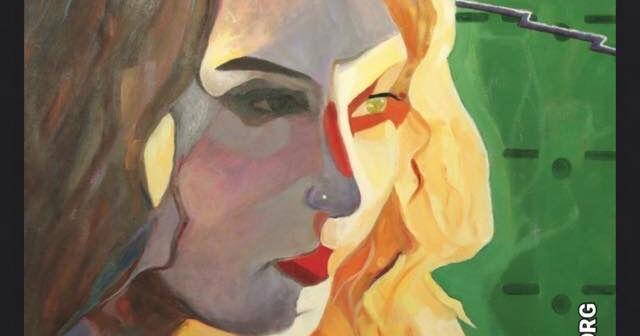
That sense of momentum and meaning is also reflected visually in this year’s Rogue Muse. On Feb. 12, the 2026 festival artwork was unveiled, created by German-born Fresno artist Petra Wolf, who has lived in the region for more than three decades.
Inspired by her daughter, Wolf’s painting took four weeks to complete. Embedded subtly in the background is Morse code spelling the word “mayday.” The muse wears a necklace shaped like a radio tower, a deliberate emblem of communication and distress.
“I wanted to put a printed word in it,” Wolf said. “I came up with the word ‘mayday.’ I put a necklace on the muse of a radio tower. I put the word ‘mayday’ in the background because of the times we are in right now.”
The hidden message functions as both warning and call to action: a quiet signal woven into beauty. Much like the festival itself, the artwork holds resplendence and urgency in careful balance: spectacle paired with substance.
Twenty-five years after its backyard beginnings, Rogue continues to defy expectations. It remains volunteer-driven, artist-centered, and structurally unconventional — yet remarkably sustainable.
Smart. Scrappy. Unconventional. And, if Serrato is correct, unstoppable.
JP Rapozo covers art and theater for The Sentinel.