
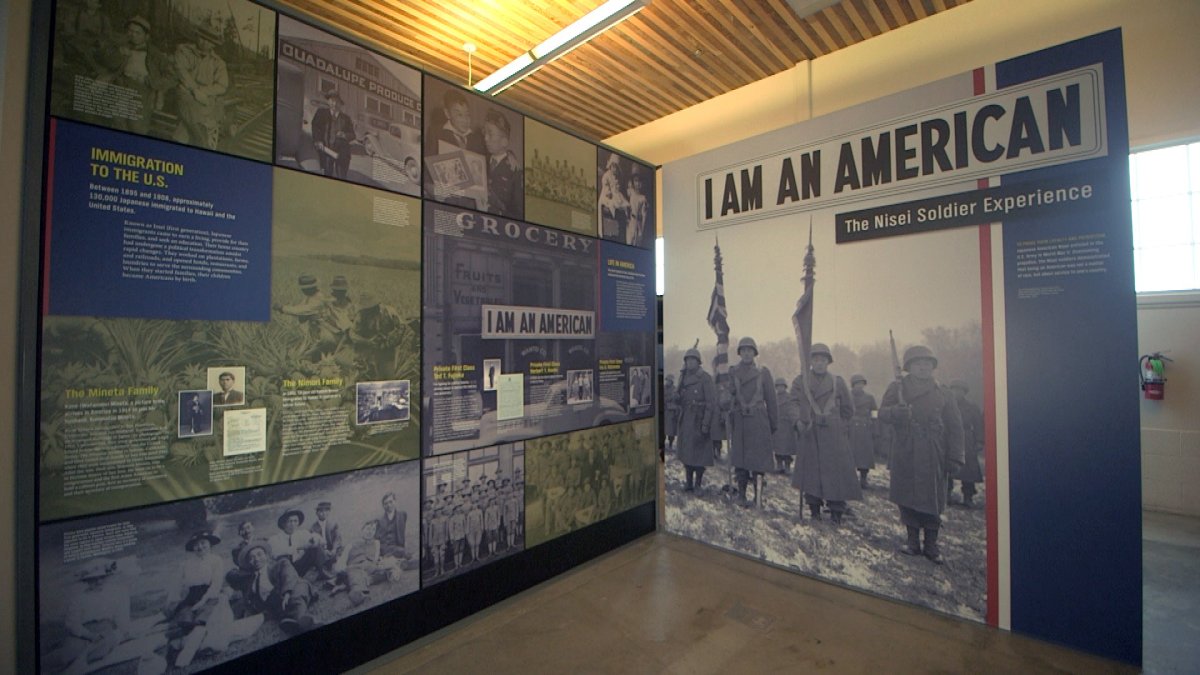
In the days and months following the attack on Pearl Harbor, drawing the U.S. into World War II, thousands of people of Japanese descent in the U.S. were forced from their homes and into incarceration camps in a wave of anti-Japanese racism.
In those same days, thousands of Japanese Americans enlisted in the U.S. military to fight for their country. A new exhibit aimed at telling their story opens on Monday in San Francisco’s Presidio.
The exhibit shines a light on the 33,000 second-generation Japanese Americans — known as Nisei — who fought for their country even as their relatives and friends were rounded up and sent to incarceration camps across the U.S over fears of their allegiances.
“For the Nisei soldiers, it was really about demonstrating their loyalty, their patriotism to this country,” said curator Christine Sato-Yamazaki of the National Veterans Network.
The exhibit, housed in a World War II-era building in the Presidio that once trained Japanese Americans to serve as translators and interpreters in the war effort, features 41 artifacts, including an army helmet worn by Medal of Honor recipient George Sakato.
There’s also a leather satchel upon which Army Sgt. Gary Uchida drew illustrations and names of the many places he visited during the war, including Europe and North Africa. There are military uniforms, including one worn by one of the women enlistees.
There are hundreds of photos, highlighting individual stories.
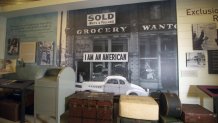
The exhibit is titled “I Am An American” after the famous Dorothea Lange photo of a grocery store in Oakland, whose Japanese American owner hung a banner reading “I Am an American” to announce his loyalty to the U.S.
Half of the Japanese Americans who answered the nation’s call immediately after Pearl Harbor were from Hawaii, with the other half from the mainland. They were placed in segregated Army units, including the famous 100th infantry/442nd all Japanese American Combat Battalion.
Joe Rosato Jr./NBC Bay AreaJoe Rosato Jr./NBC Bay Area
Photos in the new “I Am An American” exhibit in San Francisco’s Presidio highlight the experience of thousands of Japanese Americans who served in U.S. forces in World War II.
That group took part in one of the most historic battles of the war when the 442nd rescued 221 members of a Texas infantry division pinned down by German troops at a cost of 800 of the rescuers’ lives.
“The 442d regimental combat team is actually one of the most decorated military unit in military history,” said Sato-Yamazaki, pointing out a display dedicated to the event.
Sato-Yamazaki’s own grandfather was a member of the 442nd, and her family was sent to a camp in Arkansas during the war. Her experience echoed many Japanese Americans whose relatives never shared many details of that chapter of their lives.
“I think growing up we didn’t know the stories,” Sato-Yamazaki said. “They don’t pass it down, they don’t talk about it.”
Joe Rosato Jr./NBC Bay AreaJoe Rosato Jr./NBC Bay Area
Photos in the new “I Am An American” exhibit in San Francisco’s Presidio highlight the experience of thousands of Japanese Americans who served in U.S. forces in World War II.
Which is why Yamazaki thinks the contributions of the Nisei during World War II are lesser known in the stories of the war. Her hope is the traveling exhibit, which is going on a 10-city tour after it leaves San Francisco at the end of August, will be instrumental in spreading those stories.
“What we want to do is introduce this story again to the American public again but through the lens of learning individual stories,” Sato-Yamazaki said.
The exhibit, a collaboration between the National Veterans Network and the National Museum of the U.S. Army, opens in the MIS Historic Learning Center in the Presidio. It runs Feb. 23 through Aug. 31.