
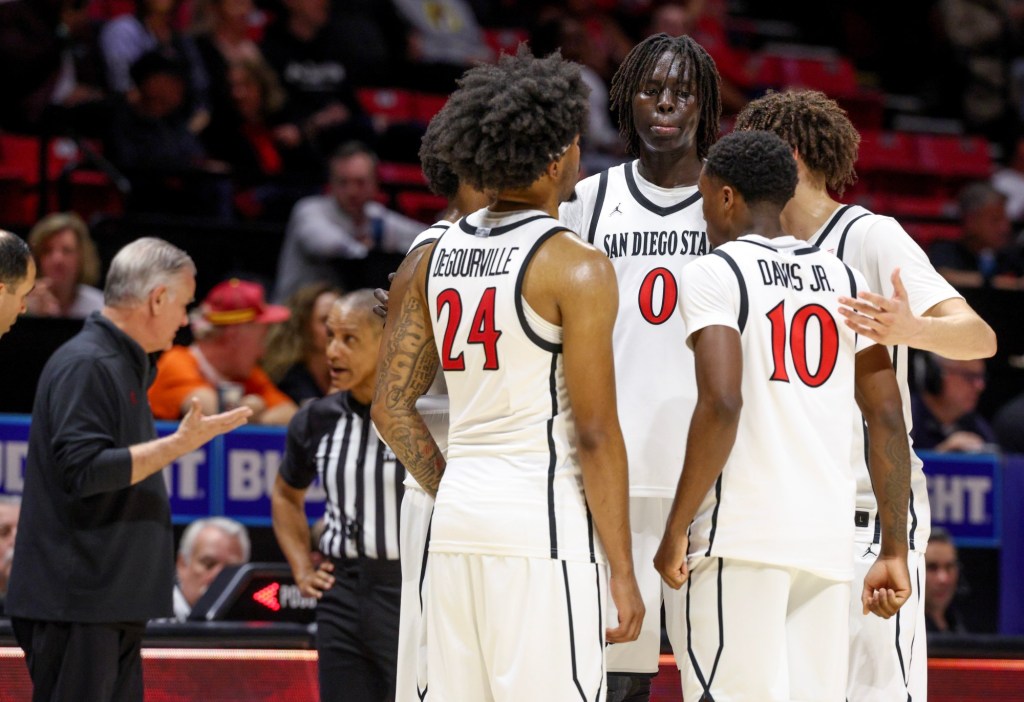
Three thoughts on San Diego State’s 73-63 loss against Grand Canyon on Tuesday night at Viejas Arena:
1. Decisions, decisions
Selection Sunday is three weeks from Sunday. For SDSU, it might also be Decision Day.
The Aztecs began Tuesday as the last team in the NCAA Tournament field according to ESPN bracketologist Joe Lunardi, meaning they’re almost certainly on the wrong side of the bubble now.
Meaning: If things stay that way and they don’t win the Mountain West tournament — something they’ve done only three times in the last 14 years — they could be in line for a three- or five-letter postseason tournament instead of their preferred four-letter destination.
Historically, the next 32 teams that don’t make the NCAA play in the NIT, which starts the Tuesday after Selection Sunday and involves home games for the higher seed.
Here’s where it gets complicated: The Aztecs can’t play the first two rounds at Viejas Arena because it is hosting the opening weekend of the NCAA Tournament this year.
A similar conflict occurred in 2009, when the Aztecs were one of the final teams left out of the NCAA field and went to the NIT. They beat Weber State at Viejas Arena on a Tuesday, then had to move to USD’s Jenny Craig Pavilion for the second round two days later against Kansas State because Viejas had the NCAA women’s tournament.
This year, they couldn’t even host the opening round. The NCAA games are Friday and Sunday, but, unlike in 2009, the NCAA now trucks in a special court for each venue that makes it unavailable to the host institution for the entire week.
That leaves three viable off-campus venues.
One is the new, 7,500-capacity Frontwave Arena in Oceanside, home of the G League’s San Diego Clippers, but it is booked most of that week. Another is UCSD’s LionTree Arena, but there’s a chance the Tritons could make the NIT and you wouldn’t want to risk “hosting” a game on your opponent’s home floor.
And then there’s USD again.
The bigger question, though, might be whether SDSU wants to play in the NIT or any other postseason event if they don’t make the Big Dance. The NIT isn’t what it used to be, a predominantly low- and mid-major tournament that last year included 15-19 San Jose State, three teams from the Big West and a UC Irvine-Chattanooga final.
The other option is the eight-team College Basketball Crown, held the first week of April in Las Vegas. The problem is it’s so late — it starts 17 days after Selection Sunday — and by then players are deep in transfer portal contemplation. The final is April 5; the transfer portal opens April 7.
The Aztecs, of course, would prefer it doesn’t come to that.
“I don’t really stress over that, because if we play the way we’re supposed to play and we win the Mountain West, we’ll find our way in there,” coach Brian Dutcher said of the four-letter tournament. “Or we’ll play good enough to win the conference tournament and play our way in.
“We’ll play our way in, or we’ll play our way out. But it’s in our hands, and that’s all I want.”
2. Gonzaga 2.0
SDSU will move to the Pac-12 next season, while Grand Canyon will remain behind in the Mountain West.
Good luck with that.
GCU is poised to become a dominant men’s basketball program in the new Mountain West — or Mountain WAC, as one coach (not so) affectionately calls it — in much the same way that Gonzaga was in the West Coast Conference. Their fellow members may regret inviting a deep-pocketed Christian university that doesn’t have the drain of football into a conference with large, financially-strapped public institutions dumping money into the gridiron.
It’s not a fair fight.
“They’ll have more resources than anybody that’s left in the Mountain West,” Dutcher said. “They may have the most resources now, because they don’t have football. They have men’s basketball and everything is sent in that direction. They’ve done a great job building that program.
“It’s a roster that’s very talented and they’re very well coached. When you’ve got talent and good coaching, you’ve got a chance to win anywhere.”
There are 11 transfers on the roster, including the entire eight-man rotation from Tuesday night.
Brian Moore Jr. was the mid-major player of the year last season at Norfolk State after averaging 18.1 points and shooting 54.5%. Brown transfer Nana Owusu-Anane had offers from all four power conferences, most notably Kansas. Efe Demirel is a 7-foot-1 pro center from Turkey who logged minutes in the prestigious Euroleague and was named one of 10 rising stars at the FIBA U18 European Championships in 2023. Jaden Henley from UNLV was one of the top Mountain West transfers.
The three guys off the bench came from Louisville, Gonzaga and Washington.
What did that cost? $5 million? $6 million? More? (SDSU is at $2.7 million this season for men’s basketball.)
“I don’t want to say it’s all about that,” Dutcher said. “There are a lot of teams that spend a lot of money on NIL that don’t have any success. But if you look at their talent, they have guards who can get to the basket and their bigs are very talented.
“And when you get a big like Nana who was supposed to go to Kansas and changes his mind to go to Grand Canyon, that doesn’t happen for free. That doesn’t happen easily. They’ve got good players.”
3. The spoiler
Grand Canyon, remember, wasn’t supposed to join the Mountain West until next season.
It has become a point of contention in the legal spat between the five “Pac-stabbers” and the Mountain West over exit fees. The five accuse Commissioner Gloria Nevarez of “fraudulently concealing a plan to covertly add Grand Canyon” before they officially gave notice of their departure and forfeited voting privileges.
The complaint adds: “Further, on information and belief, the Mountain West and the remaining members stand to receive certain benefits from Grand Canyon’s admission that will not be shared with Plaintiffs.”
That, presumably, is an additional early-entry payment beyond the negotiated entry fee. No dollar amount has been publicly disclosed, but let’s say it was a couple extra million.
The great irony: It could backfire spectacularly.
Grand Canyon hasn’t built a tournament-worthy resume, but it could play spoiler. It has already swept the regular-season series against both SDSU and Boise State, two teams with NCAA aspirations that are leaving for the Pac-12. The Torvik metric allows you to tinker with results, changing wins to losses or dropping games altogether to see how they impact tournament chances, and SDSU would firmly be in the field without the pair of GCU losses. Boise State wouldn’t be a lock, but it would be in the conversation.
NCAA Tournament payouts go to the conference, not individual schools, and whatever the departing schools generate will stay behind with the Mountain West. Each appearance is worth at least $2 million to the conference over the following six years, and it increases with each victory.
If Boise State and SDSU both make it, that’s an extra $4 million minimum for the Mountain West. If neither makes it, that’s $0 for the Mountain West.
The Mountain West likely got extra money by adding Grand Canyon a year early. But did it lose more?