
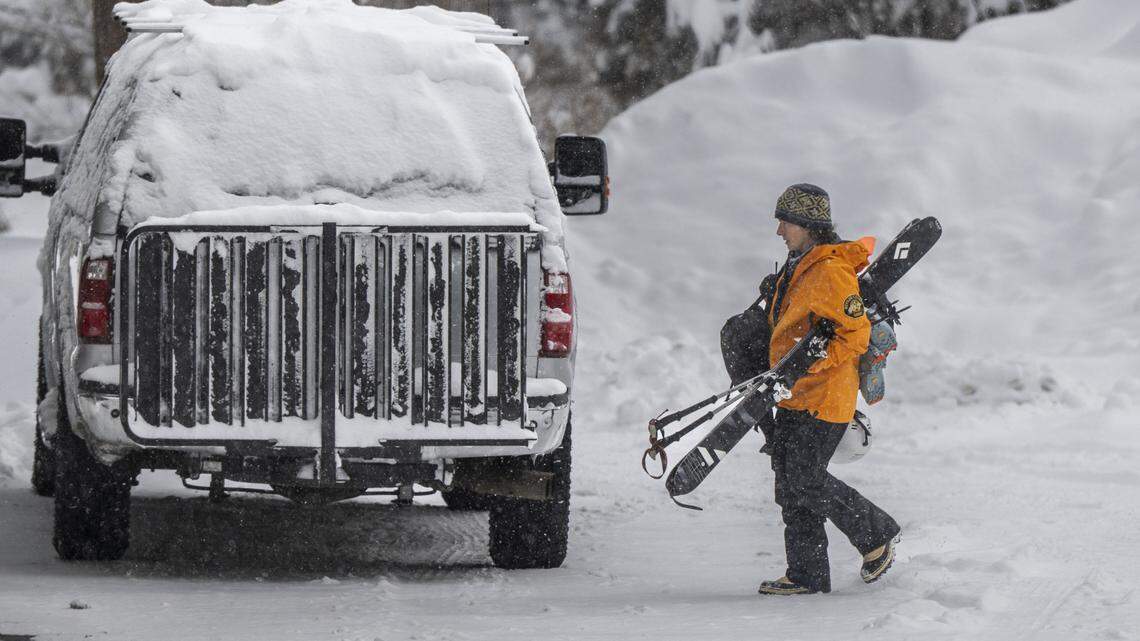
Eight people trapped in an avalanche near Truckee have been found dead, while one person remained missing, authorities said Wednesday, noting that the search and rescue for the 15 people caught in the slide near Castle Peak had moved to a recovery mission.
It is the deadliest avalanche in California since at least 1951, and one of the deadliest in the nation, according to the Colorado Avalanche Information Center.
The group of backcountry skiers included four ski guides and 11 clients and were at the end of a three-day tour when the avalanche struck around 11:30 a.m Tuesday. Once Nevada County Sheriff’s Office officials were able to reach the skiers Tuesday evening, six were alive. Two were taken to a hospital.
Nevada County Sheriff Shannan Moon said the last person in the group who had not been found was presumed dead.
“Our mission now is to get them home,” she said of the people who died, “and making sure that we’re doing it safely and in constant conversation with those families.”
Before Tuesday’s avalanche, the deadliest California avalanche on record killed seven people at Alpine Meadows in March 1982.
Avalanche search update
Moon said the Sheriff’s Office was still in conversation with guide company officials about the decision to take the three-day trip in such perilous conditions. The avalanche came amid a powerful winter storm that has dumped multiple feet of snow in the mountains and prompted warnings of high avalanche danger in the Lake Tahoe backcountry.
The incident occurred in the Castle Peak area, where a snowmobiler died in a similar slide at the start of the year and where three other fatal avalanches have happened since 2012. It is popular with backcountry skiers.
The tour was led by Blackbird Mountain Guides and the group had been staying at a lodging area known as the Frog Lake Huts. It has a communal area with a kitchen, fireplace, and sleeping quarters.
A post on the company’s Instagram page three days ago warned about avalanche hazards. It featured a video in the area of Mt. Rose, which is in Nevada and about 25 miles from where the incident occurred.
“As we move into a large storm cycle this week, pay close attention to places where faceting has been particularly strong — avalanches could behave abnormally, and the hazard could last longer than normal,” it said.
Moon said the guide company had been “very cooperative” in providing information from the trip and members of the group had responded with rescuers.
“They wanted to do everything that they could to assist,” she said.
Blackbird Mountain Guides lists avalanche safety courses, guided by the American Institute for Avalanche Research and Education, as among their offerings.
The research organization told The Sacramento Bee in a statement it “was not involved in the planning or on-the-ground operations” of the trip.
“Travel in avalanche terrain involves inherent and dynamic risk,” the statement said.
Sheriff’s Office Capt. Rusty Greene said Wednesday that those who survived reported that someone saw the avalanche occurring and yelled before the group was overtaken by the snow. The group was “fairly close together,” when it occurred, he said.
The six survivors had sheltered in place and attempted to locate missing members of their group before rescuers arrived, Moon said. Three deceased skiers had been located prior to the arrival of search teams.
Rescuers reached the survivors after 5:30 p.m. Tuesday after traveling to the site using a specialized snow vehicle and then reaching the area on skis. Moon said it took several hours to take those rescued from the site of the avalanche to the trailhead, where ambulances were waiting to take the injured people to the hospital.
Difficult weather and safety conditions were affecting the search for the final person, Moon said. The people who died were from multiple states, said the sheriff, who declined to release their names during a midday press conference Wednesday.
Families of the victims are “still reeling,” she said. Moon noted that an investigation into the tragedy is ongoing.
Ski community reacts to the news
Skiing is a community bond in Truckee and other Tahoe area mountain towns. News of the catastrophic avalanche cut a wide swath through that community, even as people tried to enjoy skiing a fresh blizzard’s deposits after a long drought of new snow.
At RMU Truckee, a combination ski shop and cocktail bar that is a mainstay of the historic downtown, employee Mac Coppes hurried to set up for the 2 p.m. opening – with his snowpants still on and his face flush from skiing at Sugar Bowl Resort.
A backcountry skier as well, Coppes only remembered to turn off his beacon — the transmitting device worn when traveling in avalanche terrain — when approached by a reporter. He’d kept it transmitting from his pocket, given the deep new snowfall, even though he’d been skiing at the resort.
A three-year resident of the area, Coppes said the threat of avalanches is always there for skiers, but that it’s a fear that can fade in intensity over time. After Tuesday’s tragedy, it was front of mind.
“It just makes it more real for everyone,” he said.
Down the street at Tahoe Dave’s Ski and Boards, a longtime area staple with five shops spread through the mountain towns, Yvonne Moore said it was the size of the group caught by the avalanche that shook her and other locals she spoke too.
Striking too, she said, was the intensity blizzard this week. Even by the Sierra range’s high standards, snow had been coming down at a remarkable pace. “This storm was massive,” she said.
Because the guides were likely local residents, she said, grieving would spread community wide and was “certain” to touch Truckee.
Concerning conditions Tuesday
Tucker Norred, a marketing manager at Boreal Mountain, a ski resort across Interstate 80 from one of the access points to the Castle Peak area, said Wednesday morning that the recent storm came on in layers that particularly exaggerated the avalanche danger.
High avalanche conditions arise in the northern Sierras when cold storms follow warm spells, Norred said. “I’ve been back there and I would not want to go out there on a day like yesterday.”
This week’s snowfall started wetter and heavier on Monday. It fell on a snowpack that hadn’t seen significant accumulation since a series of storms around Christmas, with the exception of one snowfall on Feb. 10. That layering of heavy snow on top of the older snowpack fueled the conditions that likely allowed for Tuesday’s large avalanche, according to the Sierra Avalanche Center.
Chris Feutrier, a forest supervisor of the U.S. Forest Service’s Tahoe National Forest, said the avalanche path was about the length of a football field and was triggered when a “persistent weak layer” of snow collapsed under a heavy load of new snowfall.
Moon, the sheriff, said rescuers were facing “horrific” and “whiteout conditions” that made their work more difficult.
“I myself like to recreate in that area,” she said. But mother nature,” she said, “it doesn’t seem to matter.”
An avalanche warning remained in effect until Thursday morning in the central Sierra Nevada Mountains between highways 49 and 4, according to the Sierra Avalanche Center. Avalanches are expected to continue in backcountry areas.
The California Department of Transportation reopened eastbound Interstate 80 Wednesday morning. Westbound I-80 was also open to vehicle traffic as were both directions of Highway 50.
This story was originally published February 18, 2026 at 10:49 AM.
Related Stories from Sacramento Bee
The Sacramento Bee
Stephen Hobbs is an enterprise reporter for The Sacramento Bee’s Capitol Bureau. He has worked for newspapers in Colorado, Florida and South Carolina.