
A new report from Amcha Initiative, a watchdog group that tracks antisemitism and anti-Zionism on college campuses, examines the prevalence of anti-Israel activism among faculty at three University of California schools.
The report, released Feb. 11, documents what it sees as harmful patterns at UC Berkeley, UC Santa Cruz and UCLA during the 2023-2025 academic years. It asserts that a surge in on-campus hostility toward Zionism and Israel since the Hamas massacre on Oct. 7, 2023, is linked to faculty and departments using “academic authority and university platforms to engage in anti-Israel activism.” Such efforts, the report states, have “fueled harassment, intimidation, and exclusion of Jewish and pro-Israel students.”
Tammi Rossman-Benjamin, Amcha’s co-founder and director who previously taught Hebrew and Jewish studies courses at UC Santa Cruz, said that this is the seventh study since the group’s launch in 2012 that has focused specifically on faculty. She authored the study with Amcha co-founder Leila Beckwith, emeritus professor at UCLA.
“We’ve built a case looking at anti-Zionist faculty activism and how it’s just so inconspicuously correlated with antisemitic activity on those campuses,” Rossman-Benjamin told J. “And I don’t mean speech. I mean harassing Jewish students, vandalism, assault, denigration, suppression of speech — measurable actions that have been taken against Jewish members of the campus community.”
A UC Berkeley spokesperson disputed the findings, saying they were derived using “unreliable sources.”
While public discussion often frames activism as student-driven, the report states, Amcha contends that faculty and academic departments play a central role by embedding political advocacy into courses, programming and official communications.
According to Amcha, many faculty members have publicly endorsed academic boycotts of Israeli institutions.
The Palestinian Campaign for the Academic and Cultural Boycott of Israel, a primary organizer of this effort, charges that Israeli universities as “major, willing and persistent accomplices in Israel’s regime of military occupation, settler-colonialism, apartheid, and now genocide.” It calls for academics to boycott “complicit Israeli institutions” by refusing any form of academic and cultural cooperation with them.
As of June 2025, 171 faculty members at UC Berkeley and 55 at UCSC were reported to Amcha’s database of faculty who have endorsed publicly accessible statements or petitions in support of an academic boycott.
“An academic boycott, unlike an economic boycott, actually calls for essentially denormalizing Israel, Zionism and Zionists on campus and in classrooms,” said Rossman-Benjamin. “This hurts any student or faculty member who wants to study or learn about Israel, but it disproportionately hurts Jewish students and Jewish faculty.”
Berkeley’s cohort of academic boycott supporters is among the largest documented at any U.S. university, according to the report. During the 2023-2025 academic years, these boycott supporters chaired or directed at least 19 Berkeley academic units, including African American studies, the Arts Research Center, the Asian American Research Center and the Center for Interdisciplinary Inquiry.
At UCSC during the same period, several academic boycott supporters likewise held leadership positions, including as campus provosts and directors of academic units such as sociology, film and digital media, critical race and ethnic studies, the Center for Middle East and North Africa, and the Center for Racial Justice.
The report contends that when faculty who are in leadership roles that shape curricula support the boycott, divestment and sanctions (BDS) movement, they can create one-sided programming and recurring activist messaging under academic authority.
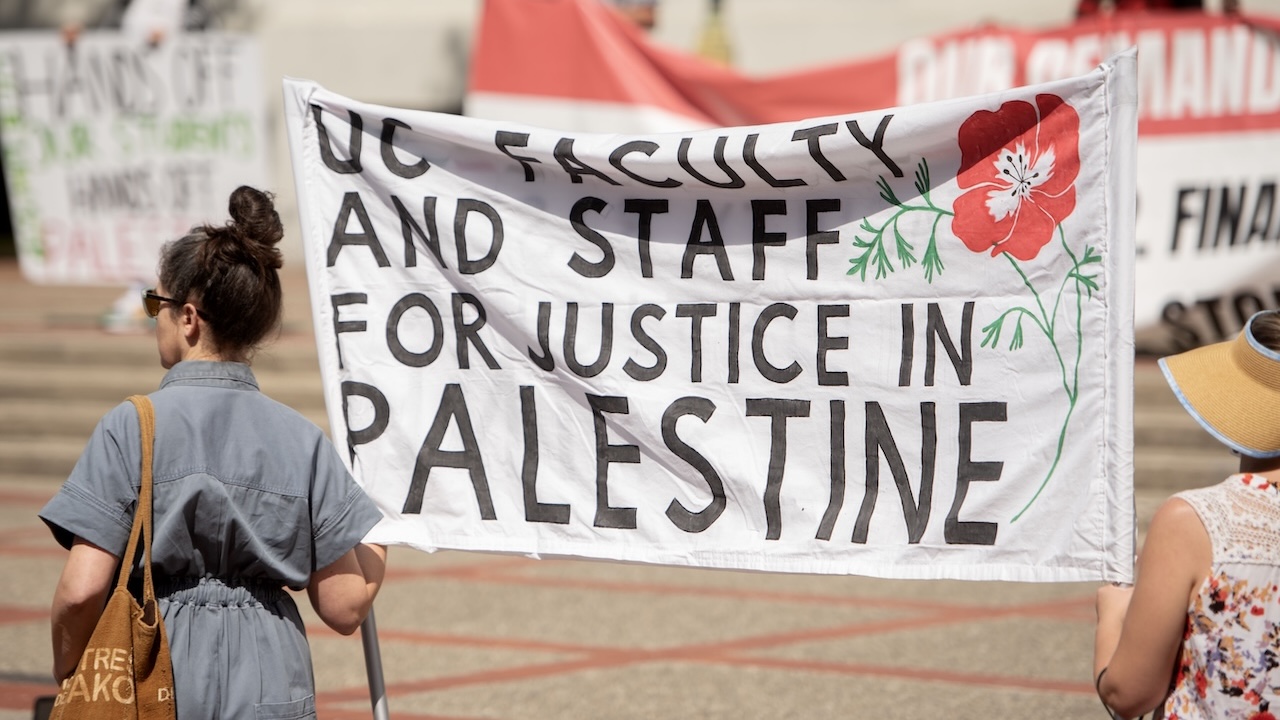
The report also examines participation in Faculty for Justice in Palestine, and Faculty and Staff for Justice in Palestine, both of which Amcha describes as the “vehicle for converting academic BDS ideology into recurring campus campaigns.” These organized faculty groups coordinate anti-Israel advocacy, co-sponsor events, promote political messaging and mobilize support in ways that the report says shift academia toward advocacy rather than neutral scholarship.
“What was wrong with what was happening wasn’t that it was anti-Israel,” said Rossman-Benjamin. “It was inappropriate for any kind of political advocacy like that to happen in a public university, classroom or conference hall.”
Dan Mogulof, assistant vice chancellor of UC Berkeley, told J. in an email that the university disputes Amcha’s claims and has an “unwavering commitment to supporting a campus community where every individual can feel safe, respected, and welcome without regard for their origins, identities, beliefs, or perspectives.”
He added: “While we appreciate this organization’s dedication to confronting antisemitism, it is unfortunate that no apparent effort was made to seek information directly from the campus and/or confirm information that appears to have been gathered from unreliable sources.”
Mogulof noted that the Anti-Defamation League’s 2025 “report card” rated the quality of Jewish life on the Berkeley campus as “excellent” and rated the administration’s response to antisemitism as being “above expectations.” He added that UC Berkeley has a “proven and long-standing commitment” to enforcing UC Regents policies that prohibit the use of the classroom for political indoctrination or political advocacy of any sort.
“Regarding the report itself, we can only note that much of what it describes is constitutionally protected expression occurring outside the classroom and/or refers to extracurricular events that no student is required to attend,” Mogulof said. “Contrary to claims in the report, we are aware of only a single instance in which questions were raised about an academic unit’s compliance with that policy. Suffice it to say that, in this one instance, the administration responded immediately to ensure the necessary changes were made.”
Scott Hernandez-Jason, assistant vice chancellor of UC Santa Cruz, told J. in an email that “antisemitism has no place at UC Santa Cruz.” The university has the responsibility “to foster a campus environment in which all students learn from each other and can express their identities freely and without fear,” he said.
“We know that incidents at universities across the nation, including our own, have been especially difficult for Jewish students,” Hernandez-Jason added. “We have been working to address the concerns of individual students when their education and sense of belonging are impacted, while also focusing on strengthening our overall campus climate to foster a sense of belonging for all students and engender a shared responsibility to live that value in our daily lives and practices.”
Related
J. covers our community better than any other source and provides news you can’t find elsewhere. Support local Jewish journalism and give to J. today. Your donation will help J. survive and thrive!