
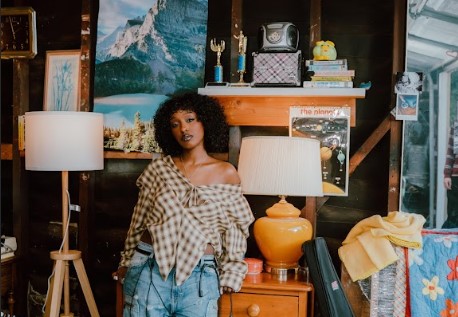
For Alemeda, the chaos of the road doesn’t feel like disruption. It feels familiar.
Growing up between two drastically different worlds — Ethiopia and Arizona — taught her to live within contrast: culture, expectations, identity, and the ever-shifting ground beneath her feet. Now, as the rising artist prepares to bring her “But Where The Hell Should I Know” headlining tour to Los Angeles at The Roxy on Feb. 26, she says that same instability has become an unlikely kind of training for the reality of being a working musician.
“Moving back and forth a lot, I got used to the chaoticness, no stability,” Alemeda said in a recent phone interview. “And I think all of that kind of helps me now, because I feel like being an artist is the most least stable thing you could ever choose to be. Financially, the success you receive from it. You can work 100 hours a week and you just get nothing. You just have to be okay with the fact that you’re putting into it.”
That acceptance, paired with a clear-eyed confidence, threads through her new EP “But What The Hell Do I Know,” a raw, self-questioning project that tracks the difference between who she was at 19 and who she’s become in her mid-20s. The EP also arrives as Alemeda continues carving space in alternative music as a Black woman blending pop, rock, and indie without asking permission to fit neatly into anyone’s genre expectations.
Hollywood Bowl’s summer shows include Foo Fighters with Gustavo Dudamel, more
“I always say a lot of my music is just super representative of my growth and just how I view the world,” she said. “As a woman, you don’t really become who you are until way later in life, because you’re constantly fed so much about how you should be and how things should go for you.”
Looking back at her earliest work, Alemeda doesn’t romanticize it, she contextualizes it.
“From my first EP to this, you could really feel the difference in how angry I was, just how certain things made me feel,” she said. “The recent EP was a better representation of how I feel about things as a 25, 24-year-old, versus the first EP I wrote when I was 19.”
When asked if there was a specific turning point that shaped the EP, Alemeda laughed, then offered what might be the most Gen Z answer possible.
“I always say me feeling like my frontal lobe is developed is what shaped the whole EP,” she said. “Because I feel like even the title of it, it’s genuinely that feeling of like, ‘Oh, I don’t know anything I thought I did.’ You have to humble yourself and really understand a lot of things you thought you did, and now you realize you didn’t.”
Black History Month 2026: A new ‘Sinners’ exhibit in LA champions the film’s achievements
That tension also mirrors her experience in an industry that still too often tries to categorize artists of color based on assumptions instead of what sound they produce.
“I’ve been pretty much open about the struggles of not being boxed into things that I’m just simply not,” she said. “A lot of people of color who are in the alternative genre really go through that, especially Black women.”
Still, she says she’s felt something begin to shift in recent years, not only because more artists are breaking the same barriers, but because audiences are getting better at listening without defaulting to stereotypes. “I think it is shifting,” Alemeda said. “I almost don’t even have to defend myself. I almost never have to come online and be like, ‘No, I’m not this. I’m this.’ Fans will do it for me.”
She remembers earlier days when she felt responsible for constant course correction.
“I was doing a lot of the physical, verbal correction very early on,” she said. “And now I’m kind of just like, ‘No, I’m just gonna show you,’ because actions speak louder.” That conviction extends to the way she performs and how her voice has become a new focal point. Alemeda pointed to a moment on the EP where she pushed herself vocally, inspired by Paramore’s Hayley Williams.
“There’s a note that I hit that’s very similar to Hayley Williams ‘All I Wanted Was You,’ that crazy belt,” she said. “That specific note, Doechii told me to do. She didn’t even want to turn the song in until we got it done because she felt like the song needed that.”
Ahead of her first full-length headlining run, Alemeda says she’s been preparing in every way she can. Physically, mentally, and creatively. “I’m just really excited, it’s my first full-length tour,” she said. “So I’ve been really doing the most to actually prepare for it. With movement lessons, vocal lessons, just planning out things for all my supporters. Cool stuff to happen throughout the show.”
Touring, for her, isn’t something to endure. It’s something she genuinely misses. “With the hecticness, I had a super hectic childhood so the touring life almost feels like home to me,” she said. “I miss it. Personally, it’s not even a bit uncomfortable for me.”
When Alemeda brings that energy to The Roxy on Feb. 26, she says she wants it to feel intimate, like a room full of people sharing the same frequency. “Fun, intimate and super chill,” she said. “The world that I’m creating for it is just like a bunch of friends hanging out. I love to talk to people and really get to know everybody there.”
Because she’s still early in her career, she treats that closeness as something precious and temporary. “I still have the opportunity to remember faces and remember names,” she said. “Every show I’ve done… I literally remember every single person from Twitter, Instagram.” And as she steps into this next era with an EP out, tour underway, and momentum building, Alemeda describes the chapter in two words: forward motion.
“I think it’s just go mode for me right now,” she said. “I want to put out the most music I’ve ever put out. I don’t even want to think about it. No second-guessing.”