
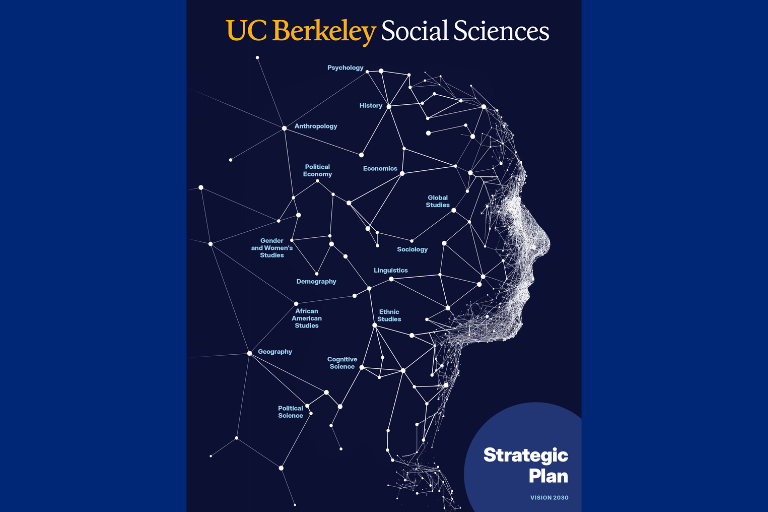
UC Berkeley’s Division of Social Sciences has unveiled a new five-year strategic plan aimed at strengthening its leadership in social science research, education and community engagement in California and around the world.
Developed after more than a year of consultation with faculty, staff and students, the plan focuses on equipping students and faculty with the skills, training and resources needed to address complex societal challenges.
Berkeley Social Sciences Dean Raka Ray, who spearheaded the plan, emphasized the importance of the social sciences in today’s rapidly changing world.
“The lessons of the Social Sciences have never been more important,” Ray said. “In an age where societies are confronting the future of democracy, inequality and environmental crises, we see Berkeley’s Social Sciences as not only a foundation for education but a guiding force for navigating these challenges.”
The strategic plan centers on three pillars: innovative research, transformative education and community building. The initiatives are designed to reinforce the Division’s role as a global leader in scholarship that addresses real-world problems, while expanding access to high-quality education and strengthening connections beyond campus.
“The long-standing comprehensive excellence of Berkeley’s social science research and teaching demands just this sort of thoughtful, intentional and ambitious planning for the future,” UC Berkeley Chancellor Rich Lyons said.
Innovative and Impactful Research
The plan’s first pillar focuses on strengthening Berkeley Social Sciences’ long-standing reputation for transformative research. Faculty in the Division are internationally recognized for work on democratic governance, socioeconomic inequality, climate change, cognitive development and other pressing issues.
They regularly secure major external funding for projects addressing racial and gender justice, economic development, mental health, energy systems and indigenous language revitalization. In recent years, the Division has attracted $269 million in external research funding, and its current faculty and faculty emeritus include six Nobel laureates, nine MacArthur Fellows, 25 members of the National Academy of Sciences and more than 130 members of the American Academy of Arts and Sciences.
“Now, during a time of dramatic societal changes and challenges, we need more than ever the insights and teachings, the analyses and discoveries of the extraordinary faculty members, who have made Berkeley’s Social Sciences Division an academic powerhouse,” Lyons said. “The social sciences are uniquely suited and situated to help us understand what is happening and to lead our exploration of the options available for addressing social challenges and opportunities that lie ahead.”
A key goal of the plan is to strengthen research infrastructure to support faculty and graduate students, while expanding the reach of research findings beyond academia to policymakers, community organizations and the public.
“These investments in research infrastructure will support the Division’s long tradition of bringing research insights and conceptual frameworks out of academia and to the public, the media, practitioners and policymakers to shape the public discourse about some of our most pressing social problems,” Sociology Chair Dave Harding said.
Transformative Education for the Next Generation
The second pillar centers on teaching the next generation through educational opportunities that are accessible, inclusive and impactful. More than one-third of the Division’s 6,947 undergraduates are the first in their families to attend college. About 29.4% of undergraduates come from communities of color, and women make up nearly 55% of Social Sciences students, compared with 40% across campus.
Students are trained to analyze social structures, historical legacies, global interconnections and processes of change. They have access to a wide range of courses in traditional disciplines such as economics, sociology, psychology, political science, ethnic studies and history, as well as interdisciplinary programs in global studies, political economy and cognitive science. Students can also choose nontraditional offerings like a master’s in Computational Social Science and a Ph.D. minor in Global Metropolitan Studies.
“We give students a place where their perspectives and experiences are valued, while providing them with tools from field leaders who are working to create positive change,” Anthropology Chair Sabrina Agarwal said.
The plan outlines three teaching goals: reducing barriers to student success, developing pedagogy for contemporary challenges and reimagining graduate education. Faculty combine large lectures with small, interactive classes that emphasize collaboration, debate, case studies, field experiences and digital tools.
As higher education adapts to new technologies such as generative AI, shifting student needs and funding pressures, the Division intends to refine its teaching strategies to create new pedagogies for a changing learning environment.
Building Community
The plan’s third pillar emphasizes community building within Berkeley and beyond. The Division employs more than 160 staff members who support students through academic advising and assist faculty with curriculum development and research.
Programs such as the Advancing Faculty Diversity initiative and Emerging Scholars Reading Groups bring together students, faculty and community members. Centers such as the Social Sciences Matrix and the D-Lab, and initiatives such as Global Democracy Commons and the Black Studies Collaboratory foster cross-disciplinary collaboration and community-engaged scholarship.
The Division also connects classroom learning to real-world experiences through the Social Sciences Career Readiness Internship Program, which provides undergraduates with workforce training and places them in paid internships to prepare for meaningful careers.
Berkeley’s Social Sciences engages with broader communities through its work with policymakers, community partners and alumni to ensure that the Division’s research and education have greater societal impact.
“Community is at the heart of everything we do — from supporting our students and faculty on campus to partnering with alumni networks around the world to turn knowledge into impact,” said Anya Essiounina, Berkeley Social Sciences’ interim assistant dean for development.
The strategic plan lays out a clear path for strengthening Berkeley Social Sciences’ impact at a time of accelerating global change. By investing in research excellence, expanding access to high-quality education and deepening partnerships beyond campus, Ray said, the Division aims to ensure its work continues to “inform public debate, shape policy and prepare students to lead and improve a complex world for generations to come.”
“Dean Raka Ray’s vision and foresight shine through this bold strategic plan, reaffirming Berkeley’s global leadership in innovative social science research, while ensuring our students gain a truly multidisciplinary education that prepares them for the most urgent challenges, now and ahead,” said Political Psychology and Legal Studies Alumna Shaudi Fulp, who is a member of the Dean’s Advisory Council.
Read the full strategic plan here.