

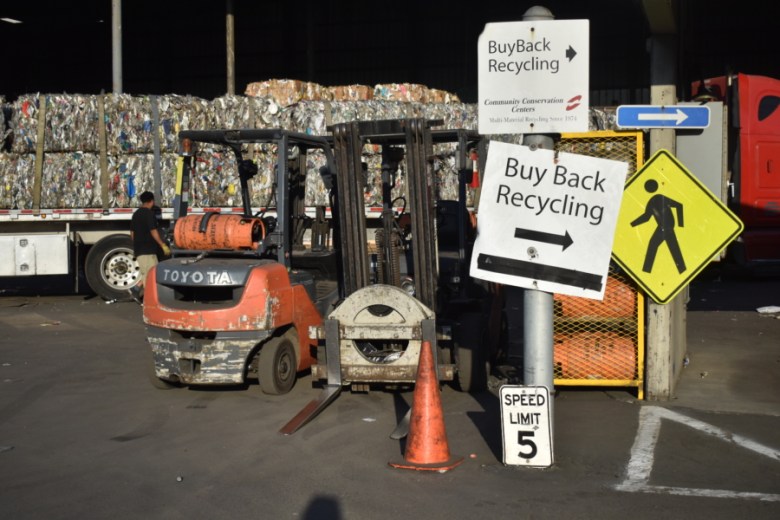
 Berkeley signed a five-year, no-bid contract with Community Conservation Centers to process the city’s recycled materials in 2021. An audit found the deal should have been subject to competitive bidding. Photo: Supriya Yelimeli
Berkeley has awarded tens of millions of dollars in contracts that weren’t subjected to a competitive bid process, according to a new report, which could lead to the city paying too much for goods and services, or create opportunities for corruption.
The investigation by the office of City Auditor Jenny Wong found Berkeley often used non-competitive contracts in cases where it should have solicited for other bids, including in two deals for recycling services worth a combined $41.4 million, which are up for extensions soon.
The auditors did not uncover evidence of misconduct by employees, nor did they identify any specific cases where Berkeley would have gotten a better deal if it had solicited bids from multiple prospective contractors. But the audit, released Thursday, called for an overhaul of what it described as outdated bureaucratic processes that contribute to the city’s reliance on no-bid deals, noting that the competitive process “can discourage favoritism and guard against waste and fraud.”
The city entered into 94 contracts, worth a total of $43 million, without documented competition in the 2024 fiscal year, according to the audit. That was during the tenure of Berkeley’s previous city manager, Dee Williams-Ridley.
Current City Manager Paul Buddenhagen broadly agreed with the audit’s recommended changes, according to the report.
Some are already being implemented — for example, several city departments have begun using digital contract management software to approve agreements that, until recently, had to be printed out and hand-delivered from one office to another around City Hall. That process took more than a month, on average, and the audit identified cases where contracts were lost or wound up sitting for days at a time on the desks of staff members who were out of the office. About two-thirds of city contracts are now handled digitally.
Berkeley is also working to fill vacancies in its General Services Division, which has been without a leader for more than a year, and where the audit found staff shortages contributed to delays and made it difficult to improve the contracting process.
Nearly 2 in 5 no-bid deals did not meet criteria for skipping competition
In a formal competitive process, which is required for larger contracts, the city might issue a request for proposals that invites companies to submit bids to provide a good or service, then choose from those offers. For smaller deals, departments launch an informal process in which staff reach out to at least three prospective contractors for quotes.
The city also allows departments to bypass the competitive process in certain situations, such as when there is a need for emergency repairs or only one contractor is able to provide the service. Many of those non-competitive deals are also subject to approval by the City Council.
But when the auditing team — made up of Wong, audit manager Caitlin Palmer and auditor Katie Wysong — reviewed waiver forms used to authorize no-bid contracts from the 2024 fiscal year, they found 38% of them did not appear to meet the criteria for skipping the competitive process.
That was also the case for two of Berkeley’s largest non-competitive deals, according to the audit. The City Council in 2021 approved a five-year contract with the Ecology Center to handle curbside recycling, which runs through the 2027 fiscal year and is worth $27.3 million. It did the same with a $14.1 million, five-year contract with Community Conservation Centers, which processes recycled material.
Neither deal met the criteria for the non-competitive process, the auditors found, but each was approved anyway. Berkeley has contracted with the two nonprofit organizations for its recycling services since the 1980s, and the auditors couldn’t find evidence the city solicited bids for the work back then, either.
“While these contracts may offer the best value or best fit for Berkeley, it is difficult for the city to determine that without open competition among all potential contractors,” the auditors wrote.
Elsewhere in the audit, Wong’s team appeared to reference the federal corruption scandal that helped bring down former Oakland Mayor Sheng Thao, in which authorities alleged the owners of the firm California Waste Solutions paid bribes in exchange for favors that included extending the company’s contract for curbside recycling there. Thao has denied the allegations.
“Contract corruption cases in neighboring jurisdictions emphasize the importance of having open, competitive contracting processes,” the Berkeley audit stated.
The City Council will soon have the option to extend the contracts with Ecology Center and Community Conservation Centers for another five years, which would bring their total value to $84.6 million.
But the audit recommended Berkeley pursue open competition for those deals before seeking approval for the extensions, and the city manager’s office agreed to do so.
Practices could shut out firms from city business
The auditors also identified nearly 100 contracts that were active as of last March in which city staff signed no-bid deals that weren’t valuable enough to trigger formal competition requirements, only to repeatedly extend or increase them well beyond that threshold.
One agreement with the nonprofit Youth Spirit Artworks was initially valued at $50,000, matching the threshold for a more stringent process, then was extended over six years until it was worth more than $700,000. A $50,000 legal services contract with the San Francisco law firm Renee Public Law Group swelled to be worth nearly $4.2 million. Most of those contract extensions were subject to approval by the City Council, although Berkeley’s charter gives the city attorney’s office the power to contract for legal services on its own.
The auditing team recommended Berkeley adopt clearer policies for contract extensions that spell out when deals should be opened back up to competition.
It also warned that continually working with the same firms and signing no-bid deals could shut out companies — including smaller businesses, and those owned by women and people of color — that might win competitive contracts with the city. A 2021 report found a disproportionate share of Berkeley’s contracts were awarded to firms owned by white men, costing those owned by others millions of dollars each year.
In its response to the audit recommendations, which was included in the report, the city manager’s office wrote that it has developed new policies for contract amendments. City Attorney Farimah Brown also agreed to report her office’s legal services contracts and amendments to the City Council each year. Neither Brown nor spokespeople for the city manager’s office responded to questions about the audit sent by Berkeleyside.
City staff are also exploring options for a digital contract management system that could be used for all of Berkeley’s contracts, though it may be difficult to buy or implement one as Berkeley looks to cut costs in anticipation of a deep budget deficit this year.
“*” indicates required fields