
The musical adaptation of “The Notebook” first opened on Broadway in 2024, two decades after the release of the film of the same name. While the musical has since ended its run on Broadway, it is now on tour, taking the stage beneath the ornate ceiling of the Orpheum Theatre in San Francisco.
Based on the 1996 novel by Nicholas Sparks, both the book and the movie’s story begin with Noah and Allie’s first meeting in the 1940s. The musical pushes this date forward to the 1960s. This is relevant to plot points such as Noah’s time serving in the army, which goes from enlistment in World War II to the Vietnam War draft. Watching the musical, one major question lingered: why? The music and lyrics by Ingrid Michaelson, famous for pop hits like “The Way I Am,” “Girls Chase Boys” and “Everybody,” seemed completely self-contained and contemporary. They bear no resemblance to the iconic musicality of the 1960s, dominated by soul, folk, and later rock — something that would have tied musical themes into the new temporal setting.
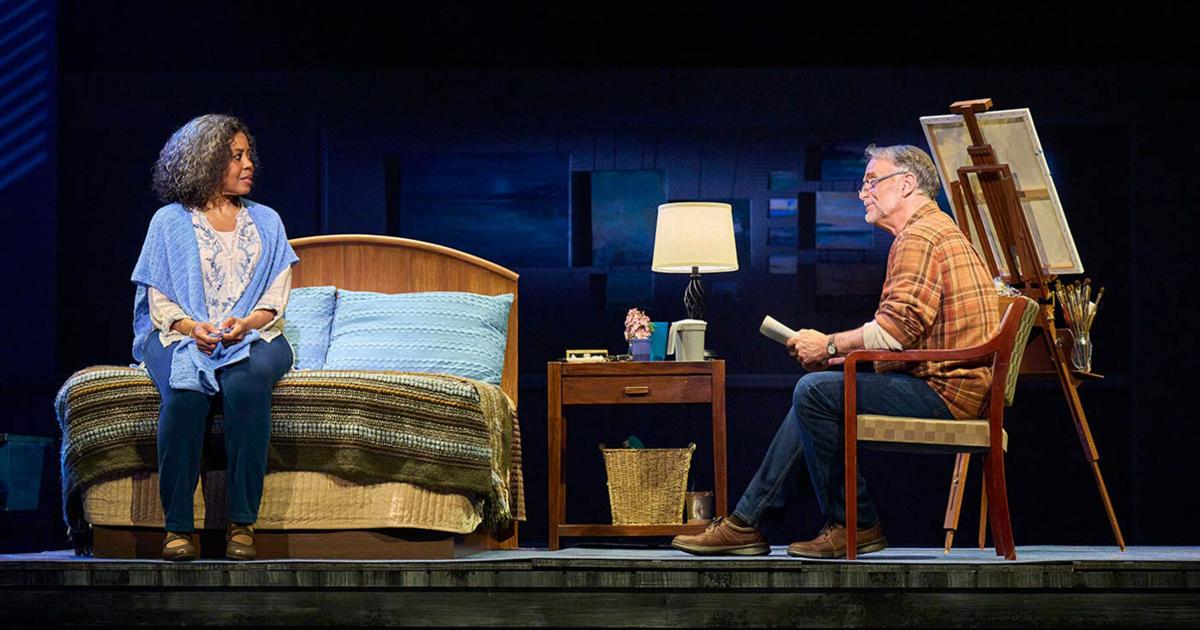
Early in the musical, older versions of Noah (Beau Gravitte) and Allie (Sharon Catherine Brown) sit at a well-loved piano as he begins to read her the story of their lives. The teenage version of Allie mentions having to leave Noah to make it home in time for a piano lesson. This sparks a memory in present-day Allie, and she begins to play a piece on the piano. Noah remarks that “music is the last thing we forget,” alluding to the progression of her Alzheimer’s disease. This line revealed the intentionality behind adapting a story already so beloved in two artistic formats into a musical — music is the only way to connect to Allie’s memories.
Noah and Allie exist as all three iterations of themselves at the same time: the teenagers in the first summer that they met, the young adults reuniting to rekindle a relationship and the older adults presently shuffling through memories. Older Noah and Allie watch their own memories, emphasizing Allie’s severance from her own life. The past, present and future interact with each other, passing props between them and crossing paths in choreography.
The musical paces the story by grouping Allie’s memories together thematically, rather than just chronologically. The choreography creates a physical representation of Allie’s Alzheimer’s, with past character iterations arranged like chess pieces across the stage. She wanders through alone, trying to see their faces, but as she approaches, each character turns away. This is paired perfectly with Brown’s performance of Allie’s internal distress at feeling her memories just out of reach.
The set design links water to memory, implying that both are intertwined with one as a physical necessity and the other as a soul necessity. During scenes at the dock, the walls are lit up with projections of ocean waves. As Allie remembers her life, the waves return — illuminating the stage in shades of blue.
The house that young Noah (Kyle Mangold) builds for Allie is subtly introduced earlier with the song “Carry You Home,” but is concretely proposed in “Blue Shutters.” This song immediately links Noah’s dream house to Allie’s signature blue wardrobe. Post-war, the two are reunited when Allie reads about the house he built in the newspaper. The final song “Coda” brought the entire cast on stage — past, present and future. They repeated the lines “I wanna go home” layered with “I will carry you home,” emphasizing the theme of home as both a physical and emotional entity.
The story of “The Notebook” still feels trite even when told in the form of musical theater, despite the best efforts of the incredibly talented cast and crew. Without a perspective challenge to the source material, or even a distinct dialogue with past iterations, there is not much to provoke profound thought in the audience. There are fragments of ideas like music and art, the ocean and memory that are not quite fully developed into meaningful motifs. Even so, the detailed set design and passionate vocal performances add enough to the intrinsic magic of live theater to draw an audience to the stage on a Thursday night.