
On a quiet campus better known for producing engineers than trophies, something extraordinary has happened.
San José State University has advanced to the national finals of the International Collegiate Programming Contest (ICPC), the premier programming competition in North America. In March, three Spartans will travel to Orlando to compete against the best student programmers on the planet.
Their team name is TEA Time, but their achievement is anything but casual.
The team — Theon Olaivar, ’27 Mathematics,Christopher Eliot Hall, ’27 Computer Science, and Amarjargal Ayurzana, ’27 Computer Science — emerged from one of the most competitive regional brackets in the country. They did so not by accident, but through years of persistence, discipline and a deep respect for the craft of thinking.
Behind them stands Ben Reed, associate professor of computer engineering and a faculty coach who arrived at San José State in 2018 and was surprised to find no competitive programming team. Remembering how profoundly the experience had shaped him as a student, Reed gathered a small group of volunteers in 2019 and began training from scratch.
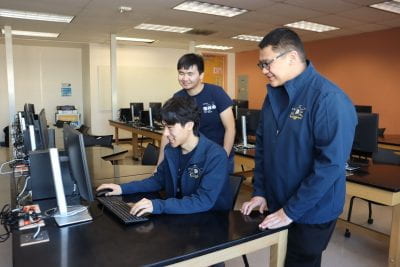
TEA Time gets ready to compete. Photo: Derrick Meyer.
Early competitions took place in Division II, which are for teams that are new to ICPC, then came the pandemic. Even with the challenges of COVID-19, SJSU qualified for the virtual national competition in 2020. But something else also took root: a culture of knowing — not just coding, but why code works. As a result, students started organizing training themselves. This past semester, student team members organized and ran all the training sessions.
Competitive programming, Reed argues, does what lectures alone cannot. “A competition like the programming contest forces students to find out if they truly understand concepts enough to implement them,” he says. “Algorithms stop being abstract concepts that you learn to pass a test, and turn into solutions to real problems. You may be able to convince a grader with rhetoric, but your compiled code will tell you if you really understand how to apply a concept correctly and efficiently.”
In an era dominated by artificial intelligence, that distinction matters more than ever. As Reed puts it, “with climate change and massive use of CPU cycles, the world desperately needs more developers who understand how to implement things efficiently.”
This year’s success also reflects something larger than a single team. It arrives on the heels of San José State being ranked ninth nationally among the top universities for software engineering degrees, outperforming institutions with far greater resources. SJSU students are not just learning to code — they are learning to think at the highest level.
“It’s hard to capture what the ICPC Nationals truly mean to us in a single sentence. It represents years of hard work, resilience, and belief— an opportunity to test ourselves, to show that SJSU can stand shoulder to shoulder with even the Ivy League, and to do what we love most: lose ourselves together in the beauty and challenge of computer science and mathematics,” said Eliot Hall, ’27 Computer Science.
That this historic moment has been sustained largely by individual generosity, including a faculty sponsor donating a significant portion of a CSU salary, only underscores the depth of commitment behind the scenes. Before the program was sustained by faculty generosity, corporations like Dell Computers helped support its growth—and the team hopes company sponsors will once again support them on the road to the ICPC competition.
For Reed, the milestone carries personal meaning. Seeing SJSU reach nationals in person, at last, had been on his bucket list. Now, it belongs to the university’s history.
For students and faculty alike, the message is clear: World-class excellence is being built here, quietly, rigorously and with heart.
And in March, the nation will be watching.