
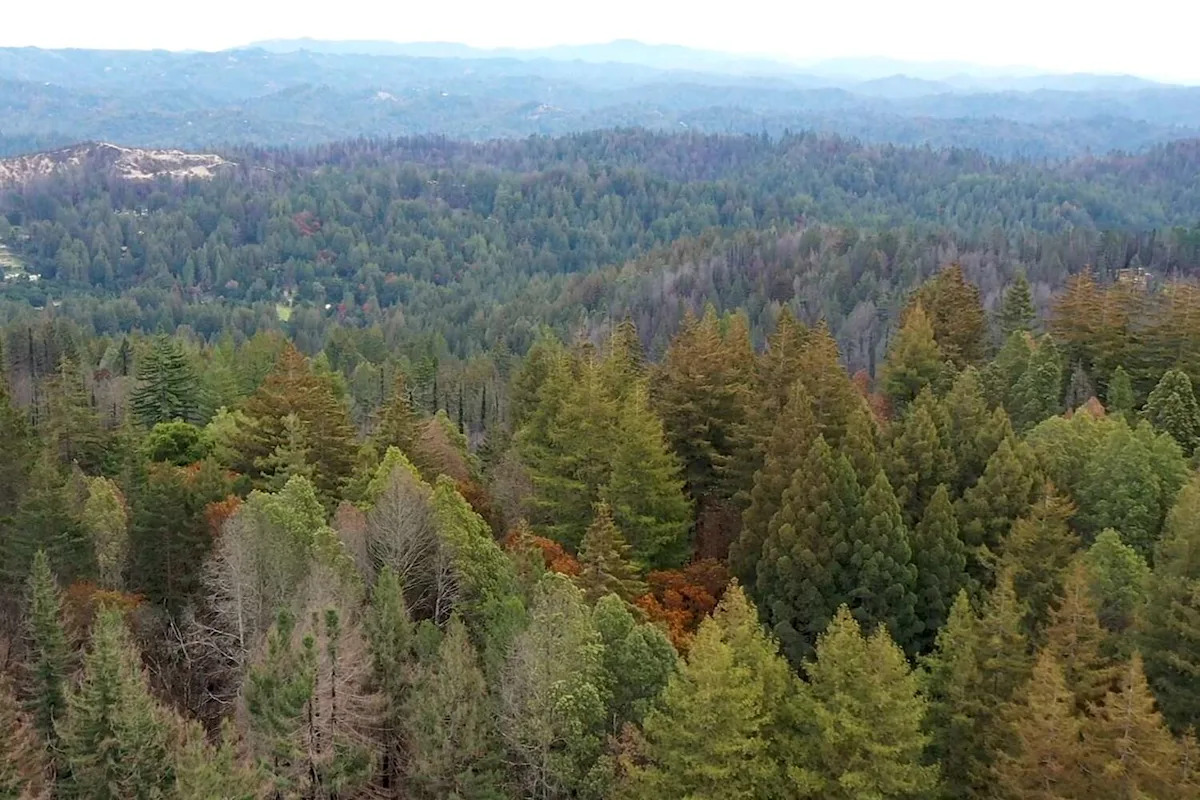
BOULDER CREEK (Santa Cruz County) –- California’s oldest state park, Big Basin Redwoods, is expanding this week with the addition of 153 acres, a forested stretch intended to help the park recover after a devastating 2020 wildfire.
The land, with a colorful history along Highway 236 in the Santa Cruz Mountains, is adjacent to where park officials are planning to rebuild the park’s burned-up headquarters. As such, it will partially serve as the new gateway to the park.
Big Basin officials envision people coming to the new property, after stopping at the planned park store, café and visitor center nearby, and taking a quick hike amid towering conifers, 20-foot waterfalls and numerous mountain views.
“We know that when people arrive at the park, they will want to see something scenic,” said Will Fourt, senior parks and recreation specialist for California Department of Parks and Recreation. “With this (site), you’ll just walk a mile or so and be able to see some of the scenery that Big Basin has to offer.”
The new land, known as the NoraBella property, was sold to California State Parks by the nonprofit Sempervirens Fund in a $2.4 million deal that closed Tuesday.
The Sempervirens Fund, which seeks to acquire redwood forests and protect them, worked for years to get the NoraBella plot, targeting it for its creeks, canyons and large trees as well as for its usefulness to Big Basin. But progress was slow.
The property was long owned by an electrical engineer who amassed cars, trailers and even an old Muni bus at the site, becoming so notorious for being a sprawling scrap heap in the woods that the owner was featured on a 2011 episode of A&E’s “Hoarders.” He did not want to sell the land.
The eccentric owner eventually ran afoul of the county because of leaching chemicals and other waste, and in the face of unpaid fines and unmet clean-up orders, he lost control of the property.
In 2020, the land, through the county, was sold to Colby Barr, a cofounder of the popular Santa Cruz-based Verve Coffee Roasters. Barr helped clean up the site and, acknowledging the Sempervirens Fund’s interest in the property, sold it to the organization.
In the meantime, as the land went through ownership changes, it burned in the CZU Lightning Complex fire. Before the land was purchased by state parks, the Sempervirens Fund had to complete a laundry list of fire mop-up and forestry work as well as ensure that pollution from the junk yard was gone.
“We went through a series of projects to make it park-ready,” said Sempervirens Fund Executive Director Sara Barth. “It feels like redemption to finally secure the forest’s future as part of Big Basin.”
The sale marks the park’s first addition in 15 years. The Sempervirens Fund is working on four other land deals in the area that it hopes will further expand the park, though none are as significant as the NoraBella property.
Big Basin, meanwhile, is slowly coming back from the CZU fire. Roughly 97% of the park’s 18,000 acres burned in the blaze, and large portions of the park remain off-limits to the public because of the devastation.
Still, the forest is mostly green again, after vast stands of Douglas fir and tan oak were reduced to charred trunks and ash. The park’s signature redwoods, among the tallest trees in the world, were largely spared.
About 20 miles of trails and 20 miles of fire roads have reopened since the fire, including the famous Redwood Loop. Eighty miles of trail and 35 miles of fire roads once greeted visitors.
Park officials are in the process of relocating the park headquarters, which formerly stood as a historical village at the heart of Big Basin’s loftiest trees, to the area next to the NoraBella property three miles away, known as Saddle Mountain. They don’t want the new development to harm the old-growth forest.
A recently drafted facilities management plan calls for a “welcome center” with visitor amenities at Saddle Mountain as well as administrative buildings, staff housing, a shuttle-service site and possible trail connections. Some of the housing may be built on the NoraBella property.
The state has allocated at least $186 million for the work, though the cost is currently estimated at $369 million. The park is hoping to fill the gap through other types of public funding and private philanthropy.
Big Basin was established in 1902 to safeguard its redwood trees and is still visited today by sightseers from all over the world wanting to gaze at the 300-foot giants.
This article originally published at California’s oldest state park expands for first time in 15 years.