
Cars lined the last stretch of highway before the exit that read “Great America Pkwy.” The smell of gas and a symphony of honks and beeps greeted the thousands of families and teenagers waiting patiently. Children squirmed in their car seats, near-bursting with the suspense of passing by the same small, faded ticket booth, the same never-ending parking lot where families applied sunscreen and forgot where they parked and the same long walk to the entrance of the park.
These were clear signs of an unforgettable day at the Great America amusement park and a hard-earned weekend well-spent.
Even within the park, the long lines continued throughout the 112-acre facility, with 4th of July festivities in the scorching heat and WinterFest days still warm from the commotion and liveliness. Especially on weekends and school holidays, students would always find a way to make time for the park.
“It was like a dopamine explosion,” said Steve Foug, a Palo Alto High School history teacher who has been going to Great America since he was 6 years old. “I remember being beyond excited driving that same exit or just waiting out by the gate.”
Story continues below advertisement
Foug’s memories are like those of many Paly students, but soon they might be just that — memories. Even as California’s Great America announced it will be celebrating its 50th anniversary this year, the park has also announced a closure that could occur as early as fall of 2027, with the park’s parent company, Six Flags, already having sold the land to the real estate company Prologis Inc. in 2022. On May 20, 2025, Six Flags Investor Day, Brian Witherow, the chief financial officer of Six Flags Entertainment Corporation, officially announced Great America’s closure.
“
Unless we decide to extend and exercise one of our options to extend that lease, that park’s last year without that extension would be after the ’27 season.”
— Brian Witherow, chief financial officer of Six Flags Entertainment Corporation
Referring to revenue from the company’s 42 parks, Witherow said Great America is “very low on the ranking of margins.” The current lease runs until June 2028, but has the potential to be extended through 2033.
The effects of the park closure take shape in different forms. Now, parkgoers interested in purchasing tickets in three of the four seasons of the year are led to a “temporarily closed” message on the official website. As the end draws closer, it’s hard to deny that the amusement park has found its spot in the hearts of many children and teenagers.
Foug considers the park a staple in his adolescence among other entertainment centers that are now non-existent in the Bay Area, like Marine World, Castle Golf and Games and Malibu Grand Prix. While Marine World relocated out of Redwood City to Vallejo in 1986 due to a lack of expansion space, the latter two faced challenges with declining popularity that led to their closure. All three had an issue with high property and operational costs, which Great America faces today.
Paly sophomore Kyle Chen has also noticed the decline in entertainment hotspots.
“It [Great America] is really impactful to youth and teens,” Chen said. “When I’m hanging out with my friends, we often don’t know what to do. Great America is basically the only significant amusement park in the Bay Area, and without it, the choices for a fun day out are even more limited.”
Foug says that with the disappearance of entertainment centers, the novelty of visiting has also been diminished.
“I don’t want to say something’s missing from today … but it’s definitely different,” Foug said. “It [an amusement park] is just not as much of an attraction anymore.”
The decrease in third spaces, categorized as informal gathering places between the leisure of home and formal business areas, has opened up opportunities for digital entertainment to step in.
Paly senior Nina Faust says that when making plans with friends, she finds herself more drawn to online experiences because of their ease and accessibility.
“I ask them, ‘Where do you guys want to go?’ and it usually takes us a good five or 10 minutes just to think of something, and that thing is usually to go to a park or something else,” Faust said. “But I’ve noticed that because of that, it’s become more tempting for me to ask them to play online games like Minecraft.”
Turns out, it isn’t just Faust experiencing this. Dan Hipp, the senior research coordinator at Children and Screens Institute of Digital Media and Child Development, observes that this phenomenon is present in data as well, and that digital media steps in when physical experiences are not readily available.
“
They [digital media tools] are self-contained amusement parks in our pockets in their own right. They’re bright, they’re loud, they’re persuasively designed and algorithmically tailored to keep users’ attention, including kids and teens.”
— Dan Hipp, senior research coordinator at Children and Screens Institute of Digital Media and Child Development
Chen recalls one of his favorite memories at Great America when he and a few friends would go there almost every week of his seventh grade summer.
“Every single time I’ve gone it’s been a great time,” Chen said. “One time, we went on a Wednesday, and there was no one at all. We rode rides until we were dizzy and sick.”
Hipp mentions that, these days, teens use screens for many hours on end. To satisfy young people’s constant need for excitement and thrill, digital media is often the outlet they turn to because of convenience.
Though digital media may give off the same dopamine rush a rollercoaster would, Hipp warns that screens lack the social and physical benefits of real-world interactions.
“The idea of a shared space on the Internet is just not equivalent, or even really analogous, to a shared space in the physical world,” Hipp said. “If you [and some friends] are in the line to go to a roller coaster … you’ve now not only had a delay before your gratification — so different from the phone — but now you’ve engaged in something in the physical world together, which is like a mutual reward experience.”
Hipp adds that not only is digital media not up to par with in-person experiences, it could very well be what is causing the disappearances of third spaces.
“The explosion of the digital world has made the … physical world less accessible in some ways,” Hipp said. “It [people staring at screens] just wasn’t the case prior to the past 20 years. … That provides important context for understanding why social events are happening the way they are, including the closure of major theme parks that for generations have been entertaining people and providing a common landmark and common experiences for everyone.”
Paly senior Annika Chu always loved visiting Great America with friends and family, and would often go when she was younger because of how close the park was. Nevertheless, she agrees that the decline in popularity of amusement parks may be the result of growing digitalization.
“If more teens are spending their free time on social media and using that to talk to their friends instead of hanging out with them and talking face-to-face, then it makes sense that we’d see more hangout spots like Great America closing,” Chu said.
However, Sunny Liu, the director of research at Stanford Social Media Lab, adds that kids using digital media to replace physical interaction is not necessarily a bad thing, and teenagers can easily connect with friends online.
“
What matters is not a space, it’s people, so you just want to find where your friends are. You want to be with your friends.”
— Sunny Liu, director of research at Stanford Social Media Lab
Liu emphasizes that there are many factors that contribute to the preference of digital media over third spaces, such as costs being a burden on families and the inconvenience of transporting them there. But more specifically, Liu says that a reason third spaces for entertainment are becoming less popular compared to social media is because of heightened concerns for safety after the COVID-19 pandemic.
“For them [parents], [being] indoor with screens actually are safer for them,” Liu said. “That’s one way to think about it: What is the environment out of the schools, out of the homes, and is that really safe?”
However, Hipp said the digital experience has its own sets of dangers, with more subjective issues revolving around addiction, online predators and extortion.
“It [a screen] warps and caricatures things in strange ways: worse sleep, more obesity and also just a brain calibrated more to the dopamine rewards from devices — which are very quick and come in this streamlined way — than those available in the outside world,” Hipp said. “What we have is people designing their brains for digital experience by exposing their brains to digital experience for eight to nine hours a day.”
This 2025 season, Bay Area students saw the cancellation of the annual Winterfest event, and the park will only reopen late March.
As a longtime parkgoer, Faust said that now the park is closing, she feels a sense of urgency to squeeze in a few more visits in its final years.
“I used to go a lot when I was younger, so it just kind of feels sad seeing a part of your childhood go away,” Faust said.
Foug also plans to go to Great America one last time before the closure, and expresses his disappointment that future generations won’t be able to enjoy the magnificence of the amusement park that shaped his childhood.
“There’s one fewer place to go with your own time,” Foug said. “It was such an instant thing you can be like, ‘hey guys, Great America this Saturday. Let’s go.’ It [Great America] is going to be missed.”
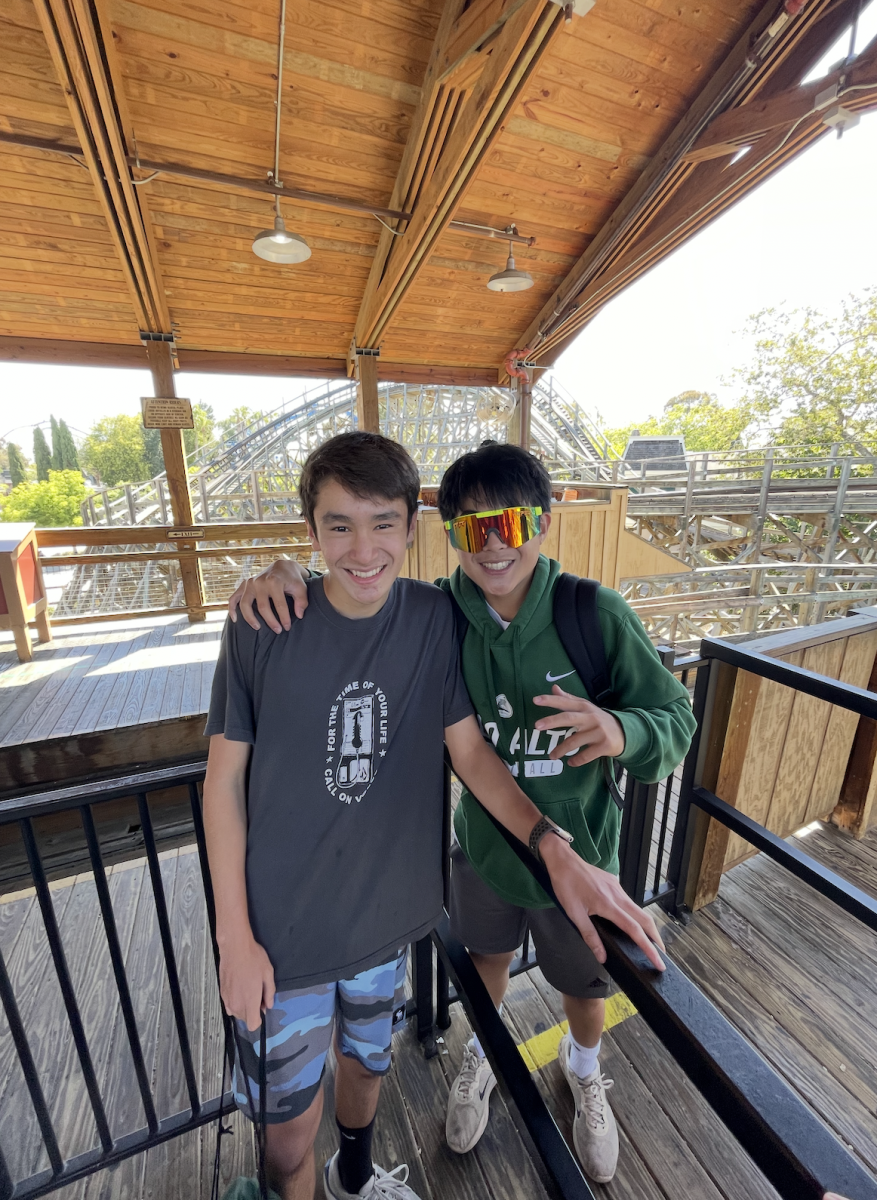
MAGICAL MEMORIES — Palo Alto High School sophomore Kyle Chen poses for a quick picture while
waiting in line at Great America in 7th grade. “To say goodbye, I’ll definitely go one more time,” Chen said.
“I’ll ride all the rides and do all the games.” Photo courtesy of Kyle Chen