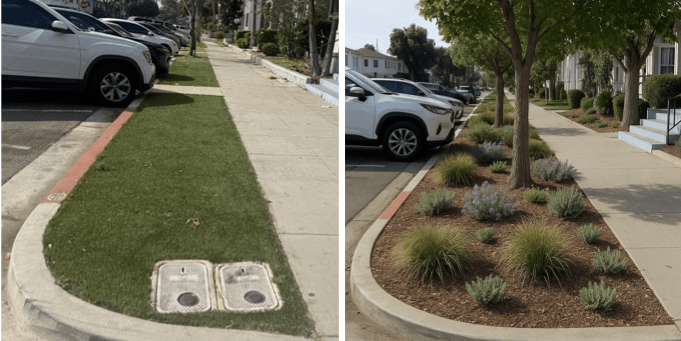
This op-ed was written by Ryan Wolfe, the president of Willmore City Community Association, a community nonprofit that works to improve and protect the physical environment and quality of life in Long Beach’s Wilmore City neighborhood and Long Beach overall.
In December 2025, Councilmember Mary Zendejas brought forward a proposal for a Green Parkways Initiative. During the city council meeting, some City staff and councilmembers raised an important point: Long Beach’s municipal code already restricts nonliving materials in parkways (the public strips of land between sidewalks and streets). Artificial turf, staff noted, is not explicitly named.
They also acknowledged a second reality: limited resources make enforcement of the existing code challenging, let alone any new provisions.
These concerns deserve to be taken seriously, but they should not be used as a reason to leave ambiguous policies in place. Clear policy is good policy. And when it comes to artificial turf in parkways, clarity is exactly what Long Beach needs.
Parkways are public spaces and as such, should deliver clear public benefits: cooling, stormwater absorption, shade, habitat and neighborhood livability. Artificial turf does none of these things. In fact, it actively undermines them.
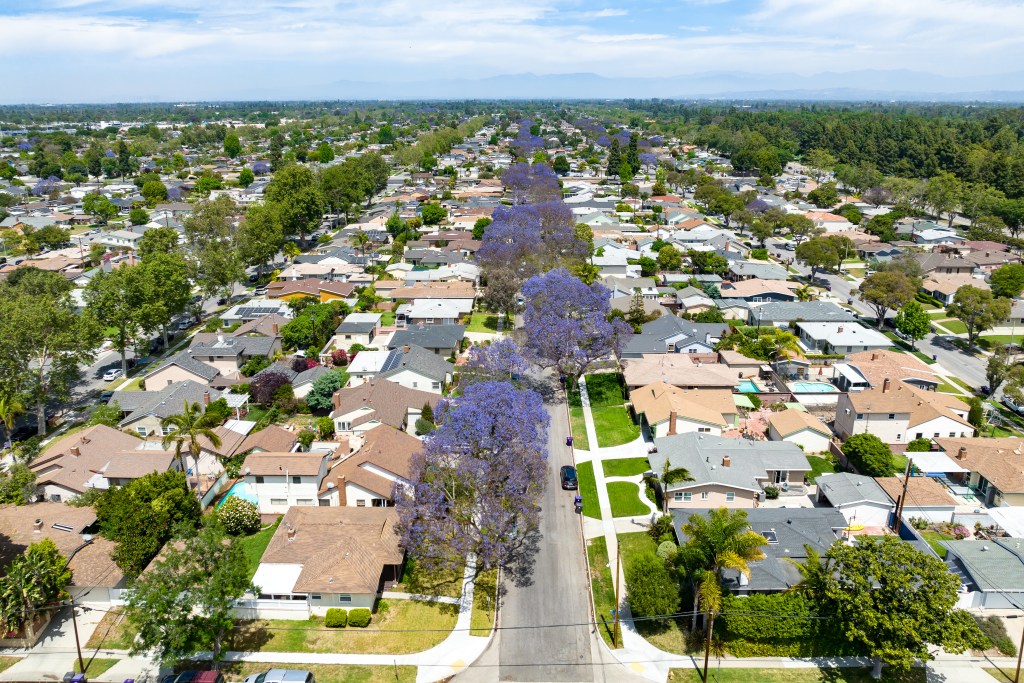 A row of jacaranda trees blooms along a street in East Long Beach on April 26, 2022. (Richard H. Grant | Signal Tribune)
Artificial turf can reach surface temperatures of 120 to 180 degrees on hot days, far hotter than shaded sidewalks or planted landscapes. These extreme temperatures increase heat exposure for pedestrians, raise cooling costs for nearby homes and disproportionately harm heat-vulnerable communities. Turf also blocks air and water from reaching tree roots, stressing or killing existing trees and preventing new ones from being planted. At a time when Long Beach is working to expand its urban tree canopy, artificial turf moves the city in the opposite direction.
The pitfalls of artificial turf extend beyond the parkway. Artificial turf sheds microplastics that wash into storm drains and waterways. Because it is impervious, turf increases runoff instead of absorbing rain and worsens localized flooding and erosion. And while turf has been mistakenly marketed as “low maintenance,” it has a short lifespan — typically eight to ten years — after which it must be removed and sent to a landfill, where it cannot be recycled.
By contrast, natural parkways with trees, native plants and permeable surfaces provide measurable, long-term benefits. Shade trees can reduce surface temperatures by up to 35 degrees and lower household energy costs. Native and drought-tolerant plants use minimal water while cooling streets through evapotranspiration. Vegetated parkways absorb and filter stormwater, reducing flood risk and supporting groundwater recharge. They improve air quality, support pollinators, increase property values and strengthen public health and community connection.
None of this is controversial. Cities like Santa Monica, Bell Gardens, Alhambra and more are moving away from synthetic landscapes in public rights-of-way because the evidence is clear: living infrastructure is more resilient, more equitable and more cost-effective over time.
The issue before Long Beach is not whether artificial turf is a good policy, but whether the City is willing to say so clearly. Ambiguous code creates confusion for residents, uneven enforcement and unnecessary conflict. Clear code sets expectations. It empowers neighborhood leaders, nonprofits and community groups to educate neighbors and lead by example. It allows residents to understand what is and is not allowed without needing case-by-case interpretation.
Want more local news?
Sign up for the Signal Tribune’s daily newsletter
Updating the municipal code to explicitly prohibit artificial turf in parkways is not about adding bureaucracy. It is about aligning city policy with city values: climate resilience, public health, equity and stewardship of shared space. As this issue moves forward for consideration in the City’s commission process and makes its way back to city council, Long Beach has an opportunity to lead by making its expectations unmistakable.
We recognize that city budgets are strained and staff resources are limited. That is precisely why clarity matters. Clear policy reduces the burden on enforcement by making rules understandable and defensible. It also enables residents to step up as partners. Many neighborhood associations and nonprofit organizations are already doing this work: planting trees, restoring parkways and helping neighbors choose living alternatives. We are not asking the City to do this alone.
Clear policy is good policy. Our parkways — and our communities — deserve nothing less.