
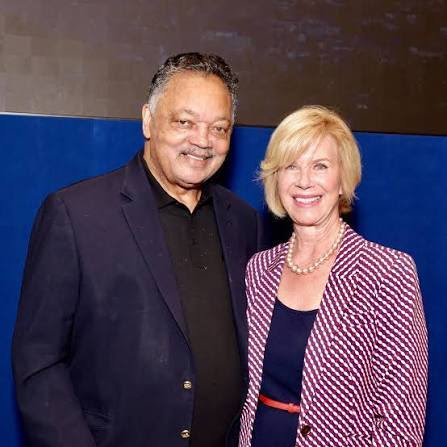
 Reverend Jesse Jackson and Supervisor Janice Hahn. Photo courtesy of Janice Hahn.
Mourning the Passing of Reverend Jesse Jackson
Supervisor Janice Hahn
Reverend Jesse Jackson was a giant of the civil rights movement who not only demanded change—he built the political power to pursue it. During the 1988 presidential campaign, several candidates sought my father Kenny Hahn’s endorsement, but he proudly chose Reverend Jackson because he believed deeply in his vision of an America rooted in justice, dignity, and opportunity. Reverend Jackson may not have won, but his campaigns changed what millions of Americans believed was possible.
Decades later, I had the honor of joining him and other leaders on a Civil Rights Pilgrimage to Alabama, where I brought my granddaughter, McKenna, and we walked across the Edmund Pettis Bridge together. It was a powerful reminder that his life’s work connected generations and continued to move our country forward. I will always be grateful for the example he set, and my heart is with his family and loved ones.
Supervisor Hilda L. Solis:
I am deeply saddened by the passing of Rev. Jesse Jackson, a towering leader of the civil rights movement who devoted his life to fighting for justice and dignity for working people and communities too often left behind.
Rev. Jackson was a tireless advocate for civil rights, voting rights, and economic opportunity. His leadership helped inspire generations of activists and public servants, and his historic presidential campaigns helped pave the way for more inclusive representation in our nation’s highest offices.
I had the honor of working with Rev. Jackson during my time as a member of Congress and later as U.S. Secretary of Labor. I will never forget walking with him across the Edmund Pettus Bridge in Selma, a powerful reminder of the sacrifices made to secure the right to vote and the work still left to do.
His impact reached far beyond our borders through his work for diplomacy, peace, and human rights. His legacy will endure in the movements he strengthened and the leaders he inspired.
Rev. Jackson’s life was a testament to faith, courage, and hope. May he rest in power.
Mayor Karen Bass”
I grew up watching Reverend Jesse Jackson lead a national movement that fought for justice for poor and working people. I am deeply saddened by his passing, but profoundly grateful for the example he set and the generation of leaders he inspired.
Rev. Jackson was a civil rights hero and a tireless advocate for those too often overlooked. He was an icon who helped elect countless Black leaders, and his historic, groundbreaking presidential campaigns paved the way for the eventual election of President Barack Obama. Jesse was also a friend, and I had the honor of working with him on a wide range of issues throughout my career.
In addition to his work on voting rights and economic justice, Rev. Jackson’s impact expanded to corporate America where he worked to make the private sector more democratized, and internationally, where he worked for diplomacy and helped secure the release of hostages.
He leaves a lasting legacy of hope and it is now up to us to Keep Hope Alive!
Gov. Gavin Newsom and First Partner Jennifer Siebel Newsom:
Jen and I mourn the loss of one of America’s greatest civil rights champions, Reverend Jesse Jackson. His footprints are found in every civil rights movement in modern history, both as a leader and as a supporter, lending his strength and his spirit to communities around the country. Here in California, he stood with farmworkers in the fields of the Central Valley, walked the streets of Los Angeles and Oakland calling for racial and economic justice, and visited campuses throughout the state, empowering a new generation of voters and activists.
Rev. Jackson’s legacy is one of fellowship, reminding us that we must ‘turn to each other, not on each other.’ He challenged all of us to live up to the promise of equality and justice for all, not just the privileged few. So today, we grieve his loss – and tomorrow we honor the Reverend by picking up his mantle, by keeping hope alive, and fighting for the world he dreamed of.
Piazza Miramare Curiosities
So yesterday, I took my morning walk, and passed through the new “Italian Piazza Miramare”. A concrete plazza with fountain, trellis, and some planters! It took over a year to build this? I’m curious to know what did this cost, and who paid for it? I’m also curious to know what the status is of the 6th Street “Welcome to San Pedro” sign, that Patti and I were vehemently opposed to it.
While I’m at it! A while back, there was some conversation about renaming Harbor Blvd., to something that honored Joe Buscaino. Is this still being discussed, or has this “hopefully” been trash canned?
George Wytovich, San Pedro
Mr. Wytovich,
Thank you for your letter.
The Little Italy of Los Angeles Association or LILAA is a nonprofit organization with a board of directors that, it explains, have “extensive experience on major projects and fundraising.” Its website states the board has received substantial commitments from a multitude of sources toward the Piazza Miramare.
It doesn’t provide a figure on the cost of the Piazza. RLN has contacted LILAA and is now waiting for a reply.
LILAA’s board of directors is composed of leaders of Los Angeles’ Italian-American community.
Broken From the Top
The recent Random Lengths News article titled, “Broken From the Top,” contains multiple inaccuracies, unsubstantiated claims, and misleading characterizations presented as fact rather than opinion or verified reporting.
The piece relies heavily on selective sourcing, anonymous allegations, and speculative conclusions while failing to provide corroborating evidence or balanced perspectives. Complex internal matters are reduced to oversimplified narratives that ignore documented procedures, legal constraints, and established oversight mechanisms. This approach misleads readers and undermines public understanding of how accountability and reform processes actually function.
Most concerning is the article’s presentation of disputed claims as settled truth. Assertions regarding misconduct, retaliation, and transparency failures are framed without acknowledging contrary facts, ongoing reviews, or the absence of findings that substantiate these claims. Responsible journalism requires distinguishing allegation from evidence, a standard this article does not meet.
Public trust depends on accuracy, context, and fairness. Publishing emotionally charged narratives without rigorous fact-checking or meaningful rebuttal does a disservice to readers and the community Random Lengths News claims to serve.
I urge the editorial staff to correct the record, provide appropriate context and uphold journalistic standards that prioritize verified facts over advocacy-driven storytelling.
Sincerely
Nicole Scalo
LA County
Dear Ms. Scalo,
This story is a candidate profile of Chief Eric Strong based on our one-on-one interview. All the scandals we discussed, except the Baker to Vegas Relay controversy, occurred between 2018 and 2022. It was important to me that his profile was situated in the current context of the federal government using its own mercenary force to execute its extreme anti-immigrant agenda. And using tactics that resemble the worst excesses of the LAPD and LASD, for which they had submitted to federal consent decrees in the past. You will need to be more specific in your allegations of multiple inaccuracies, unsubstantiated claims, and mischaracterizations.
Terelle Jerricks, Managing Editor
LA County Sheriff Candidate Eric Strong was strong on the weaknesses of the LA County sheriff’s department, particularly the failures of the current Sheriff, Robert Luna.
I agree.
Sheriff’s deputies are facing unprecedented demands and untold privations. I have heard and read from multiple sources that deputies are expected to work double shifts, 16-hour shifts, with few breaks (if any).
The number of suicides in the sheriff’s department is particularly disturbing, and the low morale cannot be ignored. I think that Strong’s estimate on the deputy shortage—1,500 men in the field—is itself a little short.
Luna has managed the decline and kept quiet about all of it, in part because if he starts speaking up, the LA County Board of Supervisors will vote to remove him—a power which LA County voters gave to the Board of Supervisors in 2022.
While Strong outlined the many failures of the current Sheriff, he was weak on details on how to reform the Sheriff’s department.
Yes, the deputies need more mental health support, but the next sheriff needs to hire more deputies to spread the workload to begin with! Can we expect the next sheriff to improve morale and increase staffing if the Sheriff and the County don’t back up the deputies and back up their efforts to crack down on crime?
How does Strong intend to bring in more deputies? Asking nicely? Will he offer them more pay? Can he push back on the anti-law enforcement culture pervasive in county government?
Arthur Christopher Schaper
Torrance
Dear Mr. Schaper,
During our interview, Chief Eric Strong argued that LASD’s recruitment struggles are largely self-inflicted and stem from leadership failures — not a lack of interest in law enforcement careers.
He contends the department’s reputation, shaped by allegations of retaliation, limited transparency, jail controversies, and politicized internal investigations, discourages qualified candidates. In his view, instability at the top erodes confidence among potential recruits. He also criticized inconsistent recruitment standards and outdated messaging, linking hiring challenges directly to internal morale.
Strong connects burnout to staffing shortages and excessive overtime, saying deputies feel overworked and unsupported. He called for confidential mental health services, peer support systems, and trauma-informed care, emphasizing that deputies carry the psychological weight of repeated exposure to trauma long after incidents end.
He further argues morale cannot improve in a culture perceived as retaliatory or politically driven. Greater transparency, fair internal processes, and stable leadership, he says, are essential to rebuilding trust.
In short, Strong believes LASD must address its internal dysfunction before deflecting criticism from those calling it out.
Terelle Jerricks, Managing Editor
Like this:
Like Loading…
Related