
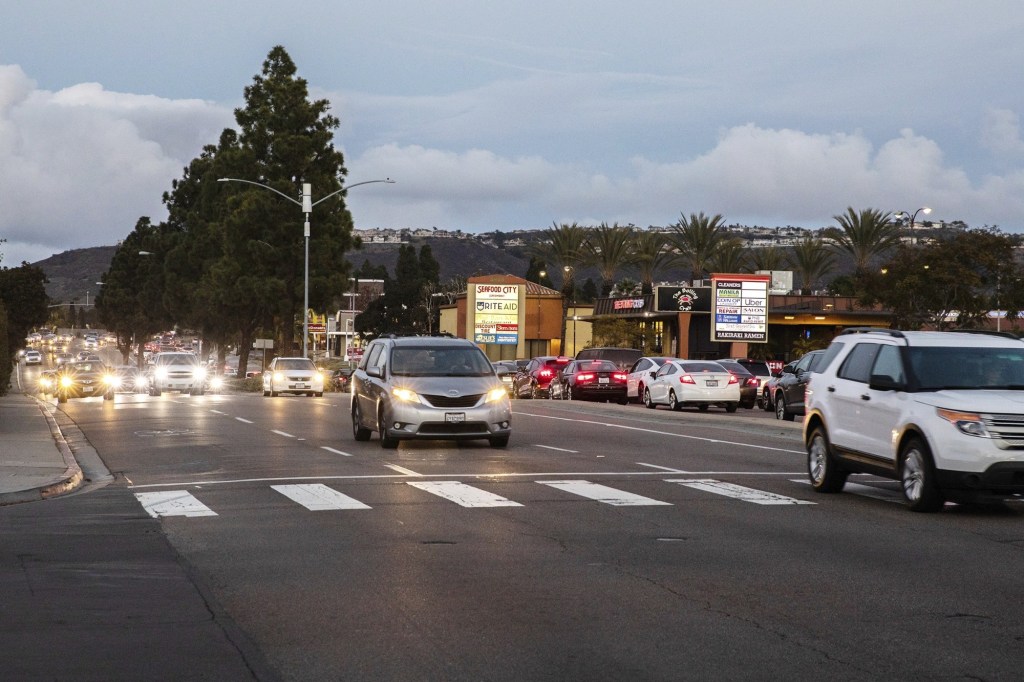
San Diego will soon lower speed limits on 680 miles of city streets — roughly one-fifth of the city — to help make vehicle crashes less frequent and less deadly.
The lower speed limits are called for in a long-awaited speed management plan that prioritizes safety near schools, in business districts and at intersections deemed dangerous because of their history or other risk factors.
The plan, which was released this week and approved Thursday by the City Council’s infrastructure committee, will reduce speed limits on more than 1,500 stretches of roadway to make them less deadly for pedestrians and cyclists. The lower limits will also give drivers more time to react to dangerous situations.
Affected streets include Aero Drive, Balboa Avenue, Bernardo Center Drive, Beyer Boulevard, Carmel Valley Road, Clairemont Mesa Boulevard, Mira Mesa Boulevard, La Jolla Village Drive, Scripps Ranch Boulevard and many others.
A 2022 state law — AB 43 — gave cities much wider discretion to reduce speed limits if they complete a thorough analysis like the city’s 135-page speed management plan.
The plan gives San Diego the comprehensive knowledge of speed and danger across the city that it has previously lacked, said Maggie McCormick, interim director of the city’s Transportation Department.
“The city now has a clear and consistent framework to reduce speeds where they will make the most safety impact for all road users,” McCormick said Thursday.
City officials said that the lower speed limits will require $2.4 million for 3,000 new signs, 1,200 new poles and overtime wages for Transportation Department workers who will install them.
Installation is slated to begin with the new fiscal year in July and start with street segments near schools, before moving on to other dangerous spots.
Nearly 400 of the 680 miles getting new speed limits are in school zones.
Just over 371 of those miles are within 500 feet of a school and will have new speed limits of 15 mph or 20 mph. Another 27 miles are between 500 feet and 1,000 feet away from a school and will get new speed limits of 25 mph.
Another 59 miles of city streets will get lower speed limits because they are in what’s characterized as a business activity district — commercial streets where people are more frequently crossing and parking.
Another 222 miles will get lower speed limits because crashes have occurred there, or because they share risk factors with city intersections where crashes have been common.
The three most important risk factors, according to the speed management plan, are locations near a transit route, spots with three or more crashes in the last 10 years and intersections where a four-lane road meets a two-lane street.
“Even small changes in speed can mean the difference between a survivable crash and a deadly one,” the speed management plan says. “Slower speeds also give drivers more time to see potential conflicts, react and stop.”
The speed management plan is part of a wider city campaign called Vision Zero, which aims to reduce traffic fatalities to zero.
San Diego has made almost no progress since Vision Zero was launched in 2015. The number of traffic deaths last year in the city was 49, up from 46 during the benchmark year of 2014. The number of severe injuries last year was 131, exactly the same number as in 2014.
City officials say the lack of progress is a call for more aggressive action. They’ve been busy the last two years adding roundabouts, refuge islands, flashing beacons, countdown timers, widened crosswalks and pedestrian-friendly “delayed green” stoplights.
But they said Thursday that they’ve fallen behind on what Vision Zero calls for.
They said that there is a backlog of 1,900 traffic improvement projects related to Vision Zero, and that it could grow without more city funding.
On the speed limits, officials stressed that they won’t make a huge difference on their own. In many cases, the lower limits will be combined with changes to intersections like roundabouts, they said.
The speed management plan and the list of street segments where speed limits will be reduced were both endorsed Thursday by the San Diego County Bicycle Coalition, Circulate San Diego and the environmental group San Diego 350.
Councilmember Marni von Wilpert said it’s frustrating that the city has to comply with state rules to lower speed limits, contending the city should have the authority to do so on its own.
State law has generally required cities to set the speed limit for a section of street at the higher end — the 85th percentile — of the speeds cars typically are driven on it.
The rule has frequently forced San Diego and other cities, after analyzing how fast drivers typically drive on a street, to raise the speed limit despite objections from elected leaders and nearby residents.
AB 43 gives cities the discretion to maintain the speed limit on a segment of street even if a study determines the 85th percentile speed is faster.
It also gives cities the discretion to lower limits if they create a speed management plan that justifies such a move.
San Diego got an early start last year when city officials reduced speeds on 17 segments of streets in business districts, a move AB 43 allowed in advance of the speed management plan.
Several residents of Prestwick Drive in La Jolla unsuccessfully lobbied the infrastructure committee Thursday to add their street to the list of those getting reduced speed limits.
The speed management plan must be finalized in a vote by the full council in coming weeks.