
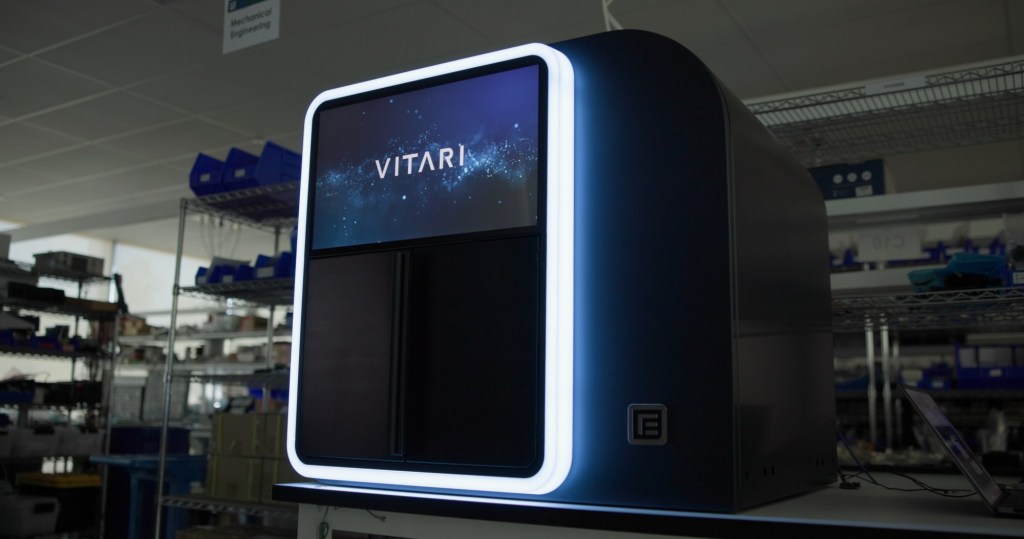
Element Biosciences is going toe-to-toe with gene-sequencing giant Illumina, unveiling a device that can read DNA for half the price of the industry leader’s technology.
On Thursday, Element Biosciences announced that its high-throughput benchtop sequencing device called VITARI can deliver a whole genome for $100.
A few years ago, Illumina came out with the NovaSeq, which turned heads for its $200 high-throughput whole genome sequencer.
Element’s VITARI is not only half the price of the NovaSeq, but it’s also a fraction of the size while maintaining lab-grade readings, the company said.
“We hope to push the field as a whole and raise the bar,” said Matthew Kellinger, co-founder and vice president of biochemistry at Element. “We were seeing sequencing stagnate in the time before Element came around. There was no competition. There was one model. That’s how it was.”
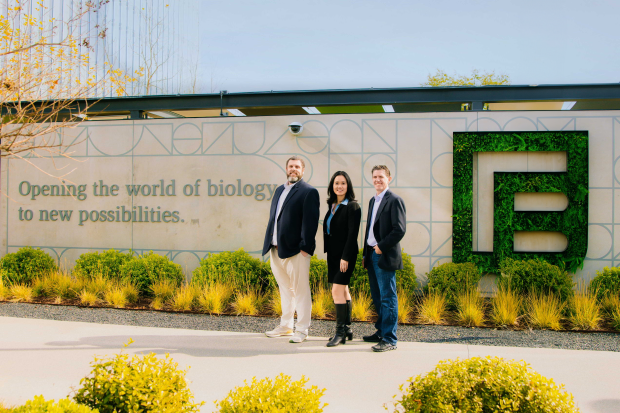
Element was founded in 2017 after three high-ranking Illumina employees walked out: Molly He is the CEO; Michael Previte is the chief technology officer of advanced research; and Kellinger is the vice president of biochemistry.
Today, Element and Illumina are in the midst of a legal battle. Element alleges antitrust and unfair competition, while Illumina alleges patent infringement. Both sides are pursuing claims in federal courts.
Element Biosciences
Element was founded in 2017 after three high-ranking Illumina employees walked out: Molly He, became CEO; Michael Previte is the chief technology officer of advanced research; and Kellinger, vice president of biochemistry. (Element Biosciences)
Demand for gene-sequencing technology has been on the rise as scientists and researchers rely on reading large quantities of genetic data to study — and sometimes treat — the root of genetic diseases and disorders.
The number of genomes analyzed is directly correlated with the ability to make discoveries, said Kristen Jepsen, director of the IGM Genomics Center at UC San Diego. With this technology, researchers could, in theory, find cures more quickly.
Element’s new instrument is marketed toward biotech firms, large pharmaceutical companies and academic centers that require substantial sequencing capacity.
While Illumina and Element are marketing whole genome sequencing at $200 and $100, respectively, most labs are sequencing genomes for roughly $400 per genome, said Jepsen.
The price per genome depends on how many genomes researchers want to read — think Costco, where buying in bulk is cheaper.
“Sequencing has become a commodity, like a bag of flour or a gallon of gas — everyone likes cheaper commodities. However, the lowest prices have typically required large upfront investments in expensive equipment. So combining low-cost equipment with low-cost sequencing is a great combination,” said Abraham Palmer, professor in the Department of Psychiatry at the School of Medicine and member of the Institute for Genomic Medicine at UCSD.
And like gasoline in a car, sequencing often limits how far the science can actually go.
“When planning a genetics experiment, scientists sometimes joke that the sample size is a function of the budget divided by the cost per sample. Lowering the cost to sequence a sample means we can do larger studies that address harder questions,” Palmer said.
A few years ago, sequencing a genome for $1,000 was considered remarkable. “So that just shows you how fast the field and the space is moving,” Kellinger said.
Element is an 8-year-old company that has more than 400 employees — 300 of whom live locally. With its new VITARI device, Element plans to hire more employees in San Diego, though it did not say how many.
Element Biosciences raised more than $277 million at a $1 billion valuation during its last Series D round. Element has more than $680 million in investment to date.
The company is not yet profitable but is “on the right path to becoming a self-sustaining business,” Kellinger said, hinting at an IPO. “Adding another one of those (public companies) to San Diego is an awesome thing. That’s the path we’re on.”