
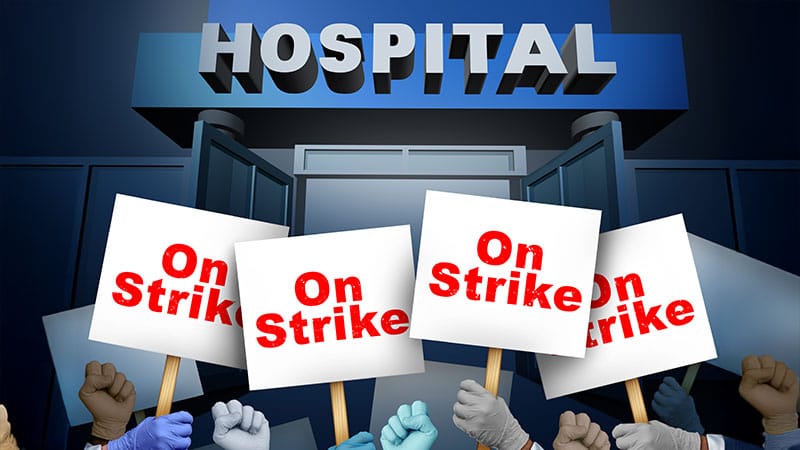
On February 17, 2026, Lizette Rivera did not clock in for her regular shift in the ICU at West Anaheim Medical Center in Anaheim, California. Instead, she joined her colleagues on the picket line. It’s a decision that the registered nurse (RN) doesn’t take lightly.
“Nobody ever wants to strike,” Rivera said. “It’s something that we try to avoid at all costs…we always hope that we can settle something before having to strike.”
Nurses have been bargaining with West Anaheim Medical Center for a year with no resolution to their concerns about patient care, safe staffing, and retention and recruitment, leaving RNs feeling like a strike was their only option.
“[Unsafe staffing levels] means that patients aren’t always getting optimal care,” Rivera said. “Appropriate staffing, competitive wages, and competitive benefits would make nurses feel acknowledged, make them feel…appreciated and make them want to stay for the long term and build a career.”
About Medscape Data
Medscape continually surveys physicians and other medical professionals about key practice challenges and current issues, creating high-impact analyses. For example, the Future of Nurse Unions Report 2025 found that:
About 14% of the nurses surveyed are union members.47% of nurses in the survey said unions were very effective or effective in representing their interests.More than 42% of surveyed nurses expect unionization to increase over the next 5 years.Behind the Picket Lines
Rivera is not alone on the picket lines. In January of this year, 30,000 nurses walked off the job at Kaiser Permanente facilities in California and Hawaii and 15,000 nurses went on strike in New York City. Low wages and high turnover have been pervasive issues, leading to unsafe staffing levels and concerns about patient safety in the nurse’s view. In fact, 68.3% of nurses reported that there were not enough staff and 77.3% cited workloads that were unsafe for patients.
Rivera received 6 weeks of training when she joined one of the highest-admitting units at West Anaheim Medical Center in 2024. Within 5 months, she was promoted to charge nurse and started training other nurses — and she was still a recent nursing school graduate.
“It’s not an appropriate assignment,” she said. “Having competitive wages and benefits would allow us to retain our nurses rather than have them come in, get minimal experience, and move on to hospitals with better options.”
The impact of low wages, high turnover, and unsafe staffing levels are visible at the bedside and have been linked to poor patient outcomes, including higher risk for preventable infections, falls, and deaths, according to Linda H Aiken, PhD, RN, professor and founding director at the Center for Health Outcomes and Policy Research at the University of Pennsylvania in Philadelphia. These issues are at the root of nursing strikes.
“Nurses don’t strike unless they believe their patients are unsafe,” said Aiken. “And they strike as a last resort.”
Despite persistent concerns, only two states — California and Oregon — have enacted minimum nurse staffing requirements. Aiken noted that the lack of policy guardrails in other states allows unsafe staffing levels to persist and is among the reasons that nurses continue to strike.
Picket Lines and Patient Care
The nurses at West Anaheim Medical Center went on strike in August 2025. The walkout was an effort to secure a contract that addressed high turnover, and included improved efforts to attract and retain nursing staff, and required strict adherence to nurse-to-patient ratio requirements.
“We didn’t want to strike,” Rivera added. “We were on strike for 1 day to show [the hospital] that we care and we want the attention from management to take us seriously.”
Hospital systems have called nursing strikes “unnecessary [and] disruptive” and referred to the RNs requests as “extreme economic demands” that put patients at risk. But RNs do think about how strikes affect their patients; awareness of care disruptions is among the reasons that nursing strikes tend to be time-limited, according to Aiken.
“Nurses only strike when it’s absolutely necessary, and they try to keep the time out to a minimum,” Aiken told Medscape Medical News.
In New York, nurses at Montefiore, Mount Sinai Hospital, and Mount Sinai Morningside and West were on strike for four weeks before reaching a tentative agreement. Nurses at NewYork-Presbyterian rejected a proposal because the hospital did not agree to safe staffing protections and remain on the picket lines.
The 2026 strike at the West Anaheim Medical Center was scheduled to last for 3 days. Rivera hopes that the scheduled strike forces hospital leadership to deliver a suitable contract that addresses RN concerns.
“We are there for our patients…to give the best care that we can,” she said. “We care about the outcomes and [the hospital] puts us in situations where we feel undervalued.”
A Strike Cycle
New contract agreements might mean an end to a strike, but RNs could end up back on the picket lines in the future.
Aiken points to hospital consolidation and corporatization as factors that influence wages, benefits, and staffing, leading to higher patient-to-nurse ratios, unsafe staffing levels, increased burnout, and lower job satisfaction.
“Because hospitals are more and more part of these large organizations and…people further and further away from patient care and further and further away from the communities where the care is taking place are making decisions about their staffing levels with pretty disastrous consequences,” she added.
Union contracts have become one of the few mechanisms to negotiate staffing language in the absence of statewide mandates. Strikes might be inevitable if hospitals refuse to negotiate agreements that reflect changing economic factors and refuse to listen to nurses on the front lines of patient care.
“Nurses are striking because we don’t really have any standards,” Aiken said. “What we’ve reverted to is relying on unions where they exist [and] unions are providing the only guardrail…through their periodic renegotiations of contracts that involve staffing.”
Jodi Helmer is a freelance journalist who writes about health and wellness for Fortune, AARP, WebMD, Fitbit, and GE HealthCare.