
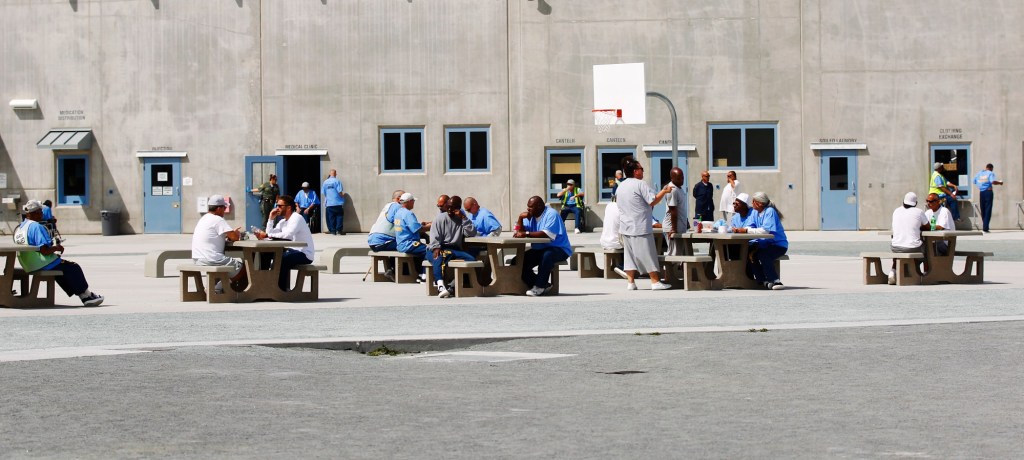
Imagine two people leaving the same prison on the same day.
One walks out with options. Family is waiting. There is a ride, a phone, a place to sleep. The paperwork says to report to parole in their county of residence, and they do. The system works quietly, as designed.
The other walks out without those things. No one waiting. No phone. No address. Just a few dollars in release money and a set of instructions that assume mobility they do not have.
The paperwork is identical. The starting conditions are not.
I work in a public space in San Diego, and over time you start to notice patterns. The same individuals cycling through parks, libraries and transit corridors. Repeated police encounters that end without arrest. Officers explaining, matter-of-factly, that someone has a warrant in another county, but that the issuing county does not want to extradite.
At first, I assumed this was mainly a homelessness issue. That is the easiest explanation when the same individuals appear repeatedly in public space. But after looking more closely, and after hearing directly from the California Department of Corrections and Rehabilitation, it became clear that this release structure applies to nearly everyone leaving prison. It simply fails most visibly for those with the least support.
That realization reframes what is happening. This is not primarily a question of enforcement or individual behavior. It is a question of system design.
To better understand what I was seeing, I contacted state offices to ask a basic question: How does release from state prison actually work in practice? State Sen. Steve Padilla’s office followed up with CDCR and provided a detailed explanation, and I appreciate that his office took the inquiry seriously.
CDCR’s response was clear. Under California law and regulation, individuals released to parole supervision are assigned to their county of last legal residence. Physical release, however, occurs at the institution itself. From there, individuals are generally expected to transport themselves to their authorized county using their release funds and report to parole on their own.
On paper, this is a reasonable system. In practice, it relies on an assumption that is not always true: that everyone leaving prison can turn authorization into movement.
For many people, that assumption holds. They have family, transportation, money and a place to land. For others, particularly people who are unhoused, mentally ill or institutionalized for long periods, it breaks down immediately.
If someone does not report to parole right away, nothing dramatic happens. There is no immediate enforcement response. Eventually, a technical parole violation, often for failure to report, may result in a warrant being issued by the supervising parole office.
But warrants do not enforce themselves.
When San Diego police later encounter someone with an out-of-county parole warrant, they contact the issuing jurisdiction to ask whether custody is requested. In many cases involving nonviolent, technical violations, the answer is no. This is not negligence. It is triage. Extradition is discretionary, resource-intensive and typically prioritized for serious or violent cases. If the issuing county does not act within a short pickup window, San Diego releases the individual locally and notifies the other agency.
At that point, something subtle but important has happened. On paper, parole supervision belongs to another county. In reality, the person remains physically present in San Diego. No single agency has violated policy. But the system’s assumptions have failed to line up.
This is how people fall between the cracks. Not through evasion or bad faith, but through a series of rational decisions made by systems that do not fully coordinate.
Once this happens, the effects can compound. An unresolved parole warrant can quietly limit access to employment or housing that requires background checks. Without work or stable housing, relocation becomes even harder. What may begin as temporary instability can harden into long-term homelessness, not because the system intended it, but because it never corrected a failed handoff at the point of release.
Prisons like Richard J. Donovan Correctional Facility also house a substantial number of individuals designated for sensitive needs yards. These are people separated for their own safety and often released with fewer social connections or support networks, further complicating a process that already assumes outside support.
San Diego is not unique in facing homelessness or reentry challenges. But as a county that hosts a major state correctional facility, it is a place where this statewide design becomes especially visible.
This is not about blame, and it is not about enforcement. It is about a gap between policy intent and lived reality.
California’s release system assumes mobility, stability and support at the moment people are least likely to have them. When that assumption fails, supervision stays on paper while people remain physically present somewhere else.
Naming that gap clearly is not a solution. But it is the first step toward an honest conversation about what actually happens after the prison gate opens.
Avalos works in a public art space in San Diego and lives in Chula Vista.