
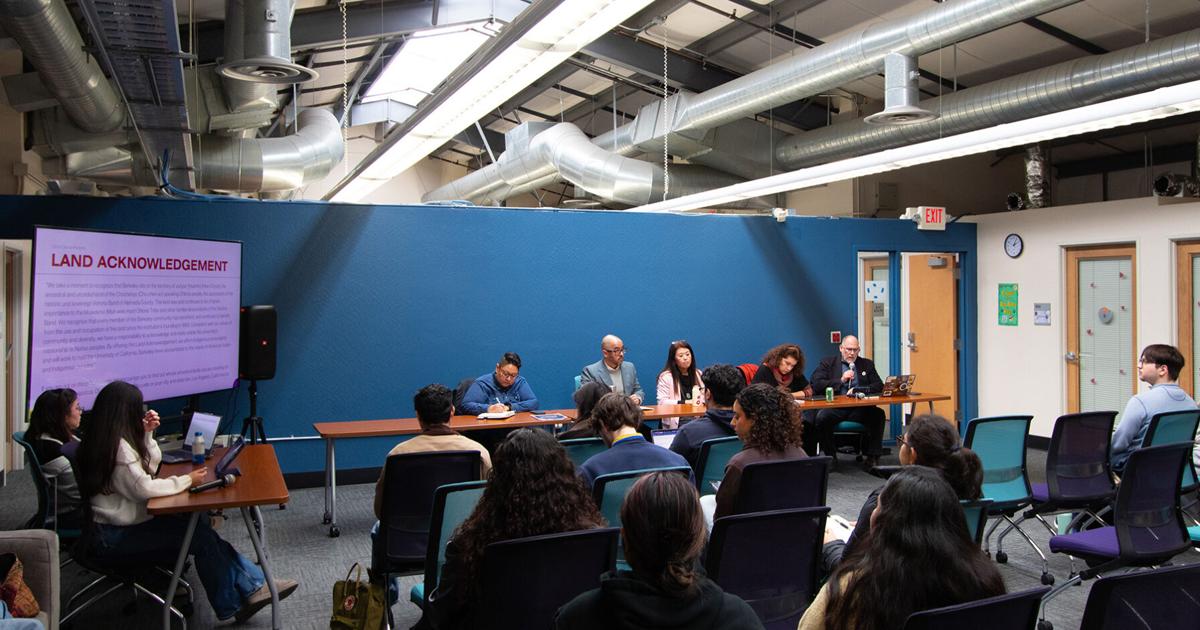
At a meeting held by the UC Berkeley Latiné Caucus on Thursday, campus administrators gave a timeline for confirming immigration enforcement activity and downplayed the most recent civil rights complaint against campus.
The meeting was held in a new format involving a public Q&A session after Chancellor Rich Lyons canceled direct meetings with the Latiné Caucus, among other groups, in July 2025.
“The idea behind the shifting of meetings was that the chancellor wanted to make sure that the administration that is more tied to these communities are the ones meeting the student groups,” explained Interim Vice Chancellor for Equity and Inclusion Fabrizio Mejia in the meeting. “It is just a shift in engagement.”
Mejia also aimed to alleviate concerns about campus’s recently announced policy to notify students of immigration enforcement actions on campus. Under that policy, UC Berkeley would send out notifications only when verified immigration enforcement actions have occurred. Campus spokesperson Janet Gilmore has previously said verifying such actions could take more than several hours.
Mejia said previous notifications sent to targeted groups on campus have taken between three and six hours to release. However, he claimed that if confirmed, reports could come out in as little as 10 minutes.
He added that campus wanted to report immigration sightings, when verified, without inciting fear in the community.
Mejia clarified in an interview after the meeting that campus would use a variety of sources to verify enforcement actions, including UCPD and community reports. He added that he believed campus would likely send out a report if there were immigration agents on campus for “general enforcement purposes,” not just for a specific immigration action.
During the meeting, campus administrators downplayed a complaint received by the U.S. Department of Education’s Office for Civil Rights targeting several ethnic and racial affinity spaces on campus, including the Latinx Student Resource Center where the meeting was held.
“We have gone through this before,” said Associate Vice Chancellor and Dean of Students Sunny Lee. “That is the goal for a lot of these attacks — to create stress.”
Mejia, who called the complaint “nonsense,” said staff at the targeted organizations were told to continue operating as they had done previously.
In an interview after the meeting, Paris Asher, a senior adviser for the Latiné Caucus and one of the event’s organizers, said the Q&A was a good opportunity for students to voice their concerns to administrators, but that she would have liked to see more.
“The bureaucracy makes it very hard for students to get what they need,” Asher said. “How are students feeling right now? Probably not great.”
Farida Dowidar contributed to this report.