
The ongoing anxiety throughout the West over the Colorado River water supply ratcheted up once again as negotiators last week blew through a second deadline in three months to reach agreement on how to divvy up the ever-diminishing flow.
The distance and tensions between the upper and lower river basin states, the latter of which includes California, seem as great as ever.
Sounds bad.
But regardless of the outcome, San Diego should remain relatively unaffected by cuts that are sure to come on the Colorado River, which supplies the region with more than half of its water.
That’s the view of Jim Madaffer, a member of the San Diego County Water Authority and the Colorado River Board of California.
He said San Diego is in a unique position with a protected supply, due to a long-term deal with the Imperial Irrigation District for river water, increased storage, a desalination plant and upcoming wastewater recycling.
“That gives us resiliency that no one else has,” he said.
Even if an eventual new river agreement leaves San Diego’s supply largely intact, that won’t do anything to change the skyrocketing trajectory of local water costs, which has become cause for alarm among politicians and ratepayers.
However, the consequences of the missed deadlines are unclear. The same goes for the increased prospect of the Trump administration taking a stronger hand in trying to force a pact, even though its preference has been for the seven basin states to come to an agreement.
That’s what the states say they want as well. Despite the lack of progress over the past couple of years, negotiations are expected to continue between the players in the upper Colorado River Basin (Colorado, New Mexico, Utah and Wyoming) and lower basin (Arizona, California and Nevada).
The potential for more litigation, a familiar companion of Western water dealings, is very real.
Some 40 million people and huge tracts of agricultural land rely on water from the Colorado. It has long been over-tapped — California had been the main culprit, though it has cut back dramatically — and climate-change-fueled drought has shrunk the river.
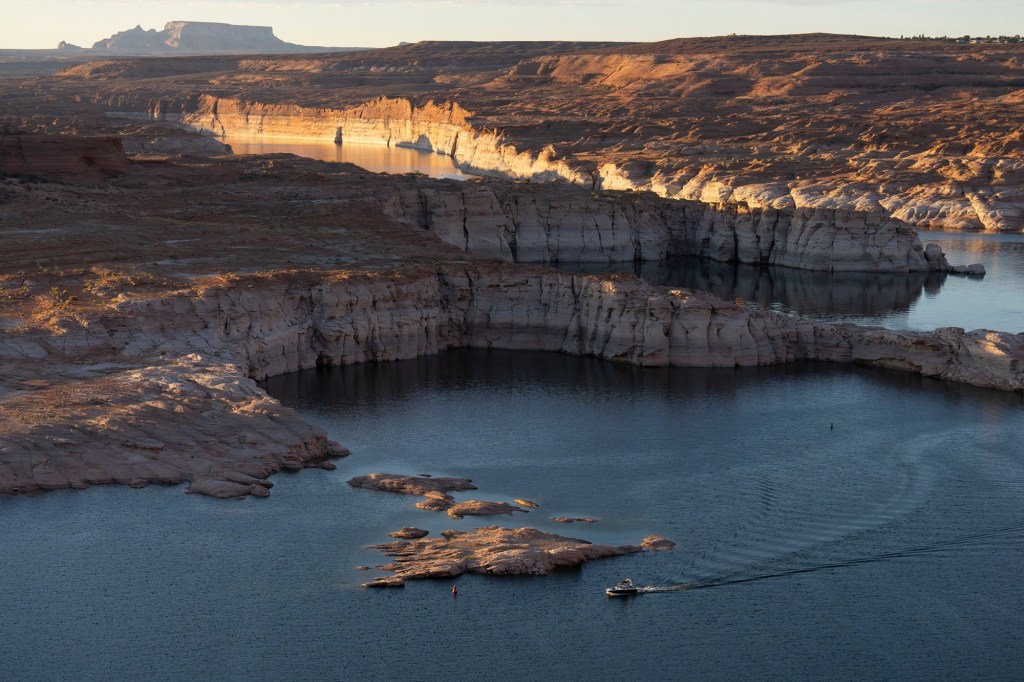
The snowpack that feeds the river is particularly dismal this year, and the main reservoirs, Lake Powell and Lake Mead, are at dangerously low levels.
“It’s like trying to split a 15 million acre-foot flow (annually) that just doesn’t exist,” said Madaffer, a former San Diego City Council member.
These days, it’s more like 12.5 million acre-feet, according to the Grand Canyon Trust. An acre-foot equals about 325,900 gallons and can serve 2½ typical four-person households each year in the San Diego region, according to the water authority.
The original agreement was drawn up in 1922 when the river flow was much higher, and even subsequent adjustments were based on more water than was actually there.
Basically, the upper basin states don’t want to sacrifice any more water, given the lower states use so much more. The lower states say they have most of the population and agricultural production, justifying their use.
All the states, particularly in the lower basin, have experienced considerable growth over the years.
Voluntary cuts and payments to farmers to leave land idle haven’t been enough to reach a long-term understanding. The existing river agreement is due to expire at the end of this year.
One way or another, river cutbacks are coming. So why shouldn’t San Diego be sweating over its supply?
The main reason is that the Imperial Irrigation District has the second-most-senior river water rights after the Palo Verde Irrigation District, which covers a comparatively smaller area of Riverside and Imperial counties.
Madaffer said that means virtually all other Colorado River users will face reductions before the IID, whose 2003 water deal with San Diego is protected by the district’s water rights.
San Diego officials made that agreement and other costly waterworks improvements to develop a reliable and independent supply after the region was threatened with devastating cuts during a drought in the 1990s. That’s when San Diego got most of its water from the Los Angeles-based Metropolitan Water District of Southern California. The SDCWA now gets hardly any from Metropolitan.
“We have the most diverse and secure water portfolio that is the envy… I’d say of the entire lower basin,” Madaffer said, referring not just to the IID agreement but other aspects of the local water system.
Not long ago, San Diego was feted in glowing national reviews, including one by The New York Times, for building its water supply.
As other jurisdictions face cuts, Madaffer believes the local water investments will again get their due, particularly the Quantification Settlement Agreement, as the IID-San Diego pact is officially known.
“People don’t know how important the QSA is,” he said.
Through the agreement, the water authority receives 200,000 acre-feet annually by paying for conservation efforts in Imperial County and 77,700 acre-feet saved by concrete lining stretches of the All-American and Coachella canals.
Madaffer said the agreement has strong legal protections in the event of any move to significantly alter or scuttle it. Nevertheless, the pressure is on all parties to the existing agreement, which also involves Native American tribes and Mexico, to do more.
Still, Madaffer said if IID were to lose, say, 100,000 acre-feet, San Diego would lose 6,000 acre-feet. The 6 percent is in the QSA.
“That’s a proverbial drop in the bucket,” he said.
Enviable as San Diego’s water supply may be, that sheen has dulled locally as costs have spiraled. Water authority rates have gone up 23 percent in the past two years and are projected to increase between 38 percent and 65 percent over the next decade.
Most people aren’t talking about the secure water, other than they’re paying too much for it.
The foresight on supply more than two decades ago had serious flaws: officials overestimated population growth and underestimated the amount of water San Diegans conserved.
Now the region has more water than it needs — and recycling projects in the city of San Diego, Oceanside and East County haven’t even kicked in — yet people in those jurisdictions and across the county have to pay for the overbuilt infrastructure regardless of how much water they use.
The water authority had anticipated a thirstier water market among its member agencies, which would have paid off much of the ambitious plan. Now the water authority is in a financial bind.
There’s a lot of finger-pointing about who and what is to blame — high-priced imported water, costly desalination and recycling operations, or all of the above. The city of San Diego is the most powerful member of the water authority, yet some of its City Council members and authority officials have been increasingly critical of each other.
The end of yearslong litigation between the water authority and Metropolitan, along with other factors, should open up more of California and the West to water sales from San Diego’s abundance. Officials are hoping that will eventually offset some of the costs of building a secure supply.
“Resiliency comes with a price,” Madaffer said.