
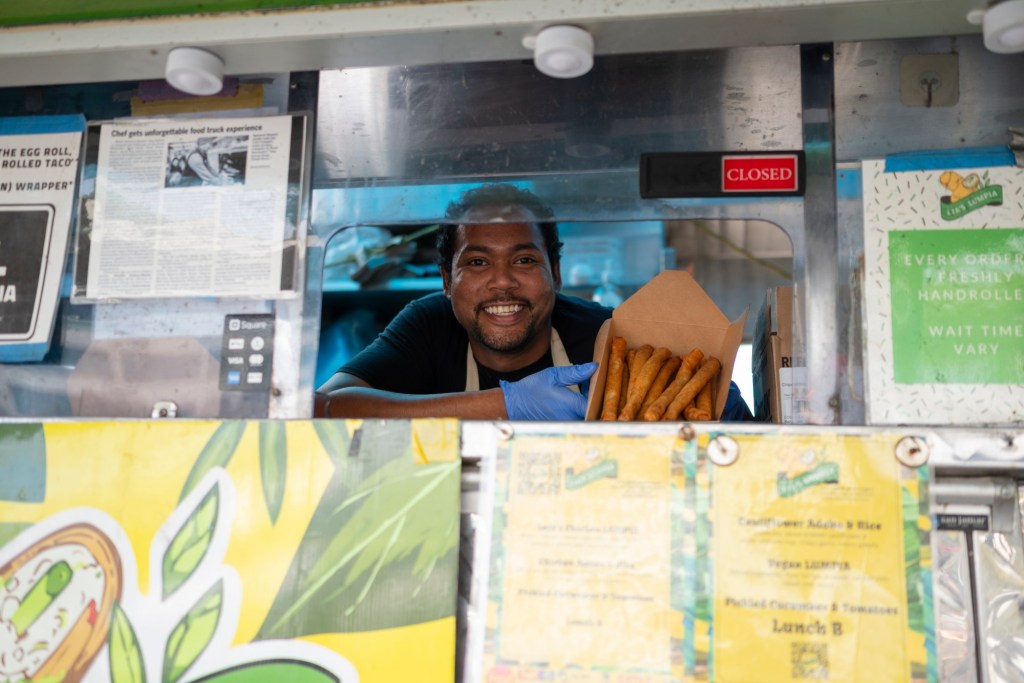
Every day after school, when Spencer Hunter got to his Filipino grandma’s house, food was always ready and waiting. When he would visit his Black grandma’s house, the smells of sweet potato pie, collard greens, and mac and cheese filled the house. At home, his mom was always cooking, including recipes from both sides of the family, along with experimenting with foods from different cultures and encouraging her kids to try something different at least once.
“That’s where food started really being instilled into my lifestyle,” he says. “During college, I studied abroad in Australia, Panama, Guatemala; everywhere I went, I was always drawn to food to experience the cultures. That is the best way you can experience cultures, by eating the food because you’re literally seeing their technology, the local produce, the local protein they have.”
He’s hoping people will take the opportunity to learn more about each other and both of his cultures at the Afro-Filipino Kamayan Dinner at the San Diego History Center from 6 to 8 p.m. Sunday. A kamayan is a traditional, communal Filipino meal in which food is served on banana leaves and eaten by hand. Hunter’s menu fuses his family’s Black and Filipino traditions with dishes like macaroni and cheese lumpia, adobo fried chicken, barbecue pulled pork, Filipino spaghetti, jasmine rice, collard greens with smoked turkey, and coconut cornbread.
Hunter, 35, is the executive chef and owner of Lia’s Lumpia, named for his mom, Lia, which they run together providing catering services, kamayan dinners, and their food truck (featured in 2019 on the Food Network’s “The Great Food Truck Race”). He and his mom live in Paradise Hills with their Carolina dog, Sugar. He took some time to talk about his path to becoming a chef and finding his passion by putting himself in uncomfortable situations.
Q: Did you always want to become a chef?
A: Nah, I thought I was going to the NFL (laughs). I went to college for sustainable architecture and within the sustainability side you study environmental studies, so that includes sustainable food management, which really stood out to me because I was seeing where people get their food from, how people get it, food deserts, the insecurities of food that really draws on more than just the taste and the presentation of food. I loved learning about it and it intrigued me. Then, all throughout college, whenever I had kickbacks and parties, I noticed I always hosted and had food. It was kind of instilled in me with my mom, my grandmothers, that food is important when being a host. It’s breaking bread with people, one of the best things you can do because you can learn about each other. You take time out of your day, you understand each other more. Fortunately, for me, I have two cultures, so we’ve got a lot to talk about.
My first job in college was a serving/waiting job, bartending and serving at weddings and stuff. My mom did events, so I was always a little kid at social events, running around behind the scenes, so I had experience without experience. That definitely helped me to get into the industry. In college, studying food management and taking tourism management classes, I was literally living it and studying it at the same time, which I think is some of the best experiential learning, some of the best ways you can retain information. Studying abroad intrigued me a lot, but what really hit home was when I was in Panama, we wanted to cook local Panamanian cuisine and it was really hard. There are only a couple of dishes because Panama is a really small country, and there are so many international influences there, so local Panamanian food is kind of lost in translation. So, coming back to San Diego after I graduated from college, I wanted to represent my own cultures and make sure that our cultures don’t get lost in translation, that’s why I wanted to represent Filipino food and African-American food.
What I love about Paradise Hills…
I love the community here. I just like going to the park with my dog, and walking around the neighborhood. There are so many people and everybody’s so nice, everybody’s friendly. My dog got out and was running down the street, and people pulled over to help. My neighbors noticed that we had a new dog, and he brought over bags of dog food for us. The community is really big. I grew up in Bonita, went to Southwestern College and then to Arizona State, so this is my ‘hood, these are my people. It’s a great community.
Q: A memory I have of the very first dish I was taught to make on my own, was when I was 11, making cornbread to go with dinner. Do you have memories of the first thing you remember learning to cook, or being trusted to cook for your family on your own?
A: One of the first things I remember making from scratch, that I love to this day and it kept me alive in college, was Alfredo sauce. My brother’s first job in high school was at a pizzeria that my mom’s friend owned, and they made everything from scratch there. I was always around, hanging out at the restaurant after school, and sometimes they let me jump in the kitchen and make my own lunch. They showed me how to make Alfredo sauce, and chicken Alfredo is one of my favorite dishes. So, I’ve been cooking that since high school, and I still use it to this day. We’ve made different interpretations of it now, with the more I’ve learned in the culinary world. A development from that dish is my pork belly carbonara. I love Italian food, and on our Afro-Filipino menu, we use pork belly all the time. So, we use the pork belly, render it down for the carbonara, and we make it to order. It’s one of my favorite dishes to cook, and it’s one of my favorite to eat, too.
Another one is deviled eggs because my mom would always have me make the deviled eggs every Thanksgiving and every holiday. She showed me how to boil the eggs and how if you overcook them there would be a green ring around it, an you don’t want that. She showed me how to mix everything and then pipe them, so that’s a fond memory of holiday time, once-in-a-while dishes. When we’d bring it to events, she’d always tell people, “These are Spencer’s deviled eggs.”
Q: The menu for the Afro-Filipino Kamayan Dinner event includes some very familiar and traditional dishes in Black and Filipino cultures. What was your process for planning this menu? What did you want to say with the dishes you selected?
A: For me, it’s like an autobiography on the table, but also it’s a lot of memories. The mac and cheese lumpia is from my grandma making mac and cheese for the holidays and my mom making mac and cheese and showing me different iterations. It was the start of Lia’s Lumpia, so whenever I talk about it, it really hits home for me. Incorporating both the Filipino and African American culture together, it’s an honor for me. It’s a culinary experience that people have probably never sat down with 40 other people and eat with your hands. It’s a time where you’re allowed to play with your food, so it’s a cool experience with a great story behind it and family memories. We’re going to have pictures of our family there. And, the best thing is there’s going to be some damned good food. It’s one of my favorite menus.
Q: A kamayan dinner is one in which the food is spread on banana leaves, family style, and eaten by hand? Is there a significance to dining this way? From your perspective, what does this do for the overall experience?
A: A kamayan stems from a boodle fight. When the American military went over to the Philippines, the high-ranking military officials wanted to bond with the lower ranks, so when they ate, they put everything on the table together, on top of banana leaves. The “fight” is to see who can eat the most food, so it’s like a little eating competition. Kamayan is a traditional way of eating with your family at home, and with no utensils. It’s a very peaceful celebration, but for special occasions. For me, this is spreading the tradition of the kamayans, but also, people are experiencing a traditional feast in a modern sense because of the food that’s presented and the style of how you eat it. It really is a memory that people will not forget.
Q: What is your goal for Sunday’s dinner? What do you hope people get from this experience?
A: One, that they love the food. Also, I hope people can see how similar our cultures are. I like to tell people we have a carne asada fries lumpia on our menu, so that’s obviously Mexican and Filipino. A lot of people don’t know how similar those cultures are. Filipinos were out there picking grapes with Cesar Chavez and them, we were protesting for agriculture rights. Spain conquered the Philippines, Spain conquered Mexico, so there are similarities in both cultures. The same thing with African American culture, the community, the family, the bonds. I like to say both cultures have a brightness and a light, and I want to show their similarities and how we can come together as one global community, and appreciate each other and respect each other, and have a night to appreciate a different culture, have a conversation, and eat some good food.
Q: What is the best advice you’ve ever received?
A: The best advice I’ve ever received is “Go with your passion until you can’t do it anymore.” In college I read about how Harvard did a study of people on their deathbed, people who knew they were going to pass away, and asked them their biggest regret in life. They said, “I never got to do what I wanted to do.” Ever since I read that, I said I’m not going to wait to try anything out. I like to tell people to take yourself out of your comfort zone. Put yourself in uncomfortable situations and that’s when you really find out about yourself. You’ll find out who you are real quick. So, try to find your passion and go for it, and if you don’t know what you want to do and you’re confused, put yourself in uncomfortable situations and you’ll get there sooner than later.
Q: What is one thing people would be surprised to find out about you?
A: I think a lot of people think that I went to culinary school, but my training is far from traditional. It is unconventional — it is family recipes, learning through experience down in Panama in a farm-to-table culinary arts program, and my grandma had one of the first Filipino restaurants in San Diego (San-Loy’s Lumpia and Food To Go in National City).
Q: Please describe your ideal San Diego weekend.
A: I don’t have weekends off, so some of the best events that we do is with the nonprofits that we work with, donating food. Then, going to eat some of the best food in town, like Yakitori Taisho in Clairemont, Harmony Cuisine 2B1 on Convoy, Ciccia Osteria in Barrio Logan, Fish Guts in Barrio Logan (the mushroom taco is a favorite).